
This feature is not available in the demo version. In the full product, you will be able to publish multiple lessons and view them at a later time.
This feature is not available in the demo version. In the full product, you will be able to create as many classrooms as desired. If your church has multiple service times, consider creating separate classrooms for each service.
This feature is not available in the demo version. In the full product, you will have access to all published programs and quarters.
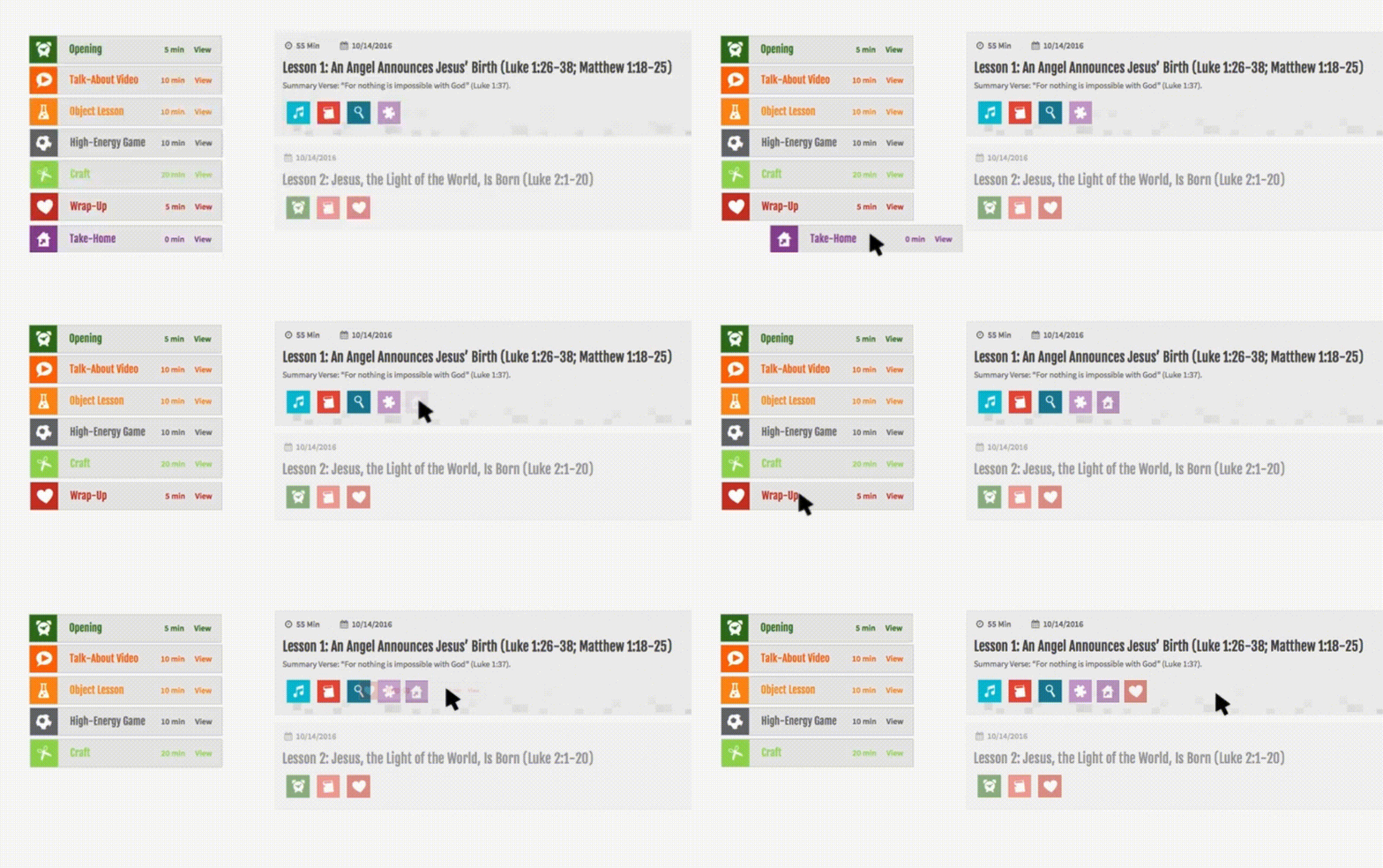
Drag & Drop Click a lesson and drag Activity Blocks from the left to the lesson on the right. See how.
Preview or Download a PDF file you can print or email.
Select a Plan to start
Program: The Bible in One Year
Now, select a Format
Quarter: Quarter One
-

Opening
5 min View
Opening
WelcomeKids share about a topic related to the lesson.Supplies
- Bible
Welcome
Thank kids for coming.
Just for fun, have kids shake hands with four friends using the back of their hands.
Make announcements.
Introduce new kids.
Celebrate birthdays by having kids sing “Happy Birthday” off-key.
Collect the offering.
Introduce the Lesson
Say: Today we’re going to learn about everything God created, including us. God created us for a reason. Let’s talk about what we would create and for what reason.
Share
Tell kids what you would create if you could create anything. Explain the reason you’d create that item. For example, maybe you’d make a machine that finds all the dirty dishes and loads them into the dishwasher because you don’t like doing dishes.
Have kids form pairs and tell what they would create if they could create anything. Have partners explain the reason they’d create their items.
After partners have discussed, ask two or three kids to share with the whole group what they talked about with their partners.
Summarize
Open a Bible, and say: We’d make some really cool things, but we’d need supplies. God made the whole world out of nothing! And he had an important reason for making people. Let’s see what the Bible says about that. The Bible isn’t an ordinary book; it’s God’s special book. The Bible is one way God talks to us. God is here right now, ready to talk to you.
Pray, thanking God for creating us for a reason.
WelcomeKids share about a topic related to the lesson.Supplies
- Bible
Welcome
Thank kids for coming.
Just for fun, have kids shake hands with four friends using the back of their hands.
Make announcements.
Introduce new kids.
Celebrate birthdays by having kids sing “Happy Birthday” off-key.
Collect the offering.
Introduce the Lesson
Say: Today we’re going to learn about everything God created, including us. God created us for a reason. Let’s talk about what we would create and for what reason.
Share
Tell kids what you would create if you could create anything. Explain the reason you’d create that item. For example, maybe you’d make a machine that finds all the dirty dishes and loads them into the dishwasher because you don’t like doing dishes.
Have kids form pairs and tell what they would create if they could create anything. Have partners explain the reason they’d create their items.
After partners have discussed, ask two or three kids to share with the whole group what they talked about with their partners.
Summarize
Open a Bible, and say: We’d make some really cool things, but we’d need supplies. God made the whole world out of nothing! And he had an important reason for making people. Let’s see what the Bible says about that. The Bible isn’t an ordinary book; it’s God’s special book. The Bible is one way God talks to us. God is here right now, ready to talk to you.
Pray, thanking God for creating us for a reason.
WelcomeKids share about a topic related to the lesson.Supplies
- Bible
Welcome
Thank kids for coming.
Just for fun, have kids shake hands with four friends using the back of their hands.
Make announcements.
Introduce new kids.
Celebrate birthdays by having kids sing “Happy Birthday” off-key.
Collect the offering.
Introduce the Lesson
Say: Today we’re going to learn about everything God created, including us. God created us for a reason. Let’s talk about what we would create and for what reason.
Share
Tell kids what you would create if you could create anything. Explain the reason you’d create that item. For example, maybe you’d make a machine that finds all the dirty dishes and loads them into the dishwasher because you don’t like doing dishes.
Have kids form pairs and tell what they would create if they could create anything. Have partners explain the reason they’d create their items.
After partners have discussed, ask two or three kids to share with the whole group what they talked about with their partners.
Summarize
Open a Bible, and say: We’d make some really cool things, but we’d need supplies. God made the whole world out of nothing! And he had an important reason for making people. Let’s see what the Bible says about that. The Bible isn’t an ordinary book; it’s God’s special book. The Bible is one way God talks to us. God is here right now, ready to talk to you.
Pray, thanking God for creating us for a reason.
WelcomeKids share about a topic related to the lesson.Supplies
- Bible
Welcome
Thank kids for coming.
Just for fun, have kids shake hands with four friends using the back of their hands.
Make announcements.
Introduce new kids.
Celebrate birthdays by having kids sing “Happy Birthday” off-key.
Collect the offering.
Introduce the Lesson
Say: Today we’re going to learn about everything God created, including us. God created us for a reason. Let’s talk about what we would create and for what reason.
Share
Tell kids what you would create if you could create anything. Explain the reason you’d create that item. For example, maybe you’d make a machine that finds all the dirty dishes and loads them into the dishwasher because you don’t like doing dishes.
Have kids form pairs and tell what they would create if they could create anything. Have partners explain the reason they’d create their items.
After partners have discussed, ask two or three kids to share with the whole group what they talked about with their partners.
Summarize
Open a Bible, and say: We’d make some really cool things, but we’d need supplies. God made the whole world out of nothing! And he had an important reason for making people. Let’s see what the Bible says about that. The Bible isn’t an ordinary book; it’s God’s special book. The Bible is one way God talks to us. God is here right now, ready to talk to you.
Pray, thanking God for creating us for a reason.
WelcomePreschoolers share about a topic related to the lesson.Supplies
- Bible
Welcome
Thank kids for coming.
Just for fun, have children shake hands with four friends using the back of their hands.
Make announcements.
Introduce new kids.
Celebrate birthdays by having preschoolers sing a birthday song off-key.
Collect the offering.
Introduce the Lesson
Say: Today we’re going to learn that God made us for a reason. Did you know that? God made you, you, and you. Point to each child. Let’s talk about some things we’ve made.
Share
Tell about a few things you’ve made. Be sure to share three different things to give preschoolers ideas for when it’s their turn to share. For example, you might say that you made a scarf from yarn, you made a doghouse from wood and nails, or you made cookies by putting all the ingredients together and baking them.
In leader-led small groups, have preschoolers share about something they’ve made.
After small groups have discussed, have adult or teen helpers share with the whole group what they talked about in their small groups.
Summarize
Open a Bible, and say: Wow! You all have made a lot of interesting creations. But the most interesting creations are you! God made you special, and God made you for a reason. Let’s see what the Bible says about how God made us. The Bible isn’t like other books—it’s really special. That’s because God can talk to us through the Bible. God is here right now, ready to talk to you!
Pray, thanking God for creating us for a reason.
WelcomeKids share about a topic related to the lesson.Supplies
- Bible
Welcome
Thank kids for coming.
Just for fun, have kids shake hands with four friends using the back of their hands.
Make announcements.
Introduce new kids.
Celebrate birthdays by having kids sing “Happy Birthday” off-key.
Collect the offering.
Introduce the Lesson
Say: Today we’re going to learn that God created us for a reason. He made each of you! ] Let’s talk about some things we’ve made.
Share
Tell about a few things you’ve made. For example, you might say that you made a scarf from yarn, you made a doghouse from wood and nails, or you made cookies by putting all the ingredients together and baking them.
In small groups, have kids share about something they’ve made.
After small groups have discussed, have a few kids share with the whole group what they talked about in their small groups.
Summarize
Open a Bible, and say: Wow! You all have made a lot of interesting creations. But the most interesting creations are you! God made you special, and God created you for a reason. Let’s see what the Bible says about how God made us. The Bible isn’t like other books—it’s really special. That’s because God can talk to us through the Bible. God is here right now, ready to talk to you!
Pray, thanking God for creating us for a reason.
-

Music Video
10 min View
Music Video
Priceless TreasureKids sing songs of praise to God.Supplies
- “Priceless Treasure” (watch or download here)
- “Shine His Light” (watch or download here)
- “Made for This” (watch or download here)
Tip
- Don’t have internet in your classroom? That’s okay! You can choose your own worship songs from our Best Of Dig In Music DVD here.
Sing Songs to God
Sing the three songs in any order.
Priceless TreasurePreschoolers sing songs of praise to God.Supplies
- “Priceless Treasure” (watch or download here)
- “Shine His Light” (watch or download here)
- “Made for This” (watch or download here)
Tip
- Don’t have internet in your classroom? That’s okay! You can choose your own worship songs from our Best Of Dig In Music DVD here.
Sing Songs to God
Sing the three songs in any order.
Priceless TreasureKids sing songs of praise to God.Supplies
- “Priceless Treasure” (watch or download here)
- “Shine His Light” (watch or download here)
- “Made for This” (watch or download here)
Tip
- Don’t have internet in your classroom? That’s okay! You can choose your own worship songs from our Best Of Dig In Music DVD here.
Sing Songs to God
Sing the three songs in any order.
Priceless TreasureKids sing songs of praise to God.Supplies
- “Priceless Treasure” (watch or download here)
- “Shine His Light” (watch or download here)
- “Made for This” (watch or download here)
Tip
- Don’t have internet in your classroom? That’s okay! You can choose your own worship songs from our Best Of Dig In Music DVD here.
Sing Songs to God
Sing the three songs in any order.
Priceless TreasureKids sing songs of praise to God.Supplies
- “Priceless Treasure” (watch or download here)
- “Shine His Light” (watch or download here)
- “Made for This” (watch or download here)
Tip
- Don’t have internet in your classroom? That’s okay! You can choose your own worship songs from our Best Of Dig In Music DVD here.
Sing Songs to God
Sing the three songs in any order.
Priceless TreasureKids sing songs of praise to God.Supplies
- “Priceless Treasure” (watch or download here)
- “Shine His Light” (watch or download here)
- “Made for This” (watch or download here)
Tip
- Don’t have internet in your classroom? That’s okay! You can choose your own worship songs from our Best Of Dig In Music DVD here.
Sing Songs to God
Sing the three songs in any order.
-

Bible Message
10 min View
Bible Message
God Creates Adam and Eve (Genesis 1–2:24)Kids make visual and audio effects of creation and play Animal Charades.Supplies
- Bible
Tips
- Showing kids a real Bible and reading part of the story directly from the Bible helps kids know this isn’t just a made-up story—it’s found in God’s Word!
- Using “pair shares” where kids share with a partner ensures everyone gets a chance to answer the question—not just one or two kids.
Make the Effects
Open your Bible to Genesis 1, and show kids the words.
Say: Today we’re going to learn about how God made the world! At first when God made the earth, there wasn’t much to it. Close your eyes. Pause.
But then God said, “Let there be light!” Open your eyes! Pause.
God decided to make it light sometimes and call that day. Other times, it would be dark—and that’s night. When I say “day,” you’ll open your eyes. When I say “night,” you’ll close them. Ready?
Night! Day! Night! Day! Night! Night! Day! Night! Day!
Whew! We just went through a bunch of nights and days in a row. But God made night and day in just one day.
On the second day, God made the sky by separating the waters of the earth and the water in the atmosphere. Hold your arm up and pretend you’re painting the sky. Pause.
Then God made seas and plants. Let’s be trees and grow! Start out in a tiny ball, like a seed. Lead kids in growing from their “seed” position to stand up tall and extend their arms like branches. Then have kids sit back down.
On the fourth day, God made the sun, moon, and stars. Make your fingers twinkle like stars. Lead kids in twinkling their fingers.
On the fifth day, God made birds and fish. You get to decide whether to be a bird or a fish. When I count to three, you’ll either flap your arms and make bird sounds, or suck in your cheeks to make a fish face. One…two…three! Allow time. Then have kids settle back down.
Wow! Our room is full of fish and birds. But the next day, God had even more animals to make. He made all the land animals. When I say “moo,” make an animal noise—any animal you’d like. One…two…three…moo! Pause.
Whew! God needed to make someone to take care of all these animals. So God made people, named Adam and Eve. Point to someone near you and say, “God made you!” Pause.
Play Animal Charades
Say: God created us for a reason. That means you! God made Adam and Eve with a purpose. Let’s read what he asked them to do.
Read Genesis 1:28 and 2:15, 19.
Adam and Eve had an important job: to take care of all the things God made! Adam even got to name the animals!
Let’s name animals now. When I point to you, you’ll pretend to be an animal, and everyone else will call out that animal’s name. Point to several kids so they can act out animals of their choice, as time allows.
Discuss
Say: God told Adam and Eve to care for his creation. And God wants us to continue that purpose today!
Ask: • How do you care for God’s creation today? Have kids turn to a partner to share. Then ask a few kids to share with everyone.
Say: You don’t have to wait until you’re grown up and can get a job to have a purpose. God created us for a reason. That means he has a special purpose for you right now!
-

Core Bible
20 min View
Core Bible Discovery
Genesis: God Creates Adam and Eve (Genesis 1–2:24)Kids make habitats and learn about the habitat God created for people, who he made very special.Supplies
- Bible
- random classroom supplies, such as tape, scissors, paper, modeling dough, and markers
- blue bedsheet
- fruit slices (1 per child)
- balloons (1 per child)
- permanent markers
- tape
Create a Habitat
Set out random classroom supplies.
Say: Your small group is going to make a zoo habitat for an animal. Decide what animal you want to make a habitat for, and then think through everything your animal would need in a home. You’ll use your creativity and anything in this classroom to design a model of the perfect habitat for your animal. For example, you might use a tape dispenser on its side to make a food dish or markers to build a fence. You’ll have just three minutes to make it!
Allow three minutes for kids to make their habitats. Then have groups tell everyone about their animals and habitats.
Ask: • What does your animal need to have a perfect home?
• Why would you care about making sure your animal had what it needed?
• How did you use creativity to make your habitat?
Say: Today we’re going to learn that God created us for a reason. But before God created people, he created a special home for us. We had to use supplies to create our habitats, but God started with nothing! Let’s see what God created and why it helped make a good home for us.
Talk About It
Say: In the beginning, there was nothing. But God is creative! So God made light and darkness. Darken the room as much as possible. With the lights off, have kids find a partner and discuss this question.
Ask: • Why would humans need light and darkness?
Turn the lights back on. Say: After he made light and darkness, God made the sky. Have kids crouch down and hold a blue bedsheet over their heads while they discuss this question.
Ask: • What does the sky do for humans?
Say: After he made the sky, God made the land and sea. Have kids run in place like they’re on land and then pretend to swim in the sea.
Ask: • Why are both of those important for humans?
Say: After he made the land and sea, God made plants, like fruit and trees. Give everyone a fruit slice to eat as kids discuss this question.
Ask: • What are your favorite plants to eat?
Say: Remember the light and darkness and the land? Those things all help plants live and grow. And humans need plants to eat. God was setting up everything just right.
After he made plants, God made the sun, moon, and stars. Have kids sing “Twinkle, Twinkle, Little Star” as fast as they can.
Ask: • Why are the sun, moon, and stars important to humans?
Say: Did you know that the moon is related to the seas? The moon actually controls when the tides in the ocean come in and go out. If the tides didn’t come in and go out like they’re supposed to, the land would flood and people would lose their homes! And the sun, in addition to providing us with light, is just the right distance from the earth so that humans and animals can survive. God made everything just right for a home for us.
Then God made fish and birds. Have kids try to answer the next question while making a fish face.
Ask: • What benefits do fish and birds bring to humans?
Say: Next, God made animals. On the count of three, have all the kids make the sound of their favorite animal. Then have kids discuss these questions in their small groups.
Ask: • What’s your favorite animal?
• What’s your favorite thing about animals?
Say: After God made all these things, God said it was good. It was kind of like your habitats. Everyone did a good job! But there’s something missing from your habitats, right? God had made the whole world, but he had one more job. So God made the best thing yet. God made people!
Read Genesis 1:26-27 and 1:31.
Say: Notice that God said it was very good when he made humans. He created us for a reason! We were the best part of his creation. He made us in his image because he wanted to be friends with us.
Breathe Life
Have small-group leaders distribute a balloon to each child.
Say: The Bible also talks about how God created people. It’s pretty amazing! Listen.
Read Genesis 2:7. Then have kids use permanent markers to draw faces on their uninflated balloons and blow them up. Help kids tie off the balloons as needed.
Say: Not only did God make the perfect place for humans to live, but he used the ground he’d made to make something even better!
But he realized making one person wasn’t enough. He realized the man needed a friend. So here’s what God did.
Read Genesis 2:21-22.
Say: God made us for a reason. He made us so unique and special! The Bible says God made us in his own image and that he breathed life into us. He didn’t do that for anything else he made. God made you for a reason. He made you unique and special. He has a purpose for your life. You may not know what that specific purpose is yet, but whenever you worship or honor God, you’re already fulfilling God’s purpose for you.
Think about special things God put into you. Maybe he made you good at math or soccer. Maybe he made you kind or encouraging. On your balloon, write words about the unique ways God made you.
As kids finish writing on their balloons, have small-group leaders help you hang the balloons up with tape. If your ceiling is low enough, you can put rolled pieces of tape on the top of the balloons and stick the balloons to the ceiling so they look like floating helium balloons. If your ceiling is too high, put rolled pieces of tape on the side of the balloons and attach them to a wall.
Say: Our room was good before you came today. But now it’s very good! It’s full of people God made for a reason! Just as your balloons are full of something that came from you—your breath—you are filled with something that came from God. You’re made in his image, made alive by his breath! He made people special, and he made us for a reason.
Genesis: God Creates Adam and Eve (Genesis 1–2:24)Kids make habitats and learn about the habitat God created for people, who he made very special.Supplies
- Bible
- random classroom supplies, such as tape, scissors, paper, modeling dough, and markers
- blue bedsheet
- fruit slices (1 per child)
- balloons (1 per child)
- permanent markers
- tape
Create a Habitat
Set out random classroom supplies, and have kids form groups of four.
Say: Your group is going to make a zoo habitat for an animal. Decide what animal you want to make a habitat for, and then think through everything your animal would need in a home. You’ll use your creativity and anything in this classroom to design a model of the perfect habitat for your animal. For example, you might use a tape dispenser on its side to make a food dish or markers to build a fence. You’ll have just three minutes to make it!
Allow three minutes for kids to make their habitats. Then have groups tell everyone about their animals and habitats.
Ask: • What does your animal need to have a perfect home?
• Why would you care about making sure your animal had what it needed?
• How did you use creativity to make your habitat?
Say: Today we’re going to learn that God created us for a reason. But before God created people, he created a special home for us. We had to use supplies to create our habitats, but God started with nothing! Let’s see what God created and why it helped make a good home for us.
Talk About It
Say: In the beginning, there was nothing. But God is creative! So God made light and darkness. Darken the room as much as possible. With the lights off, have kids find a partner and discuss this question.
Ask: • Why would humans need light and darkness?
Turn the lights back on. Say: After he made light and darkness, God made the sky. Have kids crouch down and hold a blue bedsheet over their heads while they discuss this question.
Ask: • What does the sky do for humans?
Say: After he made the sky, God made the land and sea. Have kids run in place like they’re on land and then pretend to swim in the sea.
Ask: • Why are both of those important for humans?
Say: After he made the land and sea, God made plants, like fruit and trees. Give everyone a fruit slice to eat as kids discuss this question.
Ask: • What are your favorite plants to eat?
Say: Remember the light and darkness and the land? Those things all help plants live and grow. And humans need plants to eat. God was setting up everything just right.
After he made plants, God made the sun, moon, and stars. Have kids sing “Twinkle, Twinkle, Little Star” as fast as they can.
Ask: • Why are the sun, moon, and stars important to humans?
Say: Did you know that the moon is related to the seas? The moon actually controls when the tides in the ocean come in and go out. If the tides didn’t come in and go out like they’re supposed to, the land would flood and people would lose their homes! And the sun, in addition to providing us with light, is just the right distance from the earth so that humans and animals can survive. God made everything just right for a home for us.
Then God made fish and birds. Have kids try to answer the next question while making a fish face.
Ask: • What benefits do fish and birds bring to humans?
Say: Next, God made animals. On the count of three, have all the kids make the sound of their favorite animal.
Ask: • What’s your favorite animal?
• What’s your favorite thing about animals?
Say: After God made all these things, God said it was good. It was kind of like your habitats. Everyone did a good job! But there’s something missing from your habitats, right? God had made the whole world, but he had one more job. So God made the best thing yet. God made people!
Read Genesis 1:26-27 and 1:31.
Say: Notice that God said it was very good when he made humans. He created us for a reason! We were the best part of his creation. He made us in his image because he wanted to be friends with us.
Breathe Life
Distribute a balloon to each child.
Say: The Bible also talks about how God created people. It’s pretty amazing! Listen.
Read Genesis 2:7. Then have kids use permanent markers to draw faces on their uninflated balloons and blow them up. Help kids tie off the balloons as needed.
Say: Not only did God make the perfect place for humans to live, but he used the ground he’d made to make something even better!
But he realized making one person wasn’t enough. He realized the man needed a friend. So here’s what God did.
Read Genesis 2:21-22.
Say: God made us for a reason. He made us so unique and special! The Bible says God made us in his own image and that he breathed life into us. He didn’t do that for anything else he made. God made you for a reason. He made you unique and special. He has a purpose for your life. You may not know what that specific purpose is yet, but whenever you worship or honor God, you’re already fulfilling God’s purpose for you.
Think about special things God put into you. Maybe he made you good at math or soccer. Maybe he made you kind or encouraging. On your balloon, write words about the unique ways God made you.
As kids finish writing on their balloons, hang the balloons up with tape. If your ceiling is low enough, you can put rolled pieces of tape on the top of the balloons and stick the balloons to the ceiling so they look like floating helium balloons. If your ceiling is too high, put rolled pieces of tape on the side of the balloons and attach them to a wall.
Say: Our room was good before you came today. But now it’s very good! It’s full of people God made for a reason! Just as your balloons are full of something that came from you—your breath—you are filled with something that came from God. You’re made in his image, made alive by his breath! He made people special, and he made us for a reason.
Genesis: God Creates Adam and Eve (Genesis 1–2:24)Kids make habitats and learn about the habitat God created for people, who he made very special.Supplies
- Bible
- random classroom supplies, such as tape, scissors, paper, modeling dough, and markers
- blue bedsheet
- fruit slices (1 per child)
- balloons (1 per child)
- permanent markers
- tape
Create a Habitat
Set out random classroom supplies, and have kids form groups of four.
Say: Your group is going to make a zoo habitat for an animal. Decide what animal you want to make a habitat for, and then think through everything your animal would need in a home. You’ll use your creativity and anything in this classroom to design a model of the perfect habitat for your animal. For example, you might use a tape dispenser on its side to make a food dish or markers to build a fence. You’ll have just three minutes to make it!
Allow three minutes for kids to make their habitats. Then have groups tell everyone about their animals and habitats.
Ask: • What does your animal need to have a perfect home?
• Why would you care about making sure your animal had what it needed?
• How did you use creativity to make your habitat?
Say: Today we’re going to learn that God created us for a reason. But before God created people, he created a special home for us. We had to use supplies to create our habitats, but God started with nothing! Let’s see what God created and why it helped make a good home for us.
Talk About It
Say: In the beginning, there was nothing. But God is creative! So God made light and darkness. Darken the room as much as possible. With the lights off, have kids find a partner and discuss this question.
Ask: • Why would humans need light and darkness?
Turn the lights back on. Say: After he made light and darkness, God made the sky. Have kids crouch down and hold a blue bedsheet over their heads while they discuss this question.
Ask: • What does the sky do for humans?
Say: After he made the sky, God made the land and sea. Have kids run in place to appreciate land.
Ask: • Why are both of those important for humans?
Say: After he made the land and sea, God made plants, like fruit and trees. Give everyone a fruit slice to eat as kids discuss this question.
Ask: • What are your favorite plants to eat?
Say: Remember the light and darkness and the land? Those things all help plants live and grow. And humans need plants to eat. God was setting up everything just right.
After he made plants, God made the sun, moon, and stars. Have kids race against each other to sing “Twinkle, Twinkle, Little Star” as fast as they can.
Ask: • Why are the sun, moon, and stars important to humans?
Say: Did you know that the moon is related to the seas? The moon actually controls when the tides in the ocean come in and go out. If the tides didn’t come in and go out like they’re supposed to, the land would flood and people would lose their homes! And the sun, in addition to providing us with light, is just the right distance from the earth so that humans and animals can survive. God made everything just right for a home for us.
Then God made fish and birds. Have kids try to answer the next question while making a fish face.
Ask: • What benefits do fish and birds bring to humans?
Say: Next, God made animals. On the count of three, have all the kids shout out their favorite animal.
Ask: • Hmm…I couldn’t quite hear everyone’s answers. Let’s try one at a time. What’s your favorite animal?
• What’s your favorite thing about animals?
Say: After God made all these things, God said it was good. It was kind of like your habitats. Everyone did a good job! But there’s something missing from your habitats, right? God had made the whole world, but he had one more job. So God made the best thing yet. God made people!
Read Genesis 1:26-27 and 1:31.
Say: Notice that God said it was very good when he made humans. He created us for a reason! We were the best part of his creation. He made us in his image because he wanted to be friends with us.
Breathe Life
Distribute a balloon to each child.
Say: The Bible also talks about how God created people. It’s pretty amazing! Listen.
Read Genesis 2:7. Then have kids use permanent markers to draw faces on their uninflated balloons and blow them up. Help kids tie off the balloons as needed.
Say: Not only did God make the perfect place for humans to live, but he used the ground he’d made to make something even better!
But he realized making one person wasn’t enough. He realized the man needed a friend. So here’s what God did.
Read Genesis 2:21-22.
Say: God made us for a reason. He made us so unique and special! The Bible says God made us in his own image and that he breathed life into us. He didn’t do that for anything else he made. God made you for a reason. He made you unique and special. He has a purpose for your life. You may not know what that specific purpose is yet, but whenever you worship or honor God, you’re already fulfilling God’s purpose for you.
Think about special things God put into you. Maybe he made you good at math or soccer. Maybe he made you kind or encouraging. On your balloon, write words about the unique ways God made you.
As kids finish writing on their balloons, hang the balloons up with tape. If your ceiling is low enough, you can put rolled pieces of tape on the top of the balloons and stick the balloons to the ceiling so they look like floating helium balloons. If your ceiling is too high, put rolled pieces of tape on the side of the balloons and attach them to a wall.
Say: Our room was good before you came today. But now it’s very good! It’s full of people God made for a reason! Just as your balloons are full of something that came from you—your breath—you are filled with something that came from God. You’re made in his image, made alive by his breath! He made people special, and he made us for a reason.
Genesis: God Creates Adam and Eve (Genesis 1–2:24)Kids make habitats and learn about the habitat God created for people, who he made very special.Supplies
- Bible
- random classroom supplies, such as tape, scissors, paper, modeling dough, and markers
- blue bedsheet
- fruit slices (1 per child)
- balloons (1 per child)
- permanent markers
- tape
Create a Habitat
Set out random classroom supplies, and have kids form mixed-age groups of four.
Say: Your group is going to make a zoo habitat for an animal. Decide what animal you want to make a habitat for, and then think through everything your animal would need in a home. You’ll use your creativity and anything in this classroom to design a model of the perfect habitat for your animal. For example, you might use a tape dispenser on its side to make a food dish or markers to build a fence. You’ll have just three minutes to make it!
Allow three minutes for kids to make their habitats. Then have groups tell everyone about their animals and habitats.
Ask: • What does your animal need to have a perfect home?
• Why would you care about making sure your animal had what it needed?
• How did you use creativity to make your habitat?
Say: Today we’re going to learn that God created us for a reason. But before God created people, he created a special home for us. We had to use supplies to create our habitats, but God started with nothing! Let’s see what God created and why it helped make a good home for us.
Talk About It
Say: In the beginning, there was nothing. But God is creative! So God made light and darkness. Darken the room as much as possible. With the lights off, have kids find a partner and discuss this question.
Ask: • Why would humans need light and darkness?
Turn the lights back on. Say: After he made light and darkness, God made the sky. Have kids crouch down and hold a blue bedsheet over their heads while they discuss this question.
Ask: • What does the sky do for humans?
Say: After he made the sky, God made the land and sea. Have kids run in place like they’re on land and then pretend to swim in the sea.
Ask: • Why are both of those important for humans?
Say: After he made the land and sea, God made plants, like fruit and trees. Give everyone a fruit slice to eat as kids discuss this question. (Note that grapes are a choking hazard to young children unless you’ve cut the grapes in half.)
Ask: • What are your favorite plants to eat?
Say: Remember the light and darkness and the land? Those things all help plants live and grow. And humans need plants to eat. God was setting up everything just right.
After he made plants, God made the sun, moon, and stars. Have kids sing “Twinkle, Twinkle, Little Star” as fast as they can.
Ask: • Why are the sun, moon, and stars important to humans?
Say: Did you know that the moon is related to the seas? The moon actually controls when the tides in the ocean come in and go out. If the tides didn’t come in and go out like they’re supposed to, the land would flood and people would lose their homes! And the sun, in addition to providing us with light, is just the right distance from the earth so that humans and animals can survive. God made everything just right for a home for us.
Then God made fish and birds. Have kids try to answer the next question while making a fish face.
Ask: • What benefits do fish and birds bring to humans?
Say: Next, God made animals. On the count of three, have all the kids make the sound of their favorite animal.
Ask: • What’s your favorite animal?
• What’s your favorite thing about animals?
Say: After God made all these things, God said it was good. It was kind of like your habitats. Everyone did a good job! But there’s something missing from your habitats, right? God had made the whole world, but he had one more job. So God made the best thing yet. God made people!
Read Genesis 1:26-27 and 1:31.
Say: Notice that God said it was very good when he made humans. He created us for a reason! We were the best part of his creation. He made us in his image because he wanted to be friends with us.
Breathe Life
Distribute a balloon to each child.
Say: The Bible also talks about how God created people. It’s pretty amazing! Listen.
Read Genesis 2:7. Then have kids use permanent markers to draw faces on their uninflated balloons and blow them up. Older kids can make two so they have one to share with a younger child. Help kids tie off the balloons as needed.
Say: Not only did God make the perfect place for humans to live, but he used the ground he’d made to make something even better!
But he realized making one person wasn’t enough. He realized the man needed a friend. So here’s what God did.
Read Genesis 2:21-22.
Say: God made us for a reason. He made us so unique and special! The Bible says God made us in his own image and that he breathed life into us. He didn’t do that for anything else he made. God made you for a reason. He made you unique and special. He has a purpose for your life. You may not know what that specific purpose is yet, but whenever you worship or honor God, you’re already fulfilling God’s purpose for you.
Think about special things God put into you. Maybe he made you good at math or soccer. Maybe he made you kind or encouraging. On your balloon, write words about the unique ways God made you. If you don’t know how to write, find an older partner to write the words you say.
As kids finish writing on their balloons, hang the balloons up with tape. If your ceiling is low enough, you can put rolled pieces of tape on the top of the balloons and stick the balloons to the ceiling so they look like floating helium balloons. If your ceiling is too high, put rolled pieces of tape on the side of the balloons and attach them to a wall.
Say: Our room was good before you came today. But now it’s very good! It’s full of people God made for a reason! Just as your balloons are full of something that came from you—your breath—you are filled with something that came from God. You’re made in his image, made alive by his breath! He made people special, and he made us for a reason.
Genesis: God Creates Adam and Eve (Genesis 1–2:24)Preschoolers make a “home,” act out the story, and receive a blessing.Supplies
- Bible
- laundry basket or large box
- cup
- plate or toy food
- blanket
- ball
- toy person figure
- balloon
- permanent marker
- glow-in-the-dark stars and moon (found at stores like Walmart or craft stores)
- rope
Easy Prep
- Put the cup, plate or toy food, blanket, toy person, and ball in a pile in the front of the room.
- Put the glow-in-the-dark stars and moon under a light so they’ll glow during the lesson. Keep them out of view of children until mentioned in the lesson.
- Blow up the balloon, and hold it closed but untied. Draw a smiley face on it with a permanent marker, and then let it deflate.
- In an area off to the side, make a circle on the floor with a rope. Make sure the space inside the circle is large enough for all the children to fit inside.
Make a Home
Say: Today we’ll learn that God made us for a reason. Before we get started, I want to tell you about a new friend coming to our class today. Show children the laundry basket or large box. He’s smaller than you and I, and I thought we could make a nice home for him, so I brought this laundry basket. Let’s think about what we could add to make it feel like a home.
Show the cup. Say: To make a nice home for our friend, we might want to have something for him to drink.
Point to the pile of items. Say: These are some other things I thought we could use to make a nice home for our friend. Let a few children take turns pulling objects from the pile and putting them in the laundry basket. Help kids talk about why the object might make the home nice. For example, the new friend might like a comfy place to sleep (the blanket), something to eat (the plate), something to play with (the ball), and a friend to spend time with (the toy person).
Invite children to add additional things to the “home” to make it nice. These can be toys or other objects from your room.
Say: I think our friend’s home would be nicer if we set up all of his stuff for him. Invite some children to help you set up the items in the “home.”
Say: This is a really nice home, and when our new friend comes, I think he’s going to like it. That reminds me of our Bible story for today. God made the whole world, and he set everything up for us, kind of like we set up a nice home for a new friend who’s coming. God made us for a reason. He made us to be his friends. Let’s look at the Bible to hear all about it.
Act It Out
Dim the lights. Show the Bible, and say: The Bible says that before God made us, he made the world. There was no light in the world. It really wasn’t a cozy place at first, but God made a lot of things that made it into a nice home. On the first day, he made light. Turn on the light.
Say: God made day and night. Dim the lights, and have the children pretend that it’s night and lie down, pretending to sleep. Then turn the lights back on, and have them pretend it’s day and jump up and stretch. Turn the lights on and off several times.
Say: It’s nice that God made light. It’s pretty hard to see when there’s no light! And it’s nice that God made night because it gives us some time to lie down and rest. So far, our home seems okay; we have light and day and night. Make sure the lights are now on.
Say: On the next day, God made the sky. Encourage kids to reach up to the sky by reaching as far above their heads as possible. Then share something you like about the sky. For example, you might like how blue it is or the big, puffy clouds. Invite children to tell things they like about the sky.
Say: The blue sky and puffy clouds are pretty nice. God did a great job making our home beautiful. Let’s see what God made next.
At that time, water covered the whole earth. There was no dry ground to stand on! Lead kids in pretending to swim. After about 30 seconds, say: It would get tiring to swim all day with no place to stop and stand. So God made the land on that day. He moved the water aside so there was water and land.
Then God made plants like trees and flowers to grow on the land. Share about a plant you like.
Ask: • What are some plants you like?
Say: God made flowers that make our land pretty. He also made trees, and some trees even have fruits or vegetables that we can eat! Lead the children in pretending to pick a fruit from a tree and eat it.
Say: So far, God made a great home for us. He made day so we can go out and play and night so we can rest. He made the beautiful sky and land for us to stand on. He made plants, and now we have something to eat.
But God wasn’t done yet. He still had more things to make and add to the earth. On the next day, God made the stars and the moon. Bring out the stars and moon, and then dim the lights so kids can see that they glow. Let children pass around the stars and moon so they can get a closer look. As they pass them, invite children to share about times they’ve looked up at stars in the sky. Then collect the stars and moon, and set them aside.
Turn on the light and say: God made the sun, too. And he made the seasons of the year. When it’s really sunny and hot in the summer, that’s because God made summer. Have kids fan themselves with one hand. When it’s cold, that’s because God made winter. Have kids pretend to shiver.
Say: On the next day, God made fish. Lead children in pretending to swim around like fish by putting their hands together in front of themselves and weaving them back and forth. God also made the birds in the sky. Lead kids in flapping their arms like wings.
Say: And after that, God made the animals on the land, like lions and dogs and cows. Let’s think of our favorite animals and make those animal sounds. Demonstrate by telling kids your favorite animal, and then make the animal sound. Allow a moment for kids to think of their favorite animals, and then have all the children try to make their favorite animals’ sounds.
Say: It was noisy once God made all the fish, birds, and animals! And God really liked all of the things he made. But all of it wasn’t enough, so he made a man and a woman. He made our bodies, and he breathed life into us. Blow up the balloon, and tie it off. Let the children see the face. Look, our new friend has arrived! Let’s show him the home we made for him.
Place the balloon in the “home” so kids can see the face. Say: We made a nice home for our new friend, like God made a nice home for us. God made animals and fish and plants for us to take care of. And he made the earth so that we have food to eat and things to drink. Hold up the cup and plate. He made day and night. Hold up the blanket. God even made friends for us. Show the toy person. And he made us to live in the home he built. Hold up the balloon. And God made us for a reason—he made us so we could be his friends.
Be Blessed
Say: God made us for a reason, and he made the world to be a nice home for us to live in. Point to the rope circle. Let’s pretend this is the world. God made the world, and then he made us. He made me for a reason. Step into the circle. And, [name of one child], God made you for a reason. Have the child you named join you in the circle. Continue naming children and having them join you inside the “world” as you do.
After all the children have joined you in the “world,” say: God made all of us for a reason. He made us to be his friends. End in a prayer thanking God for making each child to be his friend.
Genesis: God Creates Adam and Eve (Genesis 1–2:24)Kids create a habitat and act out how God breathed life into Adam.Supplies
- Bible
- random classroom supplies, such as tape, scissors, paper, modeling dough, and markers
- blue bedsheet
- fruit slices (1 per child)
- balloons (1 per child)
- permanent markers
- tape
Create a Habitat
Set out random classroom supplies, and have kids form groups of four.
Say: Your group is going to make a zoo habitat for an animal. Decide what animal you want to make a habitat for, and then think through everything your animal would need in a home. You’ll use your creativity and anything in this classroom to make a perfect habitat for your animal. Instead of saying “make” or “made,” we might say “created.” So let’s create some great habitats. For example, you might use a tape dispenser on its side to make a food dish or markers to build a fence. You’ll have just three minutes to make it!
Allow three minutes for kids to make their habitats. Then have groups tell everyone about their animals and habitats.
Ask: • What does your animal need to have a perfect home?
• Why would you care about making sure your animal had what it needed?
• How did you use creativity to make your habitat?
Say: Today we’re going to learn that God created us for a reason. But before God created people, he created a special home for us. We had to use supplies to create our habitats, but God started with nothing! Let’s see what God created and why it helped make a good home for us.
Talk About It
Have kids get in small groups. Say: In the beginning, there was nothing. But God is creative! So God made light and darkness. Darken the room as much as possible. With the lights off, have kids discuss this question in their small groups.
Ask: • Why would people need light and darkness?
Turn the lights back on. Say: After he made light and darkness, God made the sky. Have kids crouch down and hold a blue bedsheet over their heads while they discuss this question.
Ask: • What does the sky do for people?
Say: After he made the sky, God made the land and sea. Have kids run in place like they’re on land and then pretend to swim in the sea.
Ask: • Why are both of those important for people?
Say: After he made the land and sea, God made plants, like fruit and trees. Give everyone a fruit slice to eat as kids discuss this question.
Ask: • What are your favorite plants to eat?
Say: Remember the light and darkness and the land? Those things all help plants live and grow. And people need plants to eat. God was setting up everything just right.
After he made plants, God made the sun, moon, and stars. Have kids sing “Twinkle, Twinkle, Little Star” as fast as they can.
Ask: • Why are the sun, moon, and stars important to people?
Say: Did you know that the moon is related to the ocean? If you’ve been to the ocean, you might’ve noticed that the waves come farther up the beach several times a day. And other times the waves stop farther out. That’s called “tides.” The moon actually controls when the tides in the ocean come in and go out. If the tides didn’t come in and go out like they’re supposed to, the land would flood and people would lose their homes! And the sun, in addition to giving us light, is just the right distance from the earth so that people and animals can survive. God made everything just right for a home for us.
Then God made fish and birds. Have kids try to answer the next question while making a fish face.
Ask: • What are some ways people enjoy fish and birds?
Say: Next, God made animals. On the count of three, have all the kids make the sound of their favorite animal.
Ask: • What’s your favorite animal?
• What’s your favorite thing about animals?
Say: After God made all these things, God said it was good. It was kind of like your habitats. Everyone did a good job! But there’s something missing from your habitats, right? God had made the whole world, but he had one more job. So God made the best thing yet. God made people!
Read Genesis 1:26-27 and 1:31.
Say: Notice that God said it was very good when he made people. He created us for a reason! We were the best part of his creation. He made us in his image because he wanted to be friends with us.
Breathe Life
Distribute a balloon to each child.
Say: The Bible also talks about how God created people. It’s pretty amazing! Listen.
Read Genesis 2:7. Then have kids use permanent markers to draw faces on their uninflated balloons and blow them up. Help kids tie off the balloons as needed.
Say: Not only did God make the perfect place for people to live, but he used the ground he’d made to make something even better!
But he realized making one person wasn’t enough. He realized the man needed a friend. So here’s what God did.
Read Genesis 2:21-22.
Say: God created us for a reason. He made us so unique and special! The Bible says God made us in his own image and that he breathed life into us. He didn’t do that for anything else he made. God created you for a reason. He made you unique and special. He has a purpose for your life. You may not know what that specific purpose is yet, but whenever you worship or honor God, you’re already fulfilling God’s purpose for you.
Think about special things God put into you. Maybe he made you good at math or soccer. Maybe he made you kind or encouraging. On your balloon, write words about the unique ways God made you.
As kids finish writing on their balloons, hang the balloons up with tape. If your ceiling is low enough, you can put rolled pieces of tape on the top of the balloons and stick the balloons to the ceiling so they look like floating helium balloons. If your ceiling is too high, put rolled pieces of tape on the side of the balloons and attach them to a wall.
Say: Our room was good before you came today. But now it’s very good! It’s full of people God created for a reason! Just as your balloons are full of something that came from you—your breath—you are filled with something that came from God. You’re made in his image, made alive by his breath! He made people special, and he created us for a reason.
-

Music Video
10 min View
Music Video
Priceless TreasureKids sing songs of praise to God.Supplies
- “Priceless Treasure” (watch or download here)
- “Shine His Light” (watch or download here)
- “Made for This” (watch or download here)
Tip
- Don’t have internet in your classroom? That’s okay! You can choose your own worship songs from our Best Of Dig In Music DVD here.
Sing Songs to God
Sing the three songs in any order.
-

Jesus Connection
10 min View
Jesus Connection
In Jesus’ ImageKids make imprints to explore how they were made in the image of Jesus.Supplies
- modeling dough
Tip
- Want to do more personal study on the presence of Jesus at Creation? Read John 1:1-5.
Explore Genesis 1:26
Say: When God made most of his creation, he simply said, “Let there be light!” or “Let the earth produce every sort of animal!” And just like that, the world was created.
But when God made people, he said something very special. Let’s see what he said.
Read Genesis 1:26.
Say: Wow! We were made in God’s image! We’re the only thing God made in his own image.
But there’s something else that’s pretty special about this verse. Let me read it again. Listen for the pronouns. Pronouns are words like I, you, he, she, we, or they.
Read Genesis 1:26.
Ask: • Why do you think God said “Let us make human beings in our image”? Who was he talking to?
Say: Sometimes we think God made Jesus when Jesus was born as a baby. But did you know Jesus was always around? Jesus is God. So Jesus was there at Creation, helping make the world.
And we were made in Jesus’ image! Pretty cool, huh?
Let’s explore what it means to show the image of something.
Make Prints
Distribute modeling dough. Have kids make fingerprints in the dough, then study and compare the dough prints to their actual fingerprints.
Kids can also make other imprints of things such as buttons or engraved Bible covers, comparing the original with the imprint.
Ask: • How did the dough imprints show the image of what they were made from?
• Share some words that describe Jesus. How can you show those qualities to others? Examples might include loving, joyful, and kind.
Say: Sometimes you might feel like you’re not good enough. Maybe you see other people who are better than you at school or sports. Or maybe other people seem more popular, or you have a hard time making friends.
When you don’t feel all that special, just remember that you were made in the image of Jesus! God created us for a reason. And one reason is that you can show other people what Jesus is like! You can show people how kind, loving, and forgiving Jesus is…because you were made in his image!
-

Prayer
5 min View
Prayer
Listen to GodKids ask God questions and listen for his answers.Ask and Listen
Say: Today we’re learning that God created us for a reason. Do you ever wonder what God’s reason was for making you? We’re going to take some time now to ask God and find out.
When we pray, we’re having a conversation with God. Sometimes people spend most of their time talking to God. But just like when you have a conversation with a friend, you can talk and listen.
Sometimes it can seem harder to hear God than to hear our friends. So let’s make sure we’re not distracted. Get into a position that feels comfortable to you. You shouldn’t be touching anyone else. Pause.
Now close your eyes. If you think you’ll want to open them, turn and face away from people. That way nothing will distract you as you listen to God. Pause.
Great! Now we’ll ask God two questions. After I say one question, I’ll pause. You can silently ask God that question and then listen for his answer.
Here’s the first question: God, what’s something special about the way you made me? Allow a minute or two for kids to listen.
God, what’s the reason you created me? Allow a minute or two for kids to listen.
Ask: • If you heard from God, what’s something God brought to your mind?
Say: It’s okay if you didn’t hear from God today. You can keep asking and listening to him throughout your week. The more we practice listening to God, the more we’ll hear him speak to us. And this is so important for you to remember: God created each of us for a reason!
-

Talk-About Video
10 min View
Talk-About Video
God’s CreationKids watch a video and discuss the Bible Point.Supplies
- “God’s Creation” teaching video (watch or download here)
Tip
- Don’t have internet in your classroom? That’s okay! You can download the videos before class using the “download” button at the link provided, or purchase DVDs here.
Discuss and Watch “God’s Creation”
Say: We’ve been learning that God made us for a reason. We can praise God in a special way. But the Bible talks about how everything God made can praise him. Let’s watch a video about that.
Watch “God’s Creation.”
Ask: • How could the skies or stars praise God?
• How could elephants and whales praise God?
Read Luke 19:40. Say: If we don’t praise God, nature can.
• What’s special about the way humans can praise God?
Say: It’s kind of a mystery how animals and nature could bring praise to God. They can’t use words to say kind things about him. Even though everything God created can praise him, nothing can love or praise him quite like we can. God made us for a reason—to love him, praise him, and be in a relationship with him.
God’s CreationKids watch a video and discuss the Bible Point.Supplies
- “God’s Creation” teaching video (watch or download here)
Tip
- Don’t have internet in your classroom? That’s okay! You can download the videos before class using the “download” button at the link provided, or purchase DVDs here.
Discuss and Watch “God’s Creation”
Say: We’ve been learning that God made us for a reason. We can praise God in a special way. But the Bible talks about how everything God made can praise him. Let’s watch a video about that.
Watch “God’s Creation.”
Ask: • How could the skies or stars praise God?
• How could elephants and whales praise God?
Read Luke 19:40. Say: If we don’t praise God, nature can.
• What’s special about the way humans can praise God?
Say: It’s kind of a mystery how animals and nature could bring praise to God. They can’t use words to say kind things about him. Even though everything God created can praise him, nothing can love or praise him quite like we can. God made us for a reason—to love him, praise him, and be in a relationship with him.
God’s CreationKids watch a video and discuss the Bible Point.Supplies
- “God’s Creation” teaching video (watch or download here)
Tip
- Don’t have internet in your classroom? That’s okay! You can download the videos before class using the “download” button at the link provided, or purchase DVDs here.
Discuss and Watch “God’s Creation”
Say: We’ve been learning that God made us for a reason. We can praise God in a special way. But the Bible talks about how everything God made can praise him. Let’s watch a video about that.
Watch “God’s Creation.”
Ask: • How could the skies or stars praise God?
• How could elephants and whales praise God?
Read Luke 19:40. Say: If we don’t praise God, nature can.
• What’s special about the way humans can praise God?
Say: It’s kind of a mystery how animals and nature could bring praise to God. They can’t use words to say kind things about him. Even though everything God created can praise him, nothing can love or praise him quite like we can. God made us for a reason—to love him, praise him, and be in a relationship with him.
God’s CreationKids watch a video and discuss the Bible Point.Supplies
- “God’s Creation” teaching video (watch or download here)
Tip
- Don’t have internet in your classroom? That’s okay! You can download the videos before class using the “download” button at the link provided, or purchase DVDs here.
Discuss and Watch “God’s Creation”
Say: We’ve been learning that God made us for a reason. We can praise God in a special way. But the Bible talks about how everything God made can praise him. Let’s watch a video about that.
Watch “God’s Creation.”
Ask: • How could the skies or stars praise God?
• How could elephants and whales praise God?
Read Luke 19:40. Say: If we don’t praise God, nature can.
• What’s special about the way humans can praise God?
Say: It’s kind of a mystery how animals and nature could bring praise to God. They can’t use words to say kind things about him. Even though everything God created can praise him, nothing can love or praise him quite like we can. God made us for a reason—to love him, praise him, and be in a relationship with him.
God’s CreationKids watch a video and discuss the Bible Point.Supplies
- “God’s Creation” teaching video (watch or download here)
Tip
- Don’t have internet in your classroom? That’s okay! You can download the videos before class using the “download” button at the link provided, or purchase DVDs here.
Discuss and Watch “God’s Creation”
Say: We’ve been learning that God made us for a reason. We can praise God in a special way. But the Bible talks about how everything God made can praise him. Let’s watch a video about that.
Watch “God’s Creation.”
Ask: • How could the skies or stars praise God?
• How could elephants and whales praise God?
Read Luke 19:40. Say: If we don’t praise God, nature can.
• What’s special about the way humans can praise God?
Say: It’s kind of a mystery how animals and nature could bring praise to God. They can’t use words to say kind things about him. Even though everything God created can praise him, nothing can love or praise him quite like we can. God made us for a reason—to love him, praise him, and be in a relationship with him.
God’s CreationRecommended for elementary kids.Supplies
“God’s Creation” teaching video (watch or download here)
Tips:
- Talk-About Videos may work for preschoolers, but they’re geared more toward elementary kids. If you find that the videos aren’t hitting the mark for your preschoolers, try using the Preschool Puppet Skit activity block instead.
- Don’t have internet in your classroom? That’s okay! You can download the videos before class using the “download” button at the link provided, or purchase DVDs here.
Discuss and Watch “God’s Creation”
Say: We’ve been learning that God made us for a reason. We can praise God in a special way. Praising is when we tell or show God he’s great. But the Bible talks about how everything God made can praise him. Let’s watch a video about that.
Watch “God’s Creation.”
Ask: • Tell about an animal you saw on the video that you think is amazing.
• Tell about a tree or the sky or something else on the video that you think is amazing.
Say: God made each one of those animals and things you shared about. They’re all amazing, and they show us that God is even more amazing than every single thing he made. God made us, too, and God gave us a special way to show that he’s amazing—we can use our voices and praise him with our words.
Ask: • What are some words or songs you can use to praise God?
Say: Even though everything God created can praise him, nothing can love or praise him quite like we can. God made us for a reason—to love him, praise him, and be in a relationship with him.
-

Preschool Puppet
10 min View
Preschool Puppet Skit
Preschool Puppet SkitRecommended for preschoolers.Not available for this age level.
Theo Designs a Box for His Nutter ButtersRecommended for preschoolers.Supplies
- Theophilus the FaithRetriever™ Puppet (order here)
- 30 craft sticks
- glue
- resealable plastic bag
Easy Prep
- Place the craft sticks and glue in the resealable plastic bag. Attach the bag to Theo’s paw.
Tip
- You may find it helpful to highlight your part and set the script on a music stand nearby during the skit.
Leader: It’s time for our puppy friend, Theo, to come for a visit. Let’s call him to our class with a “woof, woof.” Ready? (Leads kids to bark until Theo is brought into view.)
Theo: It’s good to see you! (Pants.) I really, really want a good scratch. Will you give me a scratch on the head? (Circulates among kids so each child can pet him.)
Leader: Thanks for giving Theo a warm welcome, friends! (Looks to Theo.) What did you bring today, Theo?
Theo: (Holds up his plastic bag.) Oh, this? I was planning to make a box to hold my Nutter Butters.
Leader: Nice, Theo! I know you love your Nutter Butters!
Theo: I do! And I want to make sure they have a special place so I can always find them. (Looks to kids.) Do you have something so special to you that you don’t want to lose it? (Listens and responds to kids’ answers. They might share about a blankie, stuffed animal, or special toy.)
Leader: Can we help you make your box, Theo?
Theo: Sure! (Dumps out the supplies.) I wonder how we can use these craft sticks to make it? (Encourages children to pick up the craft sticks and discuss different ways they might make the box. After some good discussion, Theo has kids vote on what they’ll do, then Theo lets the kids help him glue the craft sticks together to make a simple box. Kids work until they’ve completed it.)
Leader: What do you think of your box, Theo?
Theo: I think this is going to be great! Thank you so much, friends!
Leader: We were glad to help! It sounds like a you had a good reason to make it.
Theo: It’s going to keep my Nutter Butters safe! That’s a very important reason.
Leader: Theo, did you know we’re learning today that God made us for a reason?
Theo: Really? What was God’s reason for making you?
Leader: (Invites kids to share what they remember from the lesson.) God made us to be his friends!
Theo: I’m glad you can be God’s friend! I’m going to take my box home and tuck my Nutter Butters safely inside it!
Leader: Great idea, Theo! Friends, let’s give Theo a big “woof, woof, goodbye”! (Leads kids to say “woof, woof, goodbye,” and then places Theo out of sight.)
Preschool Puppet SkitRecommended for preschoolers.Not available for this age level.
Preschool Puppet SkitRecommended for preschoolers.Not available for this age level.
Preschool Puppet SkitRecommended for preschoolers.Not available for this age level.
Preschool Puppet SkitRecommended for preschoolers.Not available for this age level.
-

Scripture Skills
10 min View
Scripture Skills
Plans for YouKids explore Ephesians 2:10 and discuss plans.Supplies
- Bibles
- “Hands-On Bible: Books of the Bible Poster Set” (purchase here)
Tips
- It may take a while for kids to find the Bible verse. That’s okay! This activity is primarily about building Bible navigation skills.
- It’s a great idea to have a stash of matching classroom Bibles, such as the Hands-On Bible. This will avoid confusion of different translations or storybook Bibles that don’t include every passage. Even so, avoid the temptation to just tell kids a page number—let kids practice finding verses.
- If you have a lot of non-readers, have some picture Bibles on hand for them to flip through as older kids look up verses. They won’t look for anything specific, but they can look at the pictures to practice paging through Bibles.
Talk About Plans
Say: Let’s take a minute to talk about plans.
If you have a lot of kids, have kids form pairs or trios to discuss these questions. Then ask for a few kids to share with everyone after each question.
Ask: • What are some plans you have for this week?
• What are some plans you have for the next year?
• What are some plans you have for when you grow up?
Say: We make plans, but things don’t always work out the way we plan. Sometimes our plans change. By the time you grow up, maybe you’ll find something you’re even more interested in to do for a job. Maybe you’ll have a job that doesn’t exist yet!
Explore Ephesians 2:10
Say: We’re learning that God created us for a reason. Maybe you’ve only been alive for 10 years. Maybe a little less, maybe a little more. You haven’t been making plans any longer than you’ve been alive. But God has been making plans for you! Let’s read a Bible verse about that.
Make sure kids all have Bibles. Younger kids can sit with older kids so they can observe the skills of using their Bibles even before being able to read.
Say: Our Bible verse is in the book of Ephesians, chapter 2, verse 10. Let’s find the book of Ephesians. That’s in the New Testament—which is the later part of the Bible. Open your Bible kind of near the back. Allow time.
- Point to the book of Ephesians on the poster so kids can see the name and what books come before and after it.
- Mention that the chapter numbers are the big numbers, and help kids find the big 2 in Ephesians.
- Mention that the verse numbers are the small numbers, and help kids find the small 10 in Ephesians 2.
- When everyone has found the verse, ask someone to read Ephesians 2:10 aloud.
Say: Awesome job! This verse says that God planned out good things for you to do in advance. Before you were even born, God had a plan for you! God created us for a reason.
Ask: • Think of someone you’ll see today. What’s something good you could do for that person today?
Say: Now, keep an eye out for people God puts in your path this week. He might just have a plan for you to help those people! God created us for a reason.
-

Activity Pages
10 min View
Activity Pages With a Point
Creating AnimalsOlder kids learn to draw animals; younger kids color and complete a picture of the Bible story.Supplies
- “God Creates Adam and Eve Activity Page” (1 per reader) (download here)
- “God Creates Adam and Eve Coloring Page” (1 per non-reader) (download here)
- pencils
- crayons
- three-hole punch and binders (optional)
Tip
- WARNING! Don’t just print and distribute! Here’s why.
Older Kids: Do an Activity Page
Say: In our Bible story, God created all the animals! Today you’ll get to learn how to create animals…at least on paper.
Distribute the activity pages and pencils. Let kids follow the step-by-step directions to draw various animals.
After kids have drawn their animals, say: Now it’s time to get really creative. In the empty box, draw an animal that doesn’t really exist! Use your imagination and create your very own animal. Don’t forget to name it! Allow time.
Ask: • Tell about the animal you made up. What did you think about as you decided what to draw?
• How was making up an animal like the way God made you? How was it different?
Say: God created us for a reason. You weren’t just random lines on a piece of paper; you’re a wonderful work of art!
Younger Kids: Color a Coloring Page
Distribute the coloring pages and crayons. Say: Look at all the beautiful things God made! Except…some of the details are missing in our picture. Can you add in the missing legs, wings, faces, and other details?
Allow time for kids to color their pages, adding missing details. Remember to let your young kids channel their inner Picassos…not Michelangelos. A tiger can have five green stick legs if that’s what kids would like to draw!
When kids finish drawing, three-hole-punch their pages and put them into binders, if desired.
-

Object Lesson
10 min View
Object Lesson
Strawberry DNAKids extract DNA from strawberries.Supplies
- frozen strawberries (1 for every small group)
- isopropyl alcohol (2 teaspoons for every small group)
- dish soap (2 teaspoons for every small group)
- salt (¼ teaspoon for every small group)
- resealable plastic bags (1 for every small group)large coffee filters (1 for every small group)
- water (3 ounces for every small group)
- 5-ounce clear cups (2 for every small group)
- tweezers or toothpicks (1 for every small group)
- paper plates (1 for every small group)
- plastic spoons (1 for every small group)
- magnifying glasses (1 for every small group) (optional)
Easy Prep
- Refrigerate the isopropyl alcohol prior to the activity, and keep it cold.
- Allow frozen strawberries to thaw prior to the activity.
Tips
- This works best when you use at least 90% alcohol.
- Try tipping the glass when you pour the alcohol in so as not to break the DNA.
Make the Extraction Mixture
Give each small group a strawberry, a resealable plastic bag, two 5-ounce clear cups, a coffee filter, tweezers or a toothpick, and a paper plate.
Say: DNA contains a special code. In people, our DNA decides if we have blond or brown hair, and green or blue eyes. It controls many other tiny details about us. Plants have DNA, too. Today we’ll remove a string of DNA from a strawberry and take a closer look at the detail of God’s creation.
Pour 3 ounces of water into one of each group’s cups. Have kids add 2 teaspoons of dish soap and ¼ teaspoon of salt to the water and mix thoroughly with a spoon until the salt dissolves. Remind kids to look at the mixture through the side of the cup rather than the top as they stir so liquid doesn’t splash in their eyes.
Say: Now we’ve made the extraction mixture. It’ll help pull out the strawberry’s DNA.
Smash a Strawberry in the Mixture
Have each group place the strawberry in the resealable bag and pour the extraction mixture into the bag with the strawberry. After removing as much air as possible, kids should seal the bag and then take turns smashing the strawberry inside the bag with their fingers, making sure there are no large pieces.
Strain the Mixture Into a Container
Have one group member hold a coffee filter over the other 5-ounce cup while another carefully pours the strawberry liquid into the coffee filter. Kids can squeeze the mixture through the coffee filter to get as much liquid as possible into the cup, straining out the chunks.
Add Alcohol and Separate DNA
Distribute 2 teaspoons of the refrigerated alcohol to each group, and have one group member hold the cup at eye level while another adds the alcohol. Kids should see the liquid separating. The DNA is the white layer that shows up at the top of the mixture.
Have kids use tweezers or a toothpick to carefully pick up the DNA and place it on a paper plate to examine with a magnifying glass if available. When pulled out, the DNA will be a mucus membrane about an inch or two long, about the width of a piece of yarn.
Talk About It
Say: Who would have thought that a simple strawberry would have so much detail and design?
Ask: • What did this experiment show you about God’s creation?
Say: God is a God of detail. He created each part of this strawberry for a reason. The DNA determines that this strawberry is red, that its stem is green, and if it’s big or little. God figured out every part before it grew to become a tasty snack.
Ask: • In what ways has God uniquely designed you? Share an example about you, such as hair color and freckles. Have kids talk with their small groups about some of their unique characteristics.
Say: God created us for a reason. We got to see God’s detailed design for a strawberry. If he made a simple fruit so special, just imagine how much detail and design he put into creating you! God created us for a reason, with special things about each of us coded into our DNA.
Strawberry DNAKids extract DNA from strawberries.Supplies
- frozen strawberries (1 for every 2-3 kids)
- isopropyl alcohol (2 teaspoons for every 2-3 kids)
- dish soap (2 teaspoons for every 2-3 kids)
- salt (¼ teaspoon for every 2-3 kids)
- resealable plastic bags (1 for every 2-3 kids)
- large coffee filters (1 for every 2-3 kids)
- water (3 ounces for every 2-3 kids)
- 5-ounce clear cups (2 for every 2-3 kids)
- tweezers or toothpicks (1 for every 2-3 kids)
- paper plates (1 for every 2-3 kids)
- plastic spoons (1 for every 2-3 kids)
- magnifying glasses (1 for every 2-3 kids) (optional)
Easy Prep
- Refrigerate the isopropyl alcohol prior to the activity, and keep it cold.
- Allow frozen strawberries to thaw prior to the activity.
Tips
- This works best when you use at least 90% alcohol.
- Try tipping the glass when you pour the alcohol in so as not to break the DNA.
Make the Extraction Mixture
Form groups of two or three. Give each group a strawberry, a resealable plastic bag, two 5-ounce clear cups, a coffee filter, tweezers or a toothpick, and a paper plate.
Say: DNA contains a special code. In people, our DNA decides if we have blond or brown hair, and green or blue eyes. It controls many other tiny details about us. Plants have DNA, too. Today we’ll remove a string of DNA from a strawberry and take a closer look at the detail of God’s creation.
Pour 3 ounces of water into one of each group’s cups. Have kids add 2 teaspoons of dish soap and ¼ teaspoon of salt to the water and mix thoroughly with a spoon until the salt dissolves. Remind kids to look at the mixture through the side of the cup rather than the top as they stir so liquid doesn’t splash in their eyes.
Say: Now we’ve made the extraction mixture. It’ll help pull out the strawberry’s DNA.
Smash a Strawberry in the Mixture
Have groups each place the strawberry in the resealable bag and pour the extraction mixture into the bag with the strawberry. After removing as much air as possible, kids should seal the bag and then take turns smashing the strawberry inside the bag with their fingers, making sure there are no large pieces.
Strain the Mixture Into a Container
Have one group member hold a coffee filter over the other 5-ounce cup while another carefully pours the strawberry liquid into the coffee filter. Kids can squeeze the mixture through the coffee filter to get as much liquid as possible into the cup, straining out the chunks.
Add Alcohol and Separate DNA
Distribute 2 teaspoons of the refrigerated alcohol to each group, and have one group member hold the cup at eye level while another adds the alcohol. Kids should see the liquid separating. The DNA is the white layer that shows up at the top of the mixture.
Have kids use tweezers or a toothpick to carefully pick up the DNA and place it on a paper plate to examine with a magnifying glass if available. When pulled out, the DNA will be a mucus membrane about an inch or two long, about the width of a piece of yarn.
Talk About It
Say: Who would have thought that a simple strawberry would have so much detail and design?
Ask: • What did this experiment show you about God’s creation?
Say: God is a God of detail. He created each part of this strawberry for a reason. The DNA determines that this strawberry is red, that its stem is green, and if it’s big or little. God figured out every part before it grew to become a tasty snack.
Ask: • In what ways has God uniquely designed you? Share an example about you, such as hair color and freckles. Have kids talk with their groups about some of their unique characteristics.
Say: God created us for a reason. We got to see God’s detailed design for a strawberry. If he made a simple fruit so special, just imagine how much detail and design he put into creating you! God created us for a reason, with special things about each of us coded into our DNA.
Strawberry DNAKids extract DNA from strawberries.Supplies
- frozen strawberries (1 for every 2-3 kids)
- isopropyl alcohol (2 teaspoons for every 2-3 kids)
- dish soap (2 teaspoons for every 2-3 kids)
- salt (¼ teaspoon for every 2-3 kids)
- resealable plastic bags (1 for every 2-3 kids)
- large coffee filters (1 for every 2-3 kids)
- water (3 ounces for every 2-3 kids)
- 5-ounce clear cups (2 for every 2-3 kids)
- tweezers or toothpicks (1 for every 2-3 kids)
- paper plates (1 for every 2-3 kids)
- plastic spoons (1 for every 2-3 kids)
- magnifying glasses (1 for every 2-3 kids) (optional)
Easy Prep
- Refrigerate the isopropyl alcohol prior to the activity, and keep it cold.
- Allow frozen strawberries to thaw prior to the activity.
Tips
- This works best when you use at least 90% alcohol.
- Try tipping the glass when you pour the alcohol in so as not to break the DNA.
Make the Extraction Mixture
Form groups of two or three. Give each group a strawberry, a resealable plastic bag, two 5-ounce clear cups, a coffee filter, tweezers or a toothpick, and a paper plate.
Say: DNA contains a special code. In people, our DNA decides if we have blond or brown hair, and green or blue eyes. It controls many other tiny details about us. Plants have DNA, too. Today we’ll remove a string of DNA from a strawberry and take a closer look at the detail of God’s creation.
Pour 3 ounces of water into one of each group’s cups. Have kids add 2 teaspoons of dish soap and ¼ teaspoon of salt to the water and mix thoroughly with a spoon until the salt dissolves. Remind kids to look at the mixture through the side of the cup rather than the top as they stir so liquid doesn’t splash in their eyes.
Say: Now we’ve made the extraction mixture. It’ll help pull out the strawberry’s DNA.
Smash a Strawberry in the Mixture
Have each groups place the strawberry in the resealable bag and pour the extraction mixture into the bag with the strawberry. After removing as much air as possible, kids should seal the bag and then take turns smashing the strawberry inside the bag with their fingers, making sure there are no large pieces.
Strain the Mixture Into a Container
Have one group member hold a coffee filter over the other 5-ounce cup while another carefully pours the strawberry liquid into the coffee filter. Kids can squeeze the mixture through the coffee filter to get as much liquid as possible into the cup, straining out the chunks.
Add Alcohol and Separate DNA
Distribute 2 teaspoons of the refrigerated alcohol to each group, and have one group member hold the cup at eye level while another adds the alcohol. Kids should see the liquid separating. The DNA is the white layer that shows up at the top of the mixture.
Have kids use tweezers or a toothpick to carefully pick up the DNA and place it on a paper plate to examine with a magnifying glass if available. When pulled out, the DNA will be a mucus membrane about an inch or two long, about the width of a piece of yarn.
Talk About It
Say: Who would have thought that a simple strawberry would have so much detail and design?
Ask: • What did this experiment show you about God’s creation?
Say: God is a God of detail. He created each part of this strawberry for a reason. The DNA determines that this strawberry is red, that its stem is green, and if it’s big or little. God figured out every part before it grew to become a tasty snack.
Ask: • In what ways has God uniquely designed you? Share an example about you, such as hair color and freckles. Have kids talk with their groups about some of their unique characteristics.
Say: God created us for a reason. We got to see God’s detailed design for a strawberry. If he made a simple fruit so special, just imagine how much detail and design he put into creating you! God created us for a reason, with special things about each of us coded into our DNA.
Strawberry DNAKids extract DNA from strawberries.Supplies
- frozen strawberries (1 for every 3 kids)
- isopropyl alcohol (2 teaspoons for every 3 kids)
- dish soap (2 teaspoons for every 3 kids)
- salt (¼ teaspoon for every 3 kids)
- resealable plastic bags (1 for every 3 kids)
- large coffee filters (1 for every 3 kids)
- water (3 ounces for every 3 kids)
- 5-ounce clear cups (2 for every 3 kids)
- tweezers or toothpicks (1 for every 3 kids)
- paper plates (1 for every 3 kids)
- plastic spoons (1 for every 3 kids)
- magnifying glasses (1 for every 3 kids) (optional)
Easy Prep
- Refrigerate the isopropyl alcohol prior to the activity, and keep it cold.
- Allow frozen strawberries to thaw prior to the activity.
Tips
- This works best when you use at least 90% alcohol.
- Try tipping the glass when you pour the alcohol in so as not to break the DNA.
Make the Extraction Mixture
Form mixed-age groups of three. Give each group a strawberry, a resealable plastic bag, two 5-ounce clear cups, a coffee filter, tweezers or a toothpick, and a paper plate.
Say: DNA contains a special code. In people, our DNA decides if we have blond or brown hair, and green or blue eyes. It controls many other tiny details about us. Plants have DNA, too. Today we’ll remove a string of DNA from a strawberry and take a closer look at the detail of God’s creation.
Pour 3 ounces of water into one of each group’s cups. Have older kids add 2 teaspoons of dish soap and ¼ teaspoon of salt to the water and mix thoroughly with a spoon until the salt dissolves. Remind kids to look at the mixture through the side of the cup rather than the top as they stir so liquid doesn’t splash in their eyes.
Say: Now we’ve made the extraction mixture. It’ll help pull out the strawberry’s DNA.
Smash a Strawberry in the Mixture
Have an older child in each group place the strawberry in the resealable bag and pour the extraction mixture into the bag with the strawberry. After removing as much air as possible, kids should seal the bag and then take turns smashing the strawberry inside the bag with their fingers, making sure there are no large pieces. This is a great time for preschoolers to get involved.
Strain the Mixture Into a Container
Have the second oldest group member hold a coffee filter over the other 5-ounce cup while the oldest carefully pours the strawberry liquid into the coffee filter. Kids can squeeze the mixture through the coffee filter to get as much liquid as possible into the cup, straining out the chunks.
Add Alcohol and Separate DNA
Distribute 2 teaspoons of the refrigerated alcohol to each group, and have one group member hold the cup at eye level while an older child adds the alcohol. Kids should see the liquid separating. The DNA is the white layer that shows up at the top of the mixture.
Have kids use tweezers or a toothpick to carefully pick up the DNA and place it on a paper plate to examine with a magnifying glass if available. When pulled out, the DNA will be a mucus membrane about an inch or two long, about the width of a piece of yarn.
Talk About It
Say: Who would have thought that a simple strawberry would have so much detail and design?
Ask: • What did this experiment show you about God’s creation?
Say: God is a God of detail. He created each part of this strawberry for a reason. The DNA determines that this strawberry is red, that its stem is green, and if it’s big or little. God figured out every part before it grew to become a tasty snack.
Ask: • In what ways has God uniquely designed you? Share an example about you, such as hair color and freckles. Have kids talk with their groups about some of their unique characteristics.
Say: God created us for a reason. We got to see God’s detailed design for a strawberry. If he made a simple fruit so special, just imagine how much detail and design he put into creating you! God created us for a reason, with special things about each of us coded into our DNA.
Seed ExplorationPreschoolers find and examine seeds in fruit.Supplies
- fruit with seeds such as watermelons, peaches, oranges, kiwis, or avocados
- paper plates (1 per child)
- small magnifying glasses (1 per child or enough to share)
- wet wipes
Easy Prep
- Cut the fruit into pieces, 1 per child. Make sure to keep 1 seed for yourself to show children.
Tips
- Seeds can be a choking hazard. Make sure preschoolers don’t put the seeds in their mouths.
- If watermelons are in season, we recommend including them since seeds can be found in each piece.
Find the Seeds
Say: God made some plants for us to eat. Did you know that fruits have seeds inside? God made seeds for a reason. Hold up a seed. I took this seed from [name of fruit], and if I put it in the ground and watered it and took care of it, it would grow into another [name of fruit]. Let’s find the seeds in our fruit and take a closer look!
Give each child a piece of fruit on a paper plate. Have kids clean their hands and then find and remove seeds with their fingers. Have kids use magnifying glasses to examine the seeds, and ask questions about what they see. Ask questions to aid discovery regarding the seeds’ color, size, and quantity. If using a fruit with one large seed, pass the seed so kids can take turns examining it.
Eat the Fruit
Say: Now that we’ve found all the seeds, let’s pray and thank God for creating this fruit for a reason—to eat it!
Say a short prayer of thanks, and then enjoy! Have wet wipes ready to clean up sticky hands and tables after kids have finished.
Talk About It
Say: God made seeds for a reason. He made some small and some big. Some seeds are easy to find, and others are a little tricky. God made seeds on purpose so that more fruit could grow. God said the plants and fruit he made were good.
Ask: • What is your favorite fruit or vegetable that God made?
Say: Just like you have a favorite fruit, God has a favorite thing he made—people! He created every single thing about us and said that the people he created weren’t just good but very good! God made us for a reason. We are his favorite creation because we can love and obey him.
Seed ExplorationKids find and examine seeds in fruit.Supplies
- fruit with seeds such as watermelons, peaches, oranges, kiwis, or avocados
- paper plates (1 per child)
- small magnifying glasses (1 per child or enough to share)
- wet wipes
Easy Prep
- Cut the fruit into pieces, 1 per child. Make sure to keep 1 seed for yourself to show children.
Tips
- If watermelons are in season, we recommend including them since seeds can be found in each piece.
Find the Seeds
Say: God created some plants for us to eat. Did you know that fruits have seeds inside? God created seeds for a reason. Hold up a seed. I took this seed from [name of fruit], and if I put it in the ground and watered it and took care of it, it would grow into another [name of fruit]. Let’s find the seeds in our fruit and take a closer look!
Give each child a piece of fruit on a paper plate. Have kids clean their hands and then find and remove seeds with their fingers. Have kids use magnifying glasses to examine the seeds, and ask questions about what they see. Ask questions to aid discovery regarding the seeds’ color, size, and how many kids can count. If using a fruit with one large seed, pass the seed so kids can take turns examining it.
Eat the Fruit
Say: Now that we’ve found all the seeds, let’s pray and thank God for creating this fruit for a reason—to eat it!
Say a short prayer of thanks, and then enjoy! Have wet wipes ready to clean up sticky hands and tables after kids have finished.
Talk About It
Say: God created seeds for a reason. He made some small and some big. Some seeds are easy to find, and others are a little tricky. God made seeds on purpose so that more fruit could grow. God said the plants and fruit he made were good.
Ask: • What is your favorite fruit or vegetable that God made?
Say: Just like you have a favorite fruit, God has a favorite thing he created—people! He created every single thing about us and said that the people he created weren’t just good but very good! God created us for a reason. We are his favorite creation because we can love and obey him.
-

Bible Memory
10 min View
Bible Memory
The Heavens and the EarthKids make artwork to depict Genesis 1:1.Supplies
- paper
- crayons
- scissors
- yarn
- transparent tape
Easy Prep
- Make a sample mobile, including a simpler version for preschoolers to copy.
Illustrate the Heavens and the Earth
Say: Let’s learn a Bible verse that sums up what happened in today’s Bible story.
The Bible is broken up into 66 books. Each book contains chapters and verses. This is the very first verse in the very first chapter in the very first book of the Bible!
In Genesis 1:1, it says: “In the beginning God created the heavens and the earth.”
Let’s make artwork that will help us remember this verse.
Have older kids make mobiles by cutting out a cloud shape and a circle decorated like the earth, then taping yarn so the cloud hangs over the earth. Younger kids can simply draw a picture of the world with a cloud above it.
Say: Let’s all say our Bible verse together, pointing to our picture as we say it.
Genesis 1:1:
In the beginning
God created the heavens (point to the cloud)
And the earth. (point to the earth)
Repeat several times.
Talk About It
Ask: • What’s your favorite thing God made? Why?
Say: God made so many wonderful things! He made [name some of the things kids shared]. But do you know what God’s most special creation was? People! People are the only thing God made that he called “very good.” God created us for a reason.
-

Deeper Bible
15 min View
Deeper Bible
Does God Have a Purpose for Kids?Kids explore their purpose as children.Supplies
- Bibles
- paper
- pens
Introduce
Say: We’re learning that God created us for a reason. It’s interesting that when God created Adam and Eve, he didn’t create them as babies. He created them as adults. And he told them that they had a purpose. Here’s what he said.
Read Genesis 1:28.
Ask: • Do those sound like things kids do? Explain.
Say: God made adults. Does that mean God created adults for a reason but not kids? Let’s dig in to that.
Make a List
Give each small group a piece of paper and a pen. Assign half of the groups to be on Team 1 and the other half to be on Team 2. Team 1 groups will list things adults can do that kids can’t. Team 2 groups will list things kids do that adults don’t do. Give groups two minutes to make their lists as long as possible.
After two minutes, call time. Have groups take turns reading their lists, avoiding repeating things other groups on their team have shared.
Say: There are a lot of things adults can do that kids can’t do. You can’t drive a car, buy a house, vote, or make a lot of decisions your mom and dad make. You probably don’t get to decide how late to stay up at night or whether you should eat ice cream for dinner.
But there are also a lot of things you do that adults usually don’t. Most adults don’t go to school or play on soccer teams.
When God told Adam and Eve to rule over his creation, he was giving them tasks that bring him joy and glory. By taking care of God’s creation, they could grow in their relationship with God, and that’s our purpose.
As you go through life, your purpose may change. But right now you have special opportunities to be in relationship with God that I, as an adult, don’t have. You can relate to him as you play on a soccer team, but I can’t. That’s an awesome purpose!
Ask: • What can you do to be in relationship with God when you’re doing things kids get to do but adults don’t do?
Dig Deeper
Say: You have a very special purpose at your age. Let’s look at some young people in the Bible who had a purpose. Listen to a message for a young guy named Timothy, and think about what his purpose was.
Have small groups read 1 Timothy 4:11-13 and discuss these questions.
Ask: • What do you think Timothy’s purpose was?
• How can you set an example for adults?
Say: Let’s look at someone else—Jesus. When we learn about Jesus, we often think of him as an adult. But did you know he did something pretty important when he was a kid? Let’s read about something Jesus did when he was 12. As you read, think about what Jesus’ purpose was in this story.
Have small groups read Luke 2:46-47 and discuss these questions.
Ask: • What do you think Jesus’ purpose was when he was a kid?
• What’s something you know about that you could teach me?
Say: Now let’s look at some verses that talk about just how specially God made us.
Have small groups read Psalm 139:13-16 and discuss these questions.
Ask: • What’s wonderfully complex about you?
• How does it feel to know God knew what would happen in your life before you were born?
Say: God made you wonderfully complex. And when you believe in Jesus, God gives you something called a “spiritual gift.” It’s something you are uniquely good at that you can use to grow in your relationship with God. It’s something wonderfully complex about how God made you! You’re going to read some verses that list some spiritual gifts. Listen for one you think fits you.
Have small groups read Romans 12:6-8 and discuss this question.
Ask: • Which of the gifts on the list do you think might be your spiritual gift?
Say: God created Adam and Eve as adults. But everyone he made since then has started out as a baby. And God created us for a reason. We can worship him and use our spiritual gifts no matter how old we are, and that helps our relationship grow!
Pray
Say: Let’s pray about how we can live for the reason God made us.
Have kids share in their small groups what they think their purpose might be and then pray together about that.
After groups have finished, pray: God, thank you for making everyone here for a special reason. Help us use our gifts and talents in everything we do so that we live for the reason you made us! In Jesus’ name, amen.
Does God Have a Purpose for Kids?Kids explore their purpose as children.Supplies
- Bibles
- paper
- pens
Introduce
Say: We’re learning that God created us for a reason. It’s interesting that when God created Adam and Eve, he didn’t create them as babies. He created them as adults. And he told them that they had a purpose. Here’s what he said.
Read Genesis 1:28.
Ask: • Do those sound like things kids do? Explain.
Say: God made adults. Does that mean God created adults for a reason but not kids? Let’s dig in to that.
Make a List
Have kids form two teams. Give each team a piece of paper and a pen. Team 1 will list things adults can do that kids can’t. Team 2 will list things kids do that adults don’t do. Give teams two minutes to make their lists as long as possible.
After two minutes, call time. Have teams take turns reading their lists.
Say: There are a lot of things adults can do that kids can’t do. You can’t drive a car, buy a house, vote, or make a lot of decisions your mom and dad make. You probably don’t get to decide how late to stay up at night or whether you should eat ice cream for dinner.
But there are also a lot of things you do that adults usually don’t. Most adults don’t go to school or play on soccer teams.
When God told Adam and Eve to rule over his creation, he was giving them tasks that bring him joy and glory. By taking care of God’s creation, they could grow in their relationship with God, and that’s our purpose.
As you go through life, your purpose may change. But right now you have special opportunities to be in relationship with God that I, as an adult, don’t have. You can relate to him as you play on a soccer team, but I can’t. That’s an awesome purpose!
Ask: • What can you do to be in relationship with God when you’re doing things kids get to do but adults don’t do?
Dig Deeper
Say: You have a very special purpose at your age. Let’s look at some young people in the Bible who had a purpose. Listen to a message for a young guy named Timothy, and think about what his purpose was.
Read 1 Timothy 4:11-13.
Ask: • What do you think Timothy’s purpose was?
• How can you set an example for adults?
Say: Let’s look at someone else—Jesus. When we learn about Jesus, we often think of him as an adult. But did you know he did something pretty important when he was a kid? Let’s read about something Jesus did when he was 12. As I read, think about what Jesus’ purpose was in this story.
Read Luke 2:46-47.
Ask: • What do you think Jesus’ purpose was when he was a kid?
• What’s something you know about that you could teach me?
Say: Now let’s look at some verses that talk about just how specially God made us.
Read Psalm 139:13-16.
Ask: • What’s wonderfully complex about you?
• How does it feel to know God knew what would happen in your life before you were born?
Say: God made you wonderfully complex. And when you believe in Jesus, God gives you something called a “spiritual gift.” It’s something you are uniquely good at that you can use to grow in your relationship with God. It’s something wonderfully complex about how God made you! I’m going to read some verses that list some spiritual gifts. Listen for one you think fits you.
Read Romans 12:6-8.
Ask: • Which of the gifts on the list do you think might be your spiritual gift?
Say: God created Adam and Eve as adults. But everyone he made since then has started out as a baby. And God created us for a reason. We can worship him and use our spiritual gifts no matter how old we are, and that helps our relationship grow!
Pray
Say: Let’s pray about how we can live for the reason God made us.
Have kids form pairs. Have partners share what they think their purpose might be and then pray together about that.
After partners have finished, pray: God, thank you for making everyone here for a special reason. Help us use our gifts and talents in everything we do so that we live for the reason you made us! In Jesus’ name, amen.
Does God Have a Purpose for Kids?Kids explore their purpose as children.Supplies
- Bibles
- paper
- pens
Introduce
Say: We’re learning that God created us for a reason. It’s interesting that when God created Adam and Eve, he didn’t create them as babies. He created them as adults. And he told them that they had a purpose. Here’s what he said.
Read Genesis 1:28.
Ask: • Do those sound like things kids do? Explain.
Say: God made adults. Does that mean God created adults for a reason but not kids? Let’s dig in to that.
Make a List
Have kids form two teams. Give each team a piece of paper and a pen. Team 1 will list things adults can do that kids can’t. Team 2 will list things kids do that adults don’t do. Give teams two minutes to make their lists as long as possible.
After two minutes, call time. Have teams take turns reading their lists.
Say: There are a lot of things adults can do that kids can’t do. You can’t drive a car, buy a house, vote, or make a lot of decisions your mom and dad make. You probably don’t get to decide how late to stay up at night or whether you should eat ice cream for dinner.
But there are also a lot of things you do that adults usually don’t. Most adults don’t go to school or play on soccer teams.
When God told Adam and Eve to rule over his creation, he was giving them tasks that bring him joy and glory. By taking care of God’s creation, they could grow in their relationship with God, and that’s our purpose.
As you go through life, your purpose may change. But right now you have special opportunities to be in relationship with God that I, as an adult, don’t have. You can relate to him as you play on a soccer team, but I can’t. That’s an awesome purpose!
Ask: • What can you do to be in relationship with God when you’re doing things kids get to do but adults don’t do?
Dig Deeper
Say: You have a very special purpose at your age. Let’s look at some young people in the Bible who had a purpose. Listen to a message for a young guy named Timothy, and think about what his purpose was.
Have a child read 1 Timothy 4:11-13.
Ask: • What do you think Timothy’s purpose was?
• How can you set an example for adults?
Say: Let’s look at someone else—Jesus. When we learn about Jesus, we often think of him as an adult. But did you know he did something pretty important when he was a kid? Let’s read about something Jesus did when he was 12. As I read, think about what Jesus’ purpose was in this story.
Read Luke 2:46-47.
Ask: • What do you think Jesus’ purpose was when he was a kid?
• What’s something you know about that you could teach me?
Say: Now let’s look at some verses that talk about just how specially God made us.
Have a child read Psalm 139:13-16.
Ask: • What’s wonderfully complex about you?
• How does it feel to know God knew what would happen in your life before you were born?
Say: God made you wonderfully complex. And when you believe in Jesus, God gives you something called a “spiritual gift.” It’s something you are uniquely good at that you can use to grow in your relationship with God. It’s something wonderfully complex about how God made you! We’re going to read some verses that list some spiritual gifts. Listen for one you think fits you.
Have a child read Romans 12:6-8.
Ask: • Which of the gifts on the list do you think might be your spiritual gift?
Say: God created Adam and Eve as adults. But everyone he made since then has started out as a baby. And God created us for a reason. We can worship him and use our spiritual gifts no matter how old we are, and that helps our relationship grow!
Pray
Say: Let’s pray about how we can live for the reason God made us.
Have kids form pairs. Have partners share what they think their purpose might be and then pray together about that.
After partners have finished, pray: God, thank you for making everyone here for a special reason. Help us use our gifts and talents in everything we do so that we live for the reason you made us! In Jesus’ name, amen.
Does God Have a Purpose for Kids?Kids explore their purpose as children.Supplies
- Bibles
- paper
- pens
Introduce
Say: We’re learning that God created us for a reason. It’s interesting that when God created Adam and Eve, he didn’t create them as babies. He created them as adults. And he told them that they had a purpose. Here’s what he said.
Read Genesis 1:28.
Ask: • Do those sound like things kids do? Explain.
Say: God made adults. Does that mean God created adults for a reason but not kids? Let’s dig in to that.
Make a List
Have kids form two mixed-age teams. Give an older child on each team a piece of paper and a pen. Team 1 will list things adults can do that kids can’t. Team 2 will list things kids do that adults don’t do. Give teams two minutes to make their lists as long as possible.
After two minutes, call time. Have teams take turns reading their lists.
Say: There are a lot of things adults can do that kids can’t do. You can’t drive a car, buy a house, vote, or make a lot of decisions your mom and dad make. You probably don’t get to decide how late to stay up at night or whether you should eat ice cream for dinner.
But there are also a lot of things you do that adults usually don’t. Most adults don’t go to school or play on soccer teams.
When God told Adam and Eve to rule over his creation, he was giving them tasks that bring him joy and glory. By taking care of God’s creation, they could grow in their relationship with God, and that’s our purpose.
As you go through life, your purpose may change. But right now you have special opportunities to be in relationship with God that I, as an adult, don’t have. You can relate to him as you play on a soccer team, but I can’t. That’s an awesome purpose!
Ask: • What can you do to be in relationship with God when you’re doing things kids get to do but adults don’t do?
Dig Deeper
Say: You have a very special purpose at your age. Let’s look at some young people in the Bible who had a purpose. Listen to a message for a young guy named Timothy, and think about what his purpose was.
Read 1 Timothy 4:11-13.
Ask: • What do you think Timothy’s purpose was?
• How can you set an example for adults?
Say: Let’s look at someone else—Jesus. When we learn about Jesus, we often think of him as an adult. But did you know he did something pretty important when he was a kid? Let’s read about something Jesus did when he was 12. As I read, think about what Jesus’ purpose was in this story.
Read Luke 2:46-47.
Ask: • What do you think Jesus’ purpose was when he was a kid?
• What’s something you know about that you could teach me?
Say: Now let’s look at some verses that talk about just how specially God made us.
Read Psalm 139:13-16.
Ask: • What’s wonderfully complex about you?
• How does it feel to know God knew what would happen in your life before you were born?
Say: God made you wonderfully complex. And when you believe in Jesus, God gives you something called a “spiritual gift.” It’s something you are uniquely good at that you can use to grow in your relationship with God. It’s something wonderfully complex about how God made you! I’m going to read some verses that list some spiritual gifts. Listen for one you think fits you.
Read Romans 12:6-8.
Ask: • Which of the gifts on the list do you think might be your spiritual gift?
Say: God created Adam and Eve as adults. But everyone he made since then has started out as a baby. And God created us for a reason. We can worship him and use our spiritual gifts no matter how old we are, and that helps our relationship grow!
Pray
Say: Let’s pray about how we can live for the reason God made us.
Have kids form mixed-age pairs. Have partners share what they think their purpose might be and then pray together about that.
After partners have finished, pray: God, thank you for making everyone here for a special reason. Help us use our gifts and talents in everything we do so that we live for the reason you made us! In Jesus’ name, amen.
Wonderfully MadePreschoolers do an activity with mirrors.Supplies
- hand mirrors (1 for every 2 children) or full-length door mirrors (1 for every 8 children)—inexpensive full-length mirrors are available at retailers like Walmart or Target for about $5
- dry-erase markers (1 for every 2 children)
- paper towels
Easy Prep
- Use dry-erase markers to draw silly facial features or accessories on each hand mirror. If using full-length mirrors, you can turn each mirror on its side, prop it on a low table, and draw 4 different images across the length of it. Draw things such as a handlebar mustache, a red clown nose, oversized lips, a top hat, brightly colored hair, or a bowtie.
Talk About How God Could Have Made Us
Say: Today we’re learning about everything that God made. God made every single thing in the world—all the animals, the plants, the ocean and mountains, even the stars in the sky. And God made each one of us, too! God likes all of the things he made in the world, but he really loves us. We are God’s special creation! And he made us just the way he wanted us to be. God could have made us with eight legs like an octopus (wiggle your arms like tentacles) or with a long trunk like an elephant (move one arm in front of you like a trunk).
Ask: • What are other ways God could have made us? Encourage children to use their imaginations to think of fun and silly ways God could’ve created people.
Say: Those are all such fun, creative ideas! Let’s look at ourselves in a mirror to see how God did make us.
Play With Mirrors
Form pairs, and give each pair a hand mirror with something drawn on it or have each pair stand by one of the images drawn on the full-length mirror. Have one child in each pair look in the mirror first. Then after a few seconds, have partners switch so each preschooler gets a turn.
Say: God did such an awesome job making you! He gave you [describe features on the mirror]. Wait a minute…That’s not right. That’s not how God made you! That would be silly! Now it’s your turn to draw on the mirror a silly way God could have made you.
Give each pair of preschoolers a paper towel and a dry-erase marker. Have preschoolers wipe off the images you drew on the mirrors, and have each preschooler draw something on their pair’s mirror. It’s okay if preschoolers just draw lines or squiggles. Once preschoolers have each contributed to their pair’s drawing, they can each look at themselves in the mirror again.
Say: There are so many ways God could have made you. But God made you for a reason just the way you are! Have preschoolers wipe off the drawings so they can see themselves clearly in the mirror. Each of you is perfectly and wonderfully made by God. He made you just the way he wants you to be!
God didn’t just make you to look like you; he also gave each of you special gifts and talents. Maybe God gave you the gift of giving really good hugs to people when they’re sad. Or maybe he made you to like science or painting pictures. Or maybe he made you so you can run really, really fast! Strike a pose in the mirror of a gift or talent God has given you—something that you like to do!
If you’re using hand mirrors for this lesson, have one preschooler hold the mirror for his or her partner while the partner strikes a pose, and then have partners switch. If you’re using full-length mirrors on their sides, have preschoolers back away from the mirrors so all the children can see themselves at the same time while they strike poses.
Say: God wonderfully made you and gave each of you special gifts, talents and interests. God made you for a reason and has good plans for each of you. You are God’s special creation, and he wants you to be his friend!
Wonderfully MadeKids do an activity with mirrors.Supplies
- hand mirrors (1 for every 2 children) or full-length door mirrors (1 for every 8 children)—inexpensive full-length mirrors are available at retailers like Walmart or Target for about $5
- dry-erase markers (1 for every 2 children)
- paper towels
Easy Prep
- Use dry-erase markers to draw silly facial features or accessories on each hand mirror. If using full-length mirrors, you can turn each mirror on its side, prop it on a low table, and draw 4 different images across the length of it. Draw things such as a handlebar mustache, a red clown nose, oversized lips, a top hat, brightly colored hair, or a bowtie.
Talk About How God Could Have Made Us
Say: Today we’re learning about everything that God made. God made every single thing in the world—all the animals, the plants, the ocean and mountains, even the stars in the sky. And God made each one of us, too! God likes all of the things he made in the world, but he really loves us. We are God’s special creation! And he made us just the way he wanted us to be. God could have made us with eight legs like an octopus (wiggle your arms like tentacles) or with a long trunk like an elephant (move one arm in front of you like a trunk).
Ask: • What are other ways God could have made us? Encourage children to use their imaginations to think of fun and silly ways God could’ve created people.
Say: Those are all such fun, creative ideas! Let’s look at ourselves in a mirror to see how God did make us.
Play With Mirrors
Form pairs, and give each pair a hand mirror with something drawn on it or have each pair stand by one of the images drawn on the full-length mirror. Have one child in each pair look in the mirror first. Then after a few seconds, have partners switch so each child gets a turn.
Say: God did such an awesome job making you! He gave you [describe features on the mirror]. Wait a minute…That’s not right. That’s not how God made you! That would be silly! Now it’s your turn to draw on the mirror a silly way God could have made you.
Give each pair of kids a paper towel and a dry-erase marker. Have kids wipe off the images you drew on the mirrors, and have each child draw something on their pair’s mirror. Once kids have each contributed to their pair’s drawing, they can each look at themselves in the mirror again.
Say: There are so many ways God could have made you. But God created you for a reason just the way you are! Have kids wipe off the drawings so they can see themselves clearly in the mirror. Each of you is perfectly and wonderfully made by God. He made you just the way he wants you to be!
God didn’t just make you to look like you; he also gave each of you special gifts and talents. Maybe God gave you the gift of giving really good hugs to people when they’re sad. Or maybe he made you to like science or painting pictures. Or maybe he made you so you can run really, really fast! Strike a pose in the mirror of a gift or talent God has given you—something that you like to do!
If you’re using hand mirrors for this lesson, have one child hold the mirror for his or her partner while the partner strikes a pose, and then have partners switch. If you’re using full-length mirrors on their sides, have kids back away from the mirrors so all the children can see themselves at the same time while they strike poses.
Say: God wonderfully made you and gave each of you special gifts, talents and interests. God created you for a reason and has good plans for each of you. You are God’s special creation, and he wants you to be his friend!
-

High-Energy Game
10 min View
High-Energy Game
In His ImageKids run a relay where they race to dress like the teacher.Supplies
- sunglasses (1 for every small group)
- hats (1 for every small group)
- scarves (1 for every small group)
- upbeat music (optional)
- music player (optional)
Tip
- You can purchase downloadable music and other items to enhance your DIG IN program here.
Run a Clothing Relay
Put on the accessories in silly or unexpected ways, such as an upside-down hat, a scarf tied like a bracelet or a tie, and sunglasses dangling from one ear. Show kids your new image and allow time for laughs.
Say: Today we’re learning that God created Adam and Eve in his image—to be like him. Let’s play a game where you work together in teams to look like me as you think more about why God created us.
Place the sunglasses, hats, and scarves in a pile at the opposite side of the room. Ask each team to pick one team member to be the model. (They might enjoy having the small-group leader be the model.) Have the other team members line up. Explain to kids that they’ll race one at a time to the other side of the room and pick one accessory. They’ll then race back to the team model and place the accessory on the model exactly as it is on you. Once the accessory is on, the next team member will race to get another accessory. The game ends when one team’s model has all three accessories styled exactly like you do.
Once kids understand the rules, begin playing. If you’d like, play music while kids play.
If time allows, play again. Have teams pick a new model, adjust your silly accessories, and have kids race again. Make sure any kids who didn’t get a turn to run the first time can run in the second round.
Talk About It
Have small groups discuss these questions.
Ask: • In this game, how was your model like me? different from me?
• We’re made in God’s image. What about people is modeled after God?
Say: God made us in his own image. This means we can see glimpses of who God is in each other and in ourselves. That shows we’re very special to him. God created us for a reason—to reflect who he is!
In His ImageKids run a relay where they race to dress like the teacher.Supplies
- sunglasses (1 for every 4 kids)
- hats (1 for every 4 kids)
- scarves (1 for every 4 kids)
- upbeat music (optional)
- music player (optional)
Tip
- You can purchase downloadable music and other items to enhance your DIG IN program here.
Recommended for 8 or more kids.
Run a Clothing Relay
Put on the accessories in silly or unexpected ways, such as an upside-down hat, a scarf tied like a bracelet or a tie, and sunglasses dangling from one ear. Show kids your new image and allow time for laughs.
Say: Today we’re learning that God created Adam and Eve in his image—to be like him. Let’s play a game where you work together in teams to look like me as you think more about why God created us.
Have kids form teams of four. Place the sunglasses, hats, and scarves in a pile at the opposite side of the room. Ask each team to pick one team member to be the model. Have the three other team members line up. Explain to kids that they’ll race one at a time to the other side of the room and pick one accessory. They’ll then race back to the team model and place the accessory on the model exactly as it is on you. Once the accessory is on, the next team member will race to get another accessory. The game ends when one team’s model has all three accessories styled exactly like you do.
Once kids understand the rules, begin playing. If you’d like, play music while kids play.
If time allows, play again. Have teams pick a new model, adjust your silly accessories, and have kids race again.
Talk About It
Ask: • In this game, how was your model like me? different from me?
• We’re made in God’s image. What about people is modeled after God?
Say: God made us in his own image. This means we can see glimpses of who God is in each other and in ourselves. That shows we’re very special to him. God created us for a reason—to reflect who he is!
In His ImageKids run a relay where they race to dress like the teacher.Supplies
- sunglasses (1 for every 4 kids)
- hats (1 for every 4 kids)
- scarves (1 for every 4 kids)
- upbeat music (optional)
- music player (optional)
Tip
- You can purchase downloadable music and other items to enhance your DIG IN program here.
Recommended for 8 or more kids.
Run a Clothing Relay
Put on the accessories in silly or unexpected ways, such as an upside-down hat, a scarf tied like a bracelet or a tie, and sunglasses dangling from one ear. Show kids your new image and allow time for laughs.
Say: Today we’re learning that God created Adam and Eve in his image—to be like him. Let’s play a game where you work together in teams to look like me as you think more about why God created us.
Have kids form teams of four. Place the sunglasses, hats, and scarves in a pile at the opposite side of the room. Ask each team to pick one team member to be the model. Have the three other team members line up. Explain to kids that they’ll race one at a time to the other side of the room and pick one accessory. They’ll then race back to the team model and place the accessory on the model exactly as it is on you. Once the accessory is on, the next team member will race to get another accessory. The game ends when one team’s model has all three accessories styled exactly like you do.
Once kids understand the rules, begin playing. If you’d like, play music while kids play.
If time allows, play again. Have teams pick a new model, adjust your silly accessories, and have kids race again.
Talk About It
Ask: • In this game, how was your model like me? different from me?
• We’re made in God’s image. What about people is modeled after God?
Say: God made us in his own image. This means we can see glimpses of who God is in each other and in ourselves. That shows we’re very special to him. God created us for a reason—to reflect who he is!
In His ImageKids run a relay where they race to dress like the teacher.Supplies
- sunglasses (1 for every 4 kids)
- hats (1 for every 4 kids)
- scarves (1 for every 4 kids)
- upbeat music (optional)
- music player (optional)
Tip
- You can purchase downloadable music and other items to enhance your DIG IN program here.
Recommended for 8 or more kids.
Run a Clothing Relay
Put on the accessories in silly or unexpected ways, such as an upside-down hat, a scarf tied like a bracelet or a tie, and sunglasses dangling from one ear. Show kids your new image and allow time for laughs.
Say: Today we’re learning that God created Adam and Eve in his image—to be like him. Let’s play a game where you work together in teams to look like me as you think more about why God created us.
Have kids form mixed-age teams of four. Place the sunglasses, hats, and scarves in a pile at the opposite side of the room. Ask each team to pick one team member to be the model. Have the three other team members line up. Explain to kids that they’ll race one at a time to the other side of the room and pick one accessory. They’ll then race back to the team model and place the accessory on the model exactly as it is on you. Once the accessory is on, the next team member will race to get another accessory. The game ends when one team’s model has all three accessories styled exactly like you do.
Once kids understand the rules, begin playing. If you’d like, play music while kids play.
If time allows, play again. Have teams pick a new model, adjust your silly accessories, and have kids race again.
Talk About It
Ask: • In this game, how was your model like me? different from me?
• We’re made in God’s image. What about people is modeled after God?
Say: God made us in his own image. This means we can see glimpses of who God is in each other and in ourselves. That shows we’re very special to him. God created us for a reason—to reflect who he is!
Celebrate God’s Creation—Us!Preschoolers identify and celebrate how they’ve been created.Recommended for 4 or more kids.
Play a Game
Say: God made people to do special things. Let’s play a game to celebrate being made special by God!
Choose one child to be the “high-fiver” and stand in the middle of the playing space. Have the rest of the kids go to one side of the room. Stand with the high-fiver in the middle of the room.
Say: I’ll shout out something special about people. If it’s true for you, hop to the person in the middle to get a high-five and then hop to the other side of the room. When kids are ready, begin. Hop to get a high-five if you are wearing blue, and then hop to the other side!
Celebrate everyone who:
- ate breakfast
- brushed their teeth
- has a pet
- likes to sing
- likes to play catch
- likes to play outside
Add in your own ideas if you’d like. Select a new high-fiver for each new celebration. If your kids are older, encourage the high-fiver to call out ideas to celebrate, only helping him or her if needed. Mix things up by calling different ways to move to the other side after kids get a high-five. Ideas include:
- jump like a kangaroo
- walk backward
- jog
- tiptoe
- gallop
- take giant steps
Talk About It
Ask: • Think of a person you really love. What are special things about that person? Share about someone from your life to begin the conversation. For example, share things about your spouse or best friend.
Say: It’s fun to celebrate the special things people do. God made us for a reason. He made us all special, and he celebrates each one of us!
Celebrate God’s Creation—Us!Kids identify and celebrate how they’ve been created.Recommended for 4 or more kids.
Play a Game
Say: God created people to do special things. Let’s play a game to celebrate being made special by God!
Choose one child to be the “high-fiver” and stand in the middle of the playing space. Have the rest of the kids go to one side of the room. Stand with the high-fiver in the middle of the room.
Say: I’ll shout out something special about people. If it’s true for you, hop to the person in the middle to get a high-five and then hop to the other side of the room. When kids are ready, begin. Hop to get a high-five if you are wearing blue, and then hop to the other side!
Celebrate everyone who:
- ate breakfast
- brushed their teeth
- has a pet
- likes to sing
- likes to play catch
- likes to play outside
Add in your own ideas if you’d like. Select a new high-fiver for each new celebration. Encourage the high-fiver to call out ideas to celebrate. Mix things up by calling different ways to move to the other side after kids get a high-five. Ideas include:
- jump like a kangaroo
- walk backward
- jog
- tiptoe
- gallop
- take giant steps
Talk About It
Ask: • Think of a person you really love. What are special things about that person? Share about someone from your life to begin the conversation. For example, share things about your spouse or best friend.
Say: It’s fun to celebrate the special things people do. God created us for a reason. He made us all special, and he celebrates each one of us!
-

Overtime
10 min View
Overtime
Spectacular SkillsKids play a version of Fruit Basket Upset and share what they’re good at.Play a Version of Fruit Basket Upset
Say: Let’s play a game! First, everyone needs to stand in a circle. Help kids stand in a wide circle.
Now take off your shoes and place them neatly together. Then stand behind them. Allow time. You’ll also take off your shoes, but set them off to the side. Then you’ll stand in the middle of the circle.
Say: Here’s how we’ll play this game. I’ll say something I’m good at. If you’re good at that, too, you have to leave your shoes and go find another pair to stand behind. I’ll also try to find a pair to stand behind. Whoever is left in the middle will be the next person to say what they’re good at.
Remember, God created us for a reason. So all the things we’re good at are special ways God made us!
Ready? I’m good at… Name something you’re good at.
Let the game keep going as long as needed to fill time until parents begin to arrive. If kids need help thinking of things they’re good at, you might suggest skills (playing piano, dancing, hitting a baseball), subjects (math, history, reading), hobbies (playing video games, taking care of animals), or traits (showing kindness, cheering people up).
-

Low-Energy Game
10 min View
Low-Energy Game
Reason Match UpKids play a version of Bingo to find out more about each other.Supplies
- “All About You” handout (1 for every 4 kids) (download here)
- pens (1 per child)
Easy Prep
- Cut apart the “All About You” handout to create 4 separate cards from each handout.
Find a Reason
Have small-group leaders give each person a pen and an “All About You” card.
Say: Today we heard how God created Adam and Eve. We’re also learning that, as he did with Adam and Eve, God created each of us for a reason. Let’s think more about those reasons as we play a game.
Your goal is to find people who match the squares on your card. For example, if a square says “I play piano,” you’ll find someone who plays piano to sign that square. Your goal is to have someone different sign each square. And no signing your own squares!
Allow time for kids to mingle around the room and find kids who match each description. More than one child may qualify for each square. For example, you might have three kids who play piano. Kids can find any one of the pianists to sign that square.
Talk About It
Have small groups discuss these questions.
Ask: • Which of the things on the card feels like the most important purpose to you? Explain.
• How could you use the descriptions on the squares you signed to worship God?
Say: Look at your card again. Before you were even born, God created every one of these unique things about the people who signed. God created us for these reasons and many more.
Reason Match UpKids play a version of Bingo to find out more about each other.Supplies
- “All About You” handout (1 for every 4 kids) (download here)
- pens (1 per child)
Easy Prep
- Cut apart the “All About You” handout to create 4 separate cards from each handout.
Recommended for 10 or more kids.
Find a Reason
Have kids gather around tables. Give each person a pen and an “All About You” card.
Say: Today we heard how God created Adam and Eve. We’re also learning that, as he did with Adam and Eve, God created each of us for a reason. Let’s think more about those reasons as we play a game.
Your goal is to find people who match the squares on your card. For example, if a square says “I play piano,” you’ll find someone who plays piano to sign that square. Your goal is to have someone different sign each square, if possible. And no signing your own squares!
Allow time for kids to mingle around the room and find kids who match each description. More than one child may qualify for each square. For example, you might have three kids who play piano. Kids can find any one of the pianists to sign that square.
Talk About It
Ask: • Which of the things on the card feels like the most important purpose to you? Explain.
• How could you use the descriptions on the squares you signed to worship God?
Say: Look at your card again. Before you were even born, God created every one of these unique things about the people who signed. God created us for these reasons and many more.
Reason Match UpKids play a version of Bingo to find out more about each other.Supplies
- “All About You” handout (1 for every 4 kids) (download here)
- pens (1 per child)
Easy Prep
- Cut apart the “All About You” handout to create 4 separate cards from each handout.
Recommended for 10 or more kids.
Find a Reason
Have kids gather around tables. Give each person a pen and an “All About You” card.
Say: Today we heard how God created Adam and Eve. We’re also learning that, as he did with Adam and Eve, God created each of us for a reason. Let’s think more about those reasons as we play a game.
Your goal is to find people who match the squares on your card. For example, if a square says “I play piano,” you’ll find someone who plays piano to sign that square. Your goal is to have someone different sign each square, if possible. And no signing your own squares!
Allow time for kids to mingle around the room and find kids who match each description. More than one child may qualify for each square. For example, you might have three kids who play piano. Kids can find any one of the pianists to sign that square.
Talk About It
Ask: • Which of the things on the card feels like the most important purpose to you? Explain.
• How could you use the descriptions on the squares you signed to worship God?
Say: Look at your card again. Before you were even born, God created every one of these unique things about the people who signed. God created us for these reasons and many more.
Reason Match UpKids play a version of Bingo to find out more about each other.Supplies
- “All About You” handout (1 for every 4 kids) (download here)
- pens (1 per child)
Easy Prep
- Cut apart the “All About You” handout to create 4 separate cards from each handout.
Recommended for 10 or more kids.
Find a Reason
Have kids gather around tables. Have non-readers pair up with older children. Give each pair a pen and an “All About You” card.
Say: Today we heard how God created Adam and Eve. We’re also learning that, as he did with Adam and Eve, God created each of us for a reason. Let’s think more about those reasons as we play a game.
Your goal is to find people who match the squares on your card. For example, if a square says “I play piano,” you’ll find someone who plays piano to sign that square. Your goal is to have someone different sign each square, if possible. And no signing your own squares!
Allow time for kids to mingle around the room and find kids who match each description. More than one child may qualify for each square. For example, you might have three kids who play piano. Kids can find any one of the pianists to sign that square.
Talk About It
Ask: • Which of the things on the card feels like the most important purpose to you? Explain.
• How could you use the descriptions on the squares you signed to worship God?
Say: Look at your card again. Before you were even born, God created every one of these unique things about the people who signed. God created us for these reasons and many more.
Special IngredientsPreschoolers pretend to be cookie ingredients.Supplies
- masking tape or rope
- upbeat music
- music player
- apron
Easy Prep
- Use tape or a rope to make a circle on the floor for your “mixing bowl.”
Tip
- You can purchase downloadable music and other items to enhance your DIG IN program here.
Recommended for 4 or more kids.
Pretend to Mix Cookies
Put on an apron as if you’re getting ready to bake. Have kids sit in a circle around your “mixing bowl.” Say: Have you ever helped make chocolate chip cookies? When you bake, there’s a reason for each ingredient you add to the mix. Let’s make some imaginary cookies here in our classroom. Since I don’t have any real chocolate chips, sugar, butter, flour, or eggs, I need you to pretend to be ingredients.
Tell kids that the circle on the floor is a pretend mixing bowl where you will mix the cookies and that you will pat kids on the head when it’s their turn to go into the bowl. When they hear the “mixer” music playing, kids in the circle should walk around in the “bowl.” When the music stops, they should freeze and get ready for the next ingredient.
Say: Since cookies are sweet and yummy, we need to start with some sugar. Who is sweet like sugar?
Go around the room and randomly pat several kids on the head, inviting them to hop into the bowl.
Say: Next we need some smooth and creamy butter. Who will be our butter?
Pat several more kids on the head, inviting them into the bowl.
Say: Let’s mix the butter and sugar a bit.
Play music, and have kids in the circle walk around inside, pretending to be stirred. As the music plays, move your arm like you’re stirring ingredients in the bowl. Stop the music after 30 to 60 seconds.
Say: Next we need eggs! They’ll help our cookie dough stick together.
Pat several more children on the head, and have them link arms with people in the circle so all the “ingredients” are connected.
Say: Let’s mix the sugar, butter, and eggs!
Play music again, and have kids move around the circle with their arms linked while the music plays. Move your arm as if you’re stirring, and then stop the music after about a minute.
Say: And we can’t forget flour! Flour will help us form the dough into cookies.
Pat several more children on the head and have them join the circle.
Say: Let’s slowly stir in our flour.
Play music again, and have kids move around the circle very slowly while the music plays. Move your arm as if slowly stirring, and then stop the music after about a minute.
Say: Hmmm…What’s missing from our chocolate chip cookies? We need chocolate chips!
Pat the remaining kids on the head to be chocolate chips and join the circle. Have the kids get “stirred up” and move around in the circle as the music plays.
After a minute, stop the music and tell kids that the spoon isn’t mixing them well enough and that it’s time for the electric mixer. Have them be crazy and wiggle, hop up and down, and move quickly around while the music plays. Repeat several times, each time saying the dough isn’t quite ready and starting the music again.
Say: I think our cookie dough is perfect! Let’s sit down around the circle and pretend our cookies are baking.
Talk About It
Say: There’s a reason for each cookie ingredient. Sugar makes cookies sweet. Butter makes them smooth and tasty. Eggs hold them together. Flour gives them their shape. And chocolate chip cookies wouldn’t be chocolate chip cookies without the chocolate chips! We pretended to make cookies, but God really did make the whole world. Everything he made is an important part of his creation. And people are the most important ingredient! God made us for a reason. The world wouldn’t be the same without [name] and [name] and [name]. And God knew our class would need [name] and [name] and [name]. Name all the kids in your class.
Ask: • What makes you important? Share your own example to start, such as you can teach God’s Word or you can cook food for your family.
Say: God is happy when we use our special gifts to make his creation a sweet place!
Reason Match UpKids play a game to find friends who have similar interests or skills.Supplies
- “All About You (Lower Elementary)” handout (1 per child) (download here)
- pens (1 per child)
Recommended for 10 or more kids.
Find a Reason
Have kids gather around tables. Give each person a pen and an “All About You” handout.
Say: Today we heard how God created Adam and Eve. We’re also learning that, as he did with Adam and Eve, God created each of us for a reason. Let’s think more about those reasons as we play a game. Talk about what each of the squares could mean for kids. For example, the picture of “art” could mean that kids like the subject of art. Determine what each will mean to your kids. For example, you might decide that the picture of pets means that you have pets, rather than you like them, or vice versa.
Say: Your goal is to find people who match the squares on your paper. For example, if a square has a picture of pets, you’ll find someone who loves pets to sign that square. Your goal is to have someone different sign each square, if possible.
Allow time for kids to mingle around the room and find kids who match each description. More than one child may qualify for each square. For example, you might have three kids who love pets. Kids can find any one of the kids who love pets to sign that square.
Talk About It
Ask: • Which of the things on the handout feels like the most important to you? Explain.
• How could you use the pictures on the squares you signed to worship God?
Say: Look at your handout again. Before you were even born, God created every one of these unique things about the people who signed. God created us for these reasons and many more.
-

Take-Home
0 min View
Take-Home
Dig In @ HomeKids receive a take-home page about the lesson.Supplies
- this week’s “Dig In @ Home” handout (1 per child) (download here)
Easy Prep
- Add your church announcements to the “Dig In @ Home” handout.
Distribute a copy of the “Dig In @ Home” handout to kids as they leave, or email it to parents during the week.
-

Craft
20 min View
Craft
Purposeful PotteryKids make dough and sculpt something with a purpose.Supplies
- flour (1½ cups for every 4 kids)
- salt (1 cup for every 4 kids)
- cornstarch (1 cup for every 4 kids)
- warm water (1 cup for every 4 kids, plus extra)
- large mixing bowl (1 for every 4 kids)
- disposable gloves or access to a sink
- disposable plates (1 per child)
- wax paper (1 foot per child)
Easy Prep
- Make a sample craft to show kids.

Make Dough
Have kids form groups of four. (If your small groups have four kids each, kids can remain in their small groups.) Give each group one mixing bowl. Also have kids put on gloves if you have them.
Have one child in each group add 1½ cups flour, one add 1 cup of cornstarch, and a third add 1 cup of salt to the bowl. Have kids work together to mix these dry ingredients with their hands. Finally, have the fourth child add 1 cup of water a little bit at a time as the others stir and knead the dough with their hands. (As kids stir, walk around with a cup of warm water in case groups need a little bit more.)
Make a Sculpture
Give each child a plate with a sheet of wax paper on it. Have kids each take one quarter of their group’s dough.
Say: When God created the world, he didn’t have ingredients like we did to make our dough. When God created people, he created us for a reason. Now that you have your dough, make something that has a purpose and a reason. For example, you might make a bowl, a paper-clip tray, or something decorative that will make you smile when you see it.
Allow time for kids to sculpt. As kids work, have them talk about what they’re making and what the purpose is.
Talk About It
Have kids discuss these questions in their groups of four.
Ask: • What was it like trying to think of something you could make that has a purpose?
• How was sculpting with your clay like the way God made people? How was it different?
Say: You might not have known what you were going to make until you started playing with the dough. But God knew what he was doing when he made people. God created us for a reason. He knows just why he made you!
Encourage kids to take their crafts home and show their friends and families the purpose of what they made, explaining that God created us for a reason. The clay will take a couple of days to completely dry, and then kids can paint it with acrylic or tempera paint if they want.
Purposeful PotteryKids make dough and sculpt something with a purpose.Supplies
- flour (1½ cups for every 4 kids)
- salt (1 cup for every 4 kids)
- cornstarch (1 cup for every 4 kids)
- warm water (1 cup for every 4 kids, plus extra)
- large mixing bowl (1 for every 4 kids)
- disposable gloves or access to a sink
- disposable plates (1 per child)
- wax paper (1 foot per child)
Easy Prep
- Make a sample craft to show kids.
Make Dough
Have kids form groups of four. Give each group one mixing bowl. Also have kids put on gloves if you have them.
Have one child in each group add 1½ cups flour, one add 1 cup of cornstarch, and a third add 1 cup of salt to the bowl. Have kids work together to mix these dry ingredients with their hands. Finally, have the fourth child add 1 cup of water a little bit at a time as the others stir and knead the dough with their hands. (As kids stir, walk around with a cup of warm water in case groups need a little bit more.)
Make a Sculpture
Give each child a plate with a sheet of wax paper on it. Have kids each take one quarter of their group’s dough.
Say: When God created the world, he didn’t have ingredients like we did to make our dough. When God created people, he created us for a reason. Now that you have your dough, make something that has a purpose and a reason. For example, you might make a bowl, a paper-clip tray, or something decorative that will make you smile when you see it.
Allow time for kids to sculpt. As kids work, have them talk about what they’re making and what the purpose is.
Talk About It
Ask: • What was it like trying to think of something you could make that has a purpose?
• How was sculpting with your clay like the way God made people? How was it different?
Say: You might not have known what you were going to make until you started playing with the dough. But God knew what he was doing when he made people. God created us for a reason. He knows just why he made you!
Encourage kids to take their crafts home and show their friends and families the purpose of what they made, explaining that God created us for a reason. The clay will take a couple of days to completely dry, and then kids can paint it with acrylic or tempera paint if they want.
Purposeful PotteryKids make dough and sculpt something with a purpose.Supplies
- flour (1½ cups for every 4 kids)
- salt (1 cup for every 4 kids)
- cornstarch (1 cup for every 4 kids)
- warm water (1 cup for every 4 kids, plus extra)
- large mixing bowl (1 for every 4 kids)
- disposable gloves or access to a sink
- disposable plates (1 per child)
- wax paper (1 foot per child)
Easy Prep
- Make a sample craft to show kids.
Make Dough
Have kids form groups of four. Give each group one mixing bowl. Also have kids put on gloves if you have them.
Have one child in each group add 1½ cups flour, one add 1 cup of cornstarch, and a third add 1 cup of salt to the bowl. Have kids work together to mix these dry ingredients with their hands. Finally, have the fourth child add 1 cup of water a little bit at a time as the others stir and knead the dough with their hands. (As kids stir, walk around with a cup of warm water in case groups need a little bit more.)
Make a Sculpture
Give each child a plate with a sheet of wax paper on it. Have kids each take one quarter of their group’s dough.
Say: When God created the world, he didn’t have ingredients like we did to make our dough. When God created people, he created us for a reason. Now that you have your dough, make something that has a purpose and a reason. For example, you might make a bowl, a paper-clip tray, or something decorative that will make you smile when you see it.
Allow time for kids to sculpt. As kids work, have them talk about what they’re making and what the purpose is.
Talk About It
Ask: • What was it like trying to think of something you could make that has a purpose?
• How was sculpting with your clay like the way God made people? How was it different?
Say: You might not have known what you were going to make until you started playing with the dough. But God knew what he was doing when he made people. God created us for a reason. He knows just why he made you!
Encourage kids to take their crafts home and show their friends and families the purpose of what they made, explaining that God created us for a reason. The clay will take a couple of days to completely dry, and then kids can paint it with acrylic or tempera paint if they want.
Purposeful PotteryKids make dough and sculpt something with a purpose.Supplies
- flour (1½ cups for every 4 kids)
- salt (1 cup for every 4 kids)
- cornstarch (1 cup for every 4 kids)
- warm water (1 cup for every 4 kids, plus extra)
- large mixing bowl (1 for every 4 kids)
- disposable gloves or access to a sink
- disposable plates (1 per child)
- wax paper (1 foot per child)
Easy Prep
- Make a sample craft to show kids.
Make Dough
Have kids form mixed-age groups of four. Give each group one mixing bowl. Also have kids put on gloves if you have them.
Have one child in each group add 1½ cups flour, one add 1 cup of cornstarch, and a third add 1 cup of salt to the bowl. Have kids work together to mix these dry ingredients with their hands. Finally, have the fourth child add 1 cup of water a little bit at a time as the others stir and knead the dough with their hands. (As kids stir, walk around with a cup of warm water in case groups need a little bit more.)
Make a Sculpture
Give each child a plate with a sheet of wax paper on it. Have kids each take one quarter of their group’s dough.
Say: When God created the world, he didn’t have ingredients like we did to make our dough. When God created people, he created us for a reason. Now that you have your dough, make something that has a purpose and a reason. For example, you might make a bowl, a paper-clip tray, or something decorative that will make you smile when you see it.
Allow time for kids to sculpt. As kids work, have them talk about what they’re making and what the purpose is.
Talk About It
Ask: • What was it like trying to think of something you could make that has a purpose?
• How was sculpting with your clay like the way God made people? How was it different?
Say: You might not have known what you were going to make until you started playing with the dough. But God knew what he was doing when he made people. God created us for a reason. He knows just why he made you!
Encourage kids to take their crafts home and show their friends and families the purpose of what they made, explaining that God created us for a reason. The clay will take a couple of days to completely dry, and then kids can paint it with acrylic or tempera paint if they want.
Purposeful PotteryPreschoolers make modeling dough from scratch.Supplies
- flour (1½ cups for every 4 kids)
- salt (1 cup for every 4 kids)
- cornstarch (1 cup for every 4 kids)
- warm water (1 cup for every 4 kids, plus extra)
- large mixing bowl (1 for every 4 kids)
- access to a sink
- disposable plates (1 per child)
- wax paper (1 foot per child)
- small cups
Easy Prep
- Round up a few extra willing helpers who can assist with today’s craft.
- Make a sample craft to show kids.
Make Dough
Divide preschoolers into groups of four, and have helpers nearby to each assist a couple of groups. Give each group one mixing bowl and the measured ingredients in small cups.
Have one child in each group add the flour, one add the cornstarch, and the third add the salt to the bowl. Have kids mix these dry ingredients with their hands. Finally, have the fourth child add the water a little bit at a time as the others stir and knead the dough with their hands.
As kids mix the dough, walk around with a cup of warm water in case groups need a little bit more. After preschoolers have had the opportunity to knead the dough for a few minutes, the helpers can finish kneading the dough to make sure all the ingredients are completely combined.
Make a Sculpture
Give each child a plate with a sheet of wax paper on it. Help preschoolers each take one quarter of their group’s dough.
Say: God made us for a reason. God made people so that we can take care of all his creation, all the plants and animals. And God made people for the special purpose of being his friends! Now that you have your dough, make something that has a special purpose. You could make a bowl or a plate that can hold things or a cool sculpture that will make you smile when you see it.
Allow time for preschoolers to sculpt. As kids work, have them talk about what they’re making and what the purpose of their creation is.
Say: You might not have known what you were going to make until you started playing with the dough. But God knew what he was doing when he made people. God made us for a reason. He knows just why he made you!
Encourage kids to take their crafts home and tell their friends and family the purpose of what they made and that God created us for a reason. The clay will take a couple of days to dry, and then kids can paint it if they want.
Purposeful PotteryKids make modeling dough from scratch.Supplies
- flour (1½ cups for every 4 kids)
- salt (1 cup for every 4 kids)
- cornstarch (1 cup for every 4 kids)
- warm water (1 cup for every 4 kids, plus extra)
- large mixing bowl (1 for every 4 kids)
- access to a sink
- disposable plates (1 per child)
- wax paper (1 foot per child)
- small cups
Easy Prep
- Round up a few extra willing helpers who can assist with today’s craft.
- Make a sample craft to show kids.
Make Dough
Divide kids into groups of four, and have helpers nearby to each assist a couple of groups. Give each group one mixing bowl and the measured ingredients in small cups.
Have one child in each group add the flour, one add the cornstarch, and the third add the salt to the bowl. Have kids mix these dry ingredients with their hands. Finally, have the fourth child add the water a little bit at a time as the others stir and knead the dough with their hands.
As kids mix the dough, walk around with a cup of warm water in case groups need a little bit more. After kids have had the opportunity to knead the dough for a few minutes, the helpers can finish kneading the dough to make sure all the ingredients are completely combined.
Make a Sculpture
Give each child a plate with a sheet of wax paper on it. Help kids each take one quarter of their group’s dough.
Say: God created us for a reason. God made people so that we can take care of all his creation, all the plants and animals. And God made people for the special purpose of being his friends! Now that you have your dough, make something that has a special purpose. You could make a bowl or a plate that can hold things or a cool sculpture that will make you smile when you see it.
Allow time for kids to sculpt. As kids work, have them talk about what they’re making and what the purpose of their creation is.
Say: You might not have known what you were going to make until you started playing with the dough. But God knew what he was doing when he made people. God created us for a reason. He knows just why he made you!
Encourage kids to take their crafts home and tell their friends and family the purpose of what they made and that God created us for a reason. The clay will take a couple of days to dry, and then kids can paint it if they want.
-

Wrap-Up
5 min View
Life Application Wrap-Up
Created for a ReasonKids give an “offering” of their talents.Supplies
- paper
- markers
- basket
Write Your Skills
Have small-group leaders distribute paper and markers.
Say: God created us for a reason. He created you with special talents and interests that you can use to bring him glory. Write or draw one of your talents or interests on your paper. Then fold it up. Allow a minute or two.
Pose and Pray
Say: Now strike a pose that represents what you wrote or drew. If you wrote “soccer,” you might pose like you’re kicking a ball. If you wrote “singing,” you might pretend to hold a microphone.
As kids pose, pray: God, thank you for creating everyone here for a reason. Thank you for creating us with different talents and interests we can use to worship you. In Jesus’ name, amen.
Give It to God
Say: As a promise to use our talents and interests to worship God this week, put your paper in this offering basket. Allow time for kids to put in their papers as an offering.
Thank kids for coming, and encourage them to find ways to use their skills and interests to worship God this week. Also invite them to come back next week.
Created for a ReasonKids give an “offering” of their talents.Supplies
- paper
- markers
- basket
Write Your Skills
Distribute paper and markers.
Say: God created us for a reason. He created you with special talents and interests that you can use to bring him glory. Write or draw one of your talents or interests on your paper. Then fold it up. Allow a minute or two.
Pose and Pray
Say: Now strike a pose that represents what you wrote or drew. If you wrote “soccer,” you might pose like you’re kicking a ball. If you wrote “singing,” you might pretend to hold a microphone.
As kids pose, pray: God, thank you for creating everyone here for a reason. Thank you for creating us with different talents and interests we can use to worship you. In Jesus’ name, amen.
Give It to God
Say: As a promise to use our talents and interests to worship God this week, put your paper in this offering basket. Allow time for kids to put in their papers as an offering.
Thank kids for coming, and encourage them to find ways to use their skills and interests to worship God this week. Also invite them to come back next week.
Created for a ReasonKids give an “offering” of their talents.Supplies
- paper
- markers
- basket
Write Your Skills
Distribute paper and markers.
Say: God created us for a reason. He created you with special talents and interests that you can use to bring him glory. Write or draw one of your talents or interests on your paper. Then fold it up. Allow a minute or two.
Pose and Pray
Say: Now strike a pose that represents what you wrote or drew. If you wrote “soccer,” you might pose like you’re kicking a ball. If you wrote “singing,” you might pretend to hold a microphone.
As kids pose, pray: God, thank you for creating everyone here for a reason. Thank you for creating us with different talents and interests we can use to worship you. In Jesus’ name, amen.
Give It to God
Say: As a promise to use our talents and interests to worship God this week, put your paper in this offering basket. Allow time for kids to put in their papers as an offering.
Thank kids for coming, and encourage them to find ways to use their skills and interests to worship God this week. Also invite them to come back next week.
Created for a ReasonKids give an “offering” of their talents.Supplies
- paper
- markers
- basket
Write Your Skills
Distribute paper and markers.
Say: God created us for a reason. He created you with special talents and interests that you can use to bring him glory. Write or draw one of your talents or interests on your paper. Then fold it up. Allow a minute or two.
Pose and Pray
Say: Now strike a pose that represents what you wrote or drew. If you wrote “soccer,” you might pose like you’re kicking a ball. If you wrote “singing,” you might pretend to hold a microphone.
As kids pose, pray: God, thank you for creating everyone here for a reason. Thank you for creating us with different talents and interests we can use to worship you. In Jesus’ name, amen.
Give It to God
Say: As a promise to use our talents and interests to worship God this week, put your paper in this offering basket. Allow time for kids to put in their papers as an offering.
Thank kids for coming, and encourage them to find ways to use their skills and interests to worship God this week. Also invite them to come back next week.
Blessings and ThanksPreschoolers act out reasons God made them and receive a blessing.Supplies
- Friends With God Story Bible (optional) (order here)
Act It Out
Say: Today we learned that God made you for a reason. Let’s think of some of those reasons right now. Go through the following list and have kids act out each reason. Invite older preschoolers to share any other reasons they can think of.
- God made you to love others. (Kids hug one or two others in the group.)
- God made you to take care of others. (Kids pretend to rock a baby.)
- God made you to be a good friend. (Kids shake hands with or high-five one or two others in the group.)
- God made you to tell others about him. (Kids whisper “God loves you” in others’ ears.)
- God made you to love him. (Kids point up.)
Receive a Blessing
Say: Those are some reasons God made you. And as we grow and change, we’ll learn more and more reasons God made us. God loves each of you so much, and he made each of you special! In adult or teen leader-led small groups of about six kids, have leaders tell each child, “[Name], God made you for a reason” and then lead the children in saying, “Thank you, God, for [name].”
After each child has been affirmed, pray: God, please help us love like you. Thank you for making each of us for a reason. In Jesus’ name, amen.
If you have extra time, spend some time reading today’s Bible story from the Friends With God Story Bible.
Thank kids for coming, and let them know that you hope to see them again soon.
Blessings and ThanksKids act out reasons God made them and receive a blessing.Supplies
- Friends With God Story Bible (optional) (order here)
Act It Out
Say: Today we learned that God created you for a reason. Let’s think of some of those reasons right now. Go through the following list and have kids act out each reason. Invite kids share any other reasons they can think of.
- God made you to love others. (Kids hug one or two others in the group.)
- God made you to take care of others. (Kids pretend to rock a baby.)
- God made you to be a good friend. (Kids shake hands with or high-five one or two others in the group.)
- God made you to tell others about him. (Kids whisper “God loves you” in others’ ears.)
- God made you to love him. (Kids point up.)
Receive a Blessing
Say: Those are some reasons God created you. And as we grow and change, we’ll learn more and more reasons God made us. God loves each of you so much, and he made each of you special! In adult or teen leader-led small groupsof about six kids, have leaders tell each child, “[Name], God made you for a reason” and then lead the children in saying, “Thank you, God, for [name].”
After each child has been affirmed, pray: God, please help us love like you. Thank you for making each of us for a reason. In Jesus’ name, amen.
If you have extra time, spend some time reading today’s Bible story from the Friends With God Story Bible.
Thank kids for coming, and let them know that you hope to see them again soon.
-

Take-Home
0 min View
Take-Home
Dig In @ HomeKids receive a take-home page about the lesson.Supplies
- this week’s “Dig In @ Home” handout (1 per child) (download here)
Easy Prep
- Add your church announcements to the “Dig In @ Home” handout.
Distribute a copy of the “Dig In @ Home” handout to kids as they leave, or email it to parents during the week.
Dig In @ HomePreschoolers receive a take-home page about the lesson.Supplies
- this week’s “Dig In @ Home” handout (1 per child) (download here)
Easy Prep
- Add your church announcements to the “Dig In @ Home” handout.
Distribute a copy of the “Dig In @ Home” handout to kids as they leave, or email it to parents during the week.
Dig In @ HomeKids receive a take-home page about the lesson.Supplies
- this week’s “Dig In @ Home” handout (1 per child) (download here)
Easy Prep
- Add your church announcements to the “Dig In @ Home” handout.
Distribute a copy of the “Dig In @ Home” handout to kids as they leave, or email it to parents during the week.
Dig In @ HomeKids receive a take-home page about the lesson.Supplies
- this week’s “Dig In @ Home” handout (1 per child) (download here)
Easy Prep
- Add your church announcements to the “Dig In @ Home” handout.
Distribute a copy of the “Dig In @ Home” handout to kids as they leave, or email it to parents during the week.
Dig In @ HomeKids receive a take-home page about the lesson.Supplies
- this week’s “Dig In @ Home” handout (1 per child) (download here)
Easy Prep
- Add your church announcements to the “Dig In @ Home” handout.
Distribute a copy of the “Dig In @ Home” handout to kids as they leave, or email it to parents during the week.
Dig In @ HomeKids receive a take-home page about the lesson.Supplies
- this week’s “Dig In @ Home” handout (1 per child) (download here)
Easy Prep
- Add your church announcements to the “Dig In @ Home” handout.
Distribute a copy of the “Dig In @ Home” handout to kids as they leave, or email it to parents during the week.
-
Opening
5 min View
Opening
WelcomeKids share about a topic related to the lesson.Supplies
- Bible
Welcome
Thank kids for coming.
Just for fun, have kids high-five three of their friends.
Make announcements.
Introduce new kids.
Celebrate birthdays by having kids whisper the “Happy Birthday” song.
Collect the offering.
Introduce the Lesson
Say: Today we’re going to learn that God lets us choose between good and evil. Let’s think about people who make good and evil choices.
Share
Tell kids about the good guys and bad guys in your favorite movie.
Have kids form pairs and tell about the good guys and bad guys in their favorite movie.
After partners have discussed, ask two or three kids to share with the whole group what they talked about with their partners.
Summarize
Open a Bible, and say: It’s easy to see good and evil choices in a movie. But we make good or bad choices a lot, too! Let’s see what the Bible says about a choice two people made—and what happened because of their choice. One way God talks to us is through the Bible—his special book. God is here right now, ready to talk to you.
Pray, thanking God for letting us choose between good and evil.
WelcomePreschoolers share about a topic related to the lesson.Supplies
- Bible
Welcome
Thank kids for coming.
Just for fun, have kids high-five three of their friends.
Make announcements.
Introduce new kids.
Celebrate birthdays by having preschoolers whisper the “Happy Birthday” song.
Collect the offering.
Introduce the Lesson
Say: Today we’re going to learn that God lets us choose between good and evil. Maybe you’ve seen a movie or read a book that had an evil character. When a character is evil, it means he or she is very mean and hurtful and does very bad things on purpose. But the good guys in movies are boys or girls who are nice and helpful to others—they make good decisions.
Share
Tell kids about the good guys and bad guys in your favorite movie.
In leader-led small groups, have preschoolers tell about the good guys and bad guys in their favorite movie.
After preschoolers have discussed, ask adult or teen helpers to share with the whole group what they talked about in their small groups.
Summarize
Open a Bible, and say: It’s easy to see good and evil choices in a movie. But we make good or bad choices a lot, too! Let’s see what the Bible says about a choice two people made—and what happened because of their choice. One way God talks to us is through the Bible—his special book. God is here right now, ready to talk to you.
Pray, thanking God for letting us choose between good and evil.
WelcomeKids share about a topic related to the lesson.Supplies
- Bible
Welcome
Thank kids for coming.
Just for fun, have kids high-five three of their friends.
Make announcements.
Introduce new kids.
Celebrate birthdays by having kids whisper the “Happy Birthday” song.
Collect the offering.
Introduce the Lesson
Say: Today we’re going to learn that God lets us choose between good and evil. Think about the good guys and bad guys that you’ve seen in a movie or read about in a book.
Share
Tell kids about the good guys and bad guys in your favorite movie.
In small groups, have kids tell about the good guys and bad guys in their favorite movie.
After groups have discussed, ask a few kids to share with the whole group what they talked about in their small groups.
Summarize
Open a Bible, and say: It’s easy to see good and evil choices in a movie. But we make good or bad choices a lot, too! Let’s see what the Bible says about a choice two people made—and what happened because of their choice. One way God talks to us is through the Bible—his special book. God is here right now, ready to talk to you.
Pray, thanking God for letting us choose between good and evil.
WelcomeKids share about a topic related to the lesson.Supplies
- Bible
Welcome
Thank kids for coming.
Just for fun, have kids high-five three of their friends.
Make announcements.
Introduce new kids.
Celebrate birthdays by having kids whisper the “Happy Birthday” song.
Collect the offering.
Introduce the Lesson
Say: Today we’re going to learn that God lets us choose between good and evil. Let’s think about people who make good and evil choices.
Share
Tell kids about the good guys and bad guys in your favorite movie.
Have kids form pairs and tell about the good guys and bad guys in their favorite movie.
After partners have discussed, ask two or three kids to share with the whole group what they talked about with their partners.
Summarize
Open a Bible, and say: It’s easy to see good and evil choices in a movie. But we make good or bad choices a lot, too! Let’s see what the Bible says about a choice two people made—and what happened because of their choice. One way God talks to us is through the Bible—his special book. God is here right now, ready to talk to you.
Pray, thanking God for letting us choose between good and evil.
WelcomeKids share about a topic related to the lesson.Supplies
- Bible
Welcome
Thank kids for coming.
Just for fun, have kids high-five three of their friends.
Make announcements.
Introduce new kids.
Celebrate birthdays by having kids whisper the “Happy Birthday” song.
Collect the offering.
Introduce the Lesson
Say: Today we’re going to learn that God lets us choose between good and evil. Let’s think about people who make good and evil choices.
Share
Tell kids about the good guys and bad guys in your favorite movie.
Have kids form pairs and tell about the good guys and bad guys in their favorite movie.
After partners have discussed, ask two or three kids to share with the whole group what they talked about with their partners.
Summarize
Open a Bible, and say: It’s easy to see good and evil choices in a movie. But we make good or bad choices a lot, too! Let’s see what the Bible says about a choice two people made—and what happened because of their choice. One way God talks to us is through the Bible—his special book. God is here right now, ready to talk to you.
Pray, thanking God for letting us choose between good and evil.
WelcomeKids share about a topic related to the lesson.Supplies
- Bible
Welcome
Thank kids for coming.
Just for fun, have kids high-five three of their friends.
Make announcements.
Introduce new kids.
Celebrate birthdays by having kids whisper the “Happy Birthday” song.
Collect the offering.
Introduce the Lesson
Say: Today we’re going to learn that God lets us choose between good and evil. Let’s think about people who make good and evil choices.
Share
Tell kids about the good guys and bad guys in your favorite movie.
Have kids form pairs and tell about the good guys and bad guys in their favorite movie.
After partners have discussed, ask two or three kids to share with the whole group what they talked about with their partners.
Summarize
Open a Bible, and say: It’s easy to see good and evil choices in a movie. But we make good or bad choices a lot, too! Let’s see what the Bible says about a choice two people made—and what happened because of their choice. One way God talks to us is through the Bible—his special book. God is here right now, ready to talk to you.
Pray, thanking God for letting us choose between good and evil.
-
Music Video
10 min View
Music Video
No Matter What I'm FacingKids sing songs of praise to God.Supplies
- “No Matter What I'm Facing” (watch or download here)
- “God Is Always With Us” (watch or download here)
- “Count Your Blessings” (watch or download here)
Tip
- Don’t have internet in your classroom? That’s okay! You can choose your own worship songs from our Best Of Dig In Music DVD here.
Sing Songs to God
Sing the three songs in any order.
No Matter What I'm FacingPreschoolers sing songs of praise to God.Supplies
- “No Matter What I'm Facing” (watch or download here)
- “God Is Always With Us” (watch or download here)
- “Count Your Blessings” (watch or download here)
Tip
- Don’t have internet in your classroom? That’s okay! You can choose your own worship songs from our Best Of Dig In Music DVD here.
Sing Songs to God
Sing the three songs in any order.
No Matter What I'm FacingKids sing songs of praise to God.Supplies
- “No Matter What I'm Facing” (watch or download here)
- “God Is Always With Us” (watch or download here)
- “Count Your Blessings” (watch or download here)
Tip
- Don’t have internet in your classroom? That’s okay! You can choose your own worship songs from our Best Of Dig In Music DVD here.
Sing Songs to God
Sing the three songs in any order.
No Matter What I'm FacingKids sing songs of praise to God.Supplies
- “No Matter What I'm Facing” (watch or download here)
- “God Is Always With Us” (watch or download here)
- “Count Your Blessings” (watch or download here)
Tip
- Don’t have internet in your classroom? That’s okay! You can choose your own worship songs from our Best Of Dig In Music DVD here.
Sing Songs to God
Sing the three songs in any order.
No Matter What I'm FacingKids sing songs of praise to God.Supplies
- “No Matter What I'm Facing” (watch or download here)
- “God Is Always With Us” (watch or download here)
- “Count Your Blessings” (watch or download here)
Tip
- Don’t have internet in your classroom? That’s okay! You can choose your own worship songs from our Best Of Dig In Music DVD here.
Sing Songs to God
Sing the three songs in any order.
No Matter What I'm FacingKids sing songs of praise to God.Supplies
- “No Matter What I'm Facing” (watch or download here)
- “God Is Always With Us” (watch or download here)
- “Count Your Blessings” (watch or download here)
Tip
- Don’t have internet in your classroom? That’s okay! You can choose your own worship songs from our Best Of Dig In Music DVD here.
Sing Songs to God
Sing the three songs in any order.
-
Bible Message
10 min View
Bible Message
Genesis: God Gives Adam and Eve a Choice to Stay Close to Him (Genesis 3)Kids touch any color except blue, and then break apart when they touch blue.Supplies
- Bible
Discuss
Open your Bible to Genesis 3, and show kids the words.
Say: Today we’re going to learn about a time some people in the Bible made a bad choice and got in trouble.
Ask: • Tell about something you did that you got in trouble for. Have kids turn to a partner to share. Then ask a few kids to share with everyone.
Say: We all do wrong things sometimes. When God made the world, he made it perfect! God made Adam and Eve, and at first, they were in perfect relationship with God and each other. Let’s link arms to show that. Lead everyone in linking arms.
Adam and Eve lived in a beautiful place called the Garden of Eden. They walked and talked with each other—and with God! That must have been so wonderful! Imagine if no one ever said or did anything mean to you. Imagine if you never did bad things that you later felt bad about. Everything was perfect.
Don’t Touch Blue
Say: God could have made Adam and Eve like robots who had no choice but to do the right thing. But he didn’t. God lets us choose between good and evil. And God had one rule for Adam and Eve.
The Garden of Eden was full of trees with delicious fruit! There was just one tree they weren’t allowed to eat from.
Let’s try something. Find something you can touch with one hand—maybe the floor, your shoe, or someone’s sleeve. You can touch any color you want—except blue. You can briefly unlink to touch something. Allow time. If your space is mostly blue, feel free to choose a different color.
Ask: • Call out how you felt trying to avoid touching blue.
Say: There were a lot of things you could touch that weren’t blue! And there was a lot of delicious fruit that was wonderful to eat. Let’s see if Adam and Eve could stick to only the good fruit.
Read Genesis 3:1-3.
Say: Oh no! The serpent tried to trick Eve by making it sound like God’s rule was that she couldn’t eat any fruit. Eve didn’t fall for that trick.
But then the serpent told Eve that if she ate the fruit, she would be like God. Would she fall for that trick? Let’s find out.
Read Genesis 3:6.
Touch Blue
Say: Oh no! Eve ate the fruit—and so did Adam! God lets us choose between good and evil. They made the evil choice. Touch something blue to show how they disobeyed. Again, you can briefly unlink if you need to. Pause.
Now let’s see what happened because of that choice.
First, they heard God coming, so they hid. Their perfect relationship with God was broken! Unlink from one of the people you’re linked to. Pause.
Then, when God asked about it, Adam blamed Eve. Their perfect relationship with each other was broken, too. Unlink from everyone and scoot apart. Pause.
And they felt ashamed. Cover your face. Pause.
God lets us choose between good and evil. But sometimes there are consequences when we choose the wrong thing. Everyone got in trouble.
The serpent was cursed to crawl on his belly. Wriggle on the ground like a snake. Pause.
Eve was cursed so that it would hurt to be pregnant and have babies. Hold your bellies like they hurt. Pause.
And Adam was cursed to have thorns that made it harder to grow food. Poke yourself with a fingernail. Pause.
Plus, God made Adam and Eve leave the wonderful Garden he had made, the Garden of Eden. Turn around and face away from everyone. Pause.
God lets us choose between good and evil. Everyone chooses wrong things sometimes, but look what happened! Wrong choices hurt others and separate us from each other. But when we ask God for help, he can help us make good choices. And when we do make bad choices, he forgives us.
-
Core Bible
20 min View
Core Bible Discovery
Genesis: God Gives Adam and Eve a Choice to Stay Close to Him (Genesis 3)Kids are tempted by cupcakes and analyze why people make certain choices.Supplies
- Bible
- table
- small plates
- napkins
- a variety of snacks, such as fruit, crackers, and cheese
- a plate of 3-5 cupcakes
Easy Prep
- Set the snacks on the table along with plates and napkins. Put the cupcakes right in the middle.
Choose Snacks
Point to the table, and say: I’ve prepared an amazing snack for you today! God created an amazing world for humans to live in, and then he created Adam and Eve. They had everything they needed, including plenty of delicious food! So to help remember that, I’ve got plenty of food for you. You can fill one plate with whatever food you want—but you may not take a cupcake.
Have kids repeat the rules to you.
Stand by the table and watch as kids take their food. If you’re concerned some kids might try to take the cupcakes despite your rule, hold the plate and stand by the table so kids can still see them, but you can move them out of the way if a child reaches for one.
When everyone has food, lead kids in this discussion as they eat.
Ask: • How did you choose what to put on your plate?
• What are your favorite foods?
Say: For our snack, you had a lot to choose from! There might’ve been things you didn’t want, but there were plenty of other choices. But there was one choice that you knew was against the rules: taking a cupcake.
We’re going to look at a time in the Bible when God had set up a perfect world. And his world included choices. God lets us choose between good and evil. Let’s see what Adam and Eve chose to do in God’s world.
Choose a Side
Read Genesis 3:1.
Say: Right off the bat, Eve has a choice. How will she respond to the serpent’s question? One choice would be to tell the truth about God’s rules. Another choice would be to complain about how strict God is.
Have half the kids go to the left side of the room, which will represent telling the truth about God’s rules. The other half of the kids will go to the right, which will represent complaining about how strict God is.
Ask: • What would make someone choose your side over the other side? Allow time for kids to talk with the others on their side of the room and then share their best arguments with the whole group.
Gather kids back in the middle of the room. Say: Let’s read on to see what Eve chose to do.
Read Genesis 3:2-3.
Say: God lets us choose between good and evil. Eve chose the good thing! The serpent had exaggerated God’s rules to sound extreme. But Eve told the truth about what God had asked her to do. But uh-oh…another choice is coming!
Read Genesis 3:4-5.
Say: Eve has another choice to make! Will she obey God’s rules, or will she eat the fruit?
Have half the kids go to the left side of the room, which will represent obeying God’s rules. The other half of the kids will go to the right, which will represent eating the fruit.
Ask: • Why would someone choose your side over the other side? Allow time for kids to talk with the others on their side of the room and then share their best arguments with the whole group.
Gather kids back in the middle of the room. Say: God lets us choose between good and evil. Obeying him is good. Eating the fruit would be evil, because that’s disobeying. Let’s see what Eve chose!
Read the first part of Genesis 3:6: “The woman was convinced. She saw that the tree was beautiful and its fruit looked delicious, and she wanted the wisdom it would give her. So she took some of the fruit and ate it.”
Say: Oh no! This time Eve chose evil! But now she has another choice to make. Remember, she wasn’t alone in the garden. Adam was there, too. Normally, sharing is a good choice…but not this time. Eve could choose to convince Adam to disobey, too. Or she could keep him away from the tree so he wouldn’t make the same evil choice.
Have half the kids go to the left side of the room, which will represent keeping Adam away from the tree. The rest of the kids will go to the right, which will represent giving fruit to Adam.
Ask: • Why would someone choose your side over the other side? Allow time for kids to talk with the others on their side of the room and then share their best arguments with the whole group.
Gather kids back in the middle of the room. Say: God lets us choose between good and evil. Eve chose evil and gave some fruit to Adam. Faced with his choice between good and evil…he chose evil! He ate the fruit, too.
The serpent told Eve that she’d become like God. But that wasn’t true. In fact, it wasn’t so great knowing about good and evil! Adam and Eve felt ashamed—something they had never felt before. They used to have a perfect relationship with God, but now they were embarrassed for him to see what they did. So they tried to hide in the garden.
God asked them, “Have you eaten from the tree whose fruit I commanded you not to eat?”
Remember, God lets us choose between good and evil. Adam and Eve have another choice to make now…will they tell the truth and apologize to God, admitting their sin? Or will they make excuses and blame each other?
Have half the kids go to the left side of the room, which will represent telling the truth and apologizing. The rest of the kids will go to the right, which will represent making excuses and blaming each other.
Ask: • What would make someone choose your side over the other side? Allow time for kids to talk with the others on their side of the room and then share their best arguments with the whole group.
Gather kids back in the middle of the room. Say: Let’s see what Adam and Eve chose. Read Genesis 3:12-13.
Say: Once again, Adam and Eve made a wrong choice. And their evil choices had consequences. Adam and Eve were punished, and their punishment included things that still punish us today. Their punishment made work a lot harder for us. And they got kicked out of the garden!
Talk About It
Have small groups discuss these questions.
Ask: • Tell about a wrong choice you made. Have small-group leaders share their own examples first.
• Tell about a time you were punished for a choice you made. Have small-group leaders share their own examples first.
• We looked at the choices Adam and Eve had to make. What are choices between good and evil that kids your age have to make?
• We talked about why people might choose one side over the other in Adam and Eve’s situation. What or who guides your choices between good and evil?
Say: God lets us choose between good and evil. He wants us to choose good and obey him. When we choose evil, we hurt our relationship with God. But God loves us so much that he made a plan to fix our relationship, even though evil has broken it. One day, many years after Adam and Eve’s bad choice, God sent his Son, Jesus, to take the punishment for our evil choices. Jesus chose good over evil every single time, but he died as a punishment for all of our evil choices. Let’s say thank you right now.
Pray: God, thank you for loving us so much that you gave us choices instead of forcing us to obey like robots. Please help us choose good over evil. Thank you for sending Jesus to help us make good choices, and thank you for sending Jesus to take our punishment when we choose evil. In Jesus’ name, amen.
Genesis: God Gives Adam and Eve a Choice to Stay Close to Him (Genesis 3)Preschoolers choose a snack and act out the story.Supplies
- Bible
- snacks (see suggestions in Easy Prep)
- cupcakes
- 3-ounce cups
- large potted plant, fake tree, or paper tree
- orange, yellow, or red construction paper
- tape
Easy Prep
- Set out a few different snacks, such as fruit slices, cheese, and crackers. Be sure to have at least 2 snacks that children can choose from. Pick snacks that you know children will enjoy, but avoid extra-special snacks so that the cupcakes will really stand out as a temptation. Have enough food (not counting the cupcakes) so each child in your group will be able to get at least 1 cupful of food.
- Set the cupcakes on the table next to the other snacks, but leave some space between the cupcakes and the other snacks so they stand apart. You only need a few cupcakes on the table—there doesn’t need to be enough for everyone because they won’t be eating them.
- Set up the large potted plant or fake tree in a corner of the room. Or cut out a basic tree shape from paper and hang it on the wall.
- Cut fruit-sized shapes from the construction paper, 1 per child.
Choose a Snack
Have children wash their hands, and then say: Today we’ll learn that God lets us choose between good and evil. That means God lets us choose to do the right, or good, thing. And since today is all about choices, we’ll start by making a choice right now.
Point to the table of snacks. We’re going to have a snack. You can choose anything on this table to eat except the cupcakes. Point out the options children can choose from, and remind them that they can’t have the cupcakes.
Distribute cups, and invite kids to choose snacks and put them in their cups. It’s okay for kids to have a little bit of each snack or a bit more of just one—whatever they choose. If a child does take a cupcake, gently take it back and remind him or her to choose anything on the table except the cupcakes.
Have children gather around the tree you set up ahead of time. Lead them in a prayer thanking God for the food, and then allow children a few minutes to enjoy their snacks. As they eat, ask: • What snacks did you choose, and why?
Say: You made a good choice if you didn’t take a cupcake.
Ask: • What did you think when you saw those yummy cupcakes that you couldn’t take?
Say: If you wanted to eat a cupcake, that means you were tempted. Sometimes we’re tempted to do something we know we shouldn’t. God wants us to choose to do right things! Even when God made the first two people, Adam and Eve, God let them make choices. Today we’ll hear about something they were tempted to eat.
After about five minutes, collect and set aside any of the unfinished snacks.
Act It Out
Show a Bible. Say: The Bible tells us about the first two people to live on Earth. Their names were Adam and Eve, and they lived in a garden. It had big, beautiful trees. Look—we’re in a garden with a tree, too. The garden where Adam and Eve lived had lots of trees with fruit they could eat. God gave them all kinds of different fruits on the trees, so they could choose what they wanted to eat. Tell about your favorite fruit, and then invite preschoolers to shout out their favorite fruits. Say: They could choose their favorites, and they had plenty of fruit to keep their bellies full. Lead children in rubbing their tummies like they’re full. But there was one tree that God said not to eat from.
One day, a snake came to Eve. Show children how to place their hands together and move their arms together like a slithering snake. Encourage them to make hissing sounds, like snakes.
Say: The snake said to Eve, “Ssssss…Did God really say you must not eat the fruit from any of the trees in the garden?” And Eve said, “Of course we may eat fruit from the trees in the garden. It’s only the fruit from the tree in the middle of the garden that we are not allowed to eat.”
Let’s pretend that this is the middle tree in the garden. The Bible says the tree was beautiful and the fruit looked delicious. Let’s add some fruit to make it look more like the tree in the Bible story. Let each child add a piece of “fruit” to the tree using the tape and the construction paper circles you cut ahead of time.
Say: Eve knew that she wasn’t supposed to eat from the middle tree in the garden. Point to your tree. God had told her that she and Adam must not eat it, or something very bad would happen. God gave them a choice. It was right there, and they could easily take one and eat it. But he told them not to eat it. Show me if you think they should eat it. Have the children give a thumbs-up if they think Adam and Eve should eat the fruit. Have them give a thumbs-down if they think Adam and Eve should not eat it.
Say: If God said they shouldn’t do it, they definitely shouldn’t. But it was probably very tempting. The fruit was right there in front of them, kind of like the cupcakes on our snack table. The fruit was beautiful and looked delicious! It must’ve been hard to make the choice not to eat it. And the snake didn’t help. The snake lied to Eve—it told her that nothing bad would happen
The sneaky snake tried to get Eve to eat the fruit. Let’s vote again. Do you think Eve should listen to the snake and eat it? Have the children give a thumbs-up if they think Adam and Eve should change their minds because of what the snake said. Have them give a thumbs-down if they think Adam and Eve should not eat it.
Say: Let’s see what Eve did. Look in the Bible. The Bible says that the snake talked Eve into eating the fruit. She thought the fruit looked delicious and she wanted it. So she took some and ate it. Then she gave some to Adam, and he ate it, too.
They made the choice to eat the fruit. But it was not a good choice. God had told them not to eat it. Have children give a thumbs-down for the bad choice. Let’s see what happened after they made a bad choice.
Right when they ate the fruit, they felt ashamed. They knew they had done something wrong and they felt bad about making that choice. They even went and hid when they heard God coming. Lead children to hide together somewhere near the tree.
Say: God was walking around in the garden, and a cool breeze was blowing. Have the children make a “whoosh” sound and wave their arms in the air.
Say: God called to Adam, “Where are you?” Adam answered God and told him, “I was afraid.” Adam might’ve known he was in trouble for making a bad choice. Then Adam blamed his bad choice on Eve. Lead the boys to point to the girls. And Eve blamed her bad choice on the snake. Lead the girls to make a snake motion and hiss.
Say: Both Adam and Eve made a bad choice. Have children show thumbs-down. God let them choose between good and evil, and they made a bad choice. God wasn’t happy when Adam and Eve chose evil. God told them that some hard things would happen because of those bad choices.
Share one or two consequences children might have when they make bad choices. For example, children might get hurt and fall if they do something that an adult said was too dangerous. They might also have to sit in timeout, miss out on a fun time, or have a toy taken away from them.
Ask: • What are some other things that can happen when someone makes a bad choice?
Say: Bad things happened to Adam and Eve because they chose to do wrong. God said their life would be really hard. He said they would have fights and be angry with each other. He said they would feel sad and have pain. Then God sent them out of the garden, and they were never allowed to go back to that beautiful garden. Lead children away from the area the tree is in.
Say: Even though Adam and Eve made a bad choice, God still loved them very much. God doesn’t want us to make bad choices, but he never stops loving us—ever. Lead children in a group hug.
Say: God let Adam and Eve make choices, and God lets us choose between good and evil, too. We have lots of choices to make every day, and it’s not always easy to make the right, or good, choice. God wants us to make good choices because he knows what’s best for us. He doesn’t want us to have bad things happen because of bad choices. But always remember that God loves you, no matter what!
Genesis: God Gives Adam and Eve a Choice to Stay Close to Him (Genesis 3)Kids choose a snack and act out the story.Supplies
- Bible
- snacks (see suggestions in Easy Prep)
- cupcakes
- 3-ounce cups
- orange, yellow, or red construction paper
- tape
- large blanket
Easy Prep
- Set out a few different snacks, such as fruit slices, cheese, and crackers. Be sure to have at least 2 snacks that children can choose from. Pick snacks that you know children will enjoy, but avoid extra-special snacks so that the cupcakes will really stand out as a temptation. Have enough food (not counting the cupcakes) so each child in your group will be able to get at least 1 cupful of food.
- Set the cupcakes on the table next to the other snacks, but leave some space between the cupcakes and the other snacks so they stand apart. You only need a few cupcakes on the table—there doesn’t need to be enough for everyone because they won’t be eating them.
- Cut fruit-sized shapes from the construction paper, 1 per child.
Choose a Snack
Have children wash their hands, and then say: Today we’ll learn that God lets us choose between good and evil. That means God lets us choose to do the right, or good, thing. And since today is all about choices, we’ll start by making a choice right now.
Point to the table of snacks. We’re going to have a snack. You can choose anything on this table to eat except the cupcakes. Point out the options children can choose from, and remind them that they can’t have the cupcakes.
Distribute cups, and invite kids to choose snacks and put them in their cups. It’s okay for kids to have a little bit of each snack or a bit more of just one—whatever they choose. If a child does take a cupcake, gently take it back and remind him or her to choose anything on the table except the cupcakes.
Have children gather in a circle. Lead them in a prayer thanking God for the food, and then allow children a few minutes to enjoy their snacks. As they eat, ask: • What snacks did you choose, and why?
Say: You made a good choice if you didn’t take a cupcake.
Ask: • What did you think when you saw those yummy cupcakes that you couldn’t take?
Say: If you wanted to eat a cupcake, that means you were tempted. Sometimes we’re tempted to do something we know we shouldn’t. God wants us to choose to do right things! Even when God made the first two people, Adam and Eve, God let them make choices. Today we’ll hear about something they were tempted to eat.
After about five minutes, collect and set aside any of the unfinished snacks.
Act It Out
Show a Bible. Say: The Bible tells us about the first two people to live on Earth. Their names were Adam and Eve, and they lived in a garden. It had big, beautiful trees. I’ll need a friend to pretend to be the tree. Invite one child to stand up in the middle of the group. Have the child put hands on hips, or you can even have him or her hold arms up in the air to make it funny. (And when the child gets tired, he or she can bring hands down to hips.)
Say: The garden where Adam and Eve lived had lots of trees with fruit they could eat. God gave them all kinds of different fruits on the trees, so they could choose what they wanted to eat.
Tell about your favorite fruit, and then invite kids to shout out their favorite fruits. Say: They could choose their favorites, and they had plenty of fruit to keep their stomachs full. But there was one tree that God said not to eat from. Point to the child pretending to be the tree.
Say: One day, a snake came to Eve. Show children how to place their hands together and move their arms together like a slithering snake. Encourage them to make hissing sounds, like snakes.
Say: The snake said to Eve, “Ssssss…Did God really say you must not eat the fruit from any of the trees in the garden?” And Eve said, “Of course we may eat fruit from the trees in the garden. It’s only the fruit from the tree in the middle of the garden that we are not allowed to eat.”
Let’s pretend that this is the middle tree in the garden. The Bible says the tree was beautiful and the fruit looked delicious. Let’s add some fruit to make it look more like the tree in the Bible story. Let each child add a piece of “fruit” to the child pretending to be the tree using the tape and the construction paper circles you cut ahead of time.
Say: Eve knew that she wasn’t supposed to eat from the middle tree in the garden. Point to your tree. God had told her that she and Adam must not eat it, or something very bad would happen. God gave them a choice. It was right there, and they could easily take one and eat it. But he told them not to eat it. Show me if you think they should eat it. Have the children give a thumbs-up if they think Adam and Eve should eat the fruit. Have them give a thumbs-down if they think Adam and Eve should not eat it.
Say: If God said they shouldn’t do it, they definitely shouldn’t. But it was probably very tempting. The fruit was right there in front of them, kind of like the cupcakes on our snack table. The fruit was beautiful and looked delicious! It must’ve been hard to make the choice not to eat it. And the snake didn’t help. The snake lied to Eve—it told her that nothing bad would happen
The sneaky snake tried to get Eve to eat the fruit. Let’s vote again. Do you think Eve should listen to the snake and eat it? Have the children give a thumbs-up if they think Adam and Eve should change their minds because of what the snake said. Have them give a thumbs-down if they think Adam and Eve should not eat it.
Say: Let’s see what Eve did. Look in the Bible. The Bible says that the snake talked Eve into eating the fruit. She thought the fruit looked delicious and she wanted it. So she took some and ate it. Then she gave some to Adam, and he ate it, too.
They made the choice to eat the fruit. But it was not a good choice. God had told them not to eat it. Have children give a thumbs-down for the bad choice. Let’s see what happened after they made a bad choice.
Right when they ate the fruit, they felt ashamed. They knew they had done something wrong and they felt bad about making that choice. They even went and hid when they heard God coming. Have the kids gather around the tree, and toss a blanket over them.
Say: God was walking around in the garden, and a cool breeze was blowing. Have the children make a “whoosh” sound.
Say: God called to Adam, “Where are you?” Adam answered God and told him, “I was afraid.” Take off the blanket.
Adam might’ve known he was in trouble for making a bad choice. Then Adam blamed his bad choice on Eve. Lead the boys to point to the girls. And Eve blamed her bad choice on the snake. Lead the girls to make a snake motion and hiss.
Say: Both Adam and Eve made a bad choice. God let them choose between good and evil, and they made a bad choice. God wasn’t happy when Adam and Eve chose evil. God told them that some hard things would happen because of those bad choices.
Share one or two consequences children might have when they make bad choices. For example, children might get hurt and fall if they do something that an adult said was too dangerous. They might also have to sit in timeout, miss out on a fun time, or have a toy taken away from them.
Ask: • What are some other things that can happen when someone makes a bad choice?
Say: Bad things happened to Adam and Eve because they chose to do wrong. God said their life would be really hard. He said they would have fights and be angry with each other. He said they would feel sad and have pain. Then God sent them out of the garden, and they were never allowed to go back to that beautiful garden. Lead children away from the area the tree is in, and let the child who was pretending to be a tree join the other children.
Say: Even though Adam and Eve made a bad choice, God still loved them very much. God doesn’t want us to make bad choices, but he never stops loving us—ever. Lead children in a group hug.
Say: God let Adam and Eve make choices, and God lets us choose between good and evil, too. We have lots of choices to make every day, and it’s not always easy to make the right, or good, choice. God wants us to make good choices because he knows what’s best for us. He doesn’t want us to have bad things happen because of bad choices. But always remember that God loves you, no matter what!
Genesis: God Gives Adam and Eve a Choice to Stay Close to Him (Genesis 3)Kids are tempted by cupcakes and analyze why people make certain choices.Supplies
- Bible
- table
- small plates
- napkins
- a variety of snacks, such as fruit, crackers, and cheese
- a plate of 3-5 cupcakes
Easy Prep
- Set the snacks on the table along with plates and napkins. Put the cupcakes right in the middle.
Choose Snacks
Point to the table, and say: I’ve prepared an amazing snack for you today! God created an amazing world for humans to live in, and then he created Adam and Eve. They had everything they needed, including plenty of delicious food! So to help remember that, I’ve got plenty of food for you. You can fill one plate with whatever food you want—but you may not take a cupcake.
Have kids repeat the rules to you.
Stand by the table and watch as kids take their food. If you’re concerned some kids might try to take the cupcakes despite your rule, hold the plate and stand by the table so kids can still see them, but you can move them out of the way if a child reaches for one.
When everyone has food, lead kids in this discussion as they eat.
Ask: • How did you choose what to put on your plate?
• What are your favorite foods?
Say: For our snack, you had a lot to choose from! There might’ve been things you didn’t want, but there were plenty of other choices. But there was one choice that you knew was against the rules: taking a cupcake.
We’re going to look at a time in the Bible when God had set up a perfect world. And his world included choices. God lets us choose between good and evil. Let’s see what Adam and Eve chose to do in God’s world.
Choose a Side
Read Genesis 3:1.
Say: Right off the bat, Eve has a choice. How will she respond to the serpent’s question? One choice would be to tell the truth about God’s rules. Another choice would be to complain about how strict God is.
Have half the kids go to the left side of the room, which will represent telling the truth about God’s rules. The other half of the kids will go to the right, which will represent complaining about how strict God is.
Ask: • What would make someone choose your side over the other side? Allow time for kids to talk with the others on their side of the room and then share their best arguments with the whole group.
Gather kids back in the middle of the room. Say: Let’s read on to see what Eve chose to do.
Read Genesis 3:2-3.
Say: God lets us choose between good and evil. Eve chose the good thing! The serpent had exaggerated God’s rules to sound extreme. But Eve told the truth about what God had asked her to do. But uh-oh…another choice is coming!
Read Genesis 3:4-5.
Say: Eve has another choice to make! Will she obey God’s rules, or will she eat the fruit?
Have half the kids go to the left side of the room, which will represent obeying God’s rules. The other half of the kids will go to the right, which will represent eating the fruit.
Ask: • Why would someone choose your side over the other side? Allow time for kids to talk with the others on their side of the room and then share their best arguments with the whole group.
Gather kids back in the middle of the room. Say: God lets us choose between good and evil. Obeying him is good. Eating the fruit would be evil, because that’s disobeying. Let’s see what Eve chose!
Read the first part of Genesis 3:6: “The woman was convinced. She saw that the tree was beautiful and its fruit looked delicious, and she wanted the wisdom it would give her. So she took some of the fruit and ate it.”
Say: Oh no! This time Eve chose evil! But now she has another choice to make. Remember, she wasn’t alone in the garden. Adam was there, too. Normally, sharing is a good choice…but not this time. Eve could choose to convince Adam to disobey, too. Or she could keep him away from the tree so he wouldn’t make the same evil choice.
Have half the kids go to the left side of the room, which will represent keeping Adam away from the tree. The rest of the kids will go to the right, which will represent giving fruit to Adam.
Ask: • Why would someone choose your side over the other side? Allow time for kids to talk with the others on their side of the room and then share their best arguments with the whole group.
Gather kids back in the middle of the room. Say: God lets us choose between good and evil. Eve chose evil and gave some fruit to Adam. Faced with his choice between good and evil…he chose evil! He ate the fruit, too.
The serpent told Eve that she’d become like God. But that wasn’t true. In fact, it wasn’t so great knowing about good and evil! Adam and Eve felt ashamed—something they had never felt before. They used to have a perfect relationship with God, but now they were embarrassed for him to see what they did. So they tried to hide in the garden.
God asked them, “Have you eaten from the tree whose fruit I commanded you not to eat?”
Remember, God lets us choose between good and evil. Adam and Eve have another choice to make now…will they tell the truth and apologize to God, admitting their sin? Or will they make excuses and blame each other?
Have half the kids go to the left side of the room, which will represent telling the truth and apologizing. The rest of the kids will go to the right, which will represent making excuses and blaming each other.
Ask: • What would make someone choose your side over the other side? Allow time for kids to talk with the others on their side of the room and then share their best arguments with the whole group.
Gather kids back in the middle of the room. Say: Let’s see what Adam and Eve chose. Read Genesis 3:12-13.
Say: Once again, Adam and Eve made a wrong choice. And their evil choices had consequences. Adam and Eve were punished, and their punishment included things that still punish us today. Their punishment made work a lot harder for us. And they got kicked out of the garden!
Talk About It
Ask: • Tell about a wrong choice you made. Share your own example first.
• Tell about a time you were punished for a choice you made. Share your own example first.
• We looked at the choices Adam and Eve had to make. What are choices between good and evil that kids your age have to make?
• We talked about why people might choose one side over the other in Adam and Eve’s situation. What or who guides your choices between good and evil?
Say: God lets us choose between good and evil. He wants us to choose good and obey him. When we choose evil, we hurt our relationship with God. But God loves us so much that he made a plan to fix our relationship, even though evil has broken it. One day, many years after Adam and Eve’s bad choice, God sent his Son, Jesus, to take the punishment for our evil choices. Jesus chose good over evil every single time, but he died as a punishment for all of our evil choices. Let’s say thank you right now.
Pray: God, thank you for loving us so much that you gave us choices instead of forcing us to obey like robots. Please help us choose good over evil. Thank you for sending Jesus to help us make good choices, and thank you for sending Jesus to take our punishment when we choose evil. In Jesus’ name, amen.
Genesis: God Gives Adam and Eve a Choice to Stay Close to Him (Genesis 3)Kids are tempted by cupcakes and analyze why people make certain choices.Supplies
- Bible
- table
- small plates
- napkins
- a variety of snacks, such as fruit, crackers, and cheese
- a plate of 3-5 cupcakes
Easy Prep
- Set the snacks on the table along with plates and napkins. Put the cupcakes right in the middle.
Choose Snacks
Point to the table, and say: I’ve prepared an amazing snack for you today! God created an amazing world for humans to live in, and then he created Adam and Eve. They had everything they needed, including plenty of delicious food! So to help remember that, I’ve got plenty of food for you. You can fill one plate with whatever food you want—but you may not take a cupcake.
Have kids repeat the rules to you.
Stand by the table and watch as kids take their food. If you’re concerned some kids might try to take the cupcakes despite your rule, hold the plate and stand by the table so kids can still see them, but you can move them out of the way if a child reaches for one.
When everyone has food, lead kids in this discussion as they eat.
Ask: • How did you choose what to put on your plate?
• What are your favorite foods?
Say: For our snack, you had a lot to choose from! There might’ve been things you didn’t want, but there were plenty of other choices. But there was one choice that you knew was against the rules: taking a cupcake.
We’re going to look at a time in the Bible when God had set up a perfect world. And his world included choices. God lets us choose between good and evil. Let’s see what Adam and Eve chose to do in God’s world.
Choose a Side
Read Genesis 3:1.
Say: Right off the bat, Eve has a choice. How will she respond to the serpent’s question? One choice would be to tell the truth about God’s rules. Another choice would be to complain about how strict God is.
Have half the kids go to the left side of the room, which will represent telling the truth about God’s rules. The other half of the kids will go to the right, which will represent complaining about how strict God is.
Ask: • What would make someone choose your side over the other side? Allow time for kids to talk with the others on their side of the room and then share their best arguments with the whole group.
Gather kids back in the middle of the room. Say: Let’s read on to see what Eve chose to do.
Read Genesis 3:2-3.
Say: God lets us choose between good and evil. Eve chose the good thing! The serpent had exaggerated God’s rules to sound extreme. But Eve told the truth about what God had asked her to do. But uh-oh…another choice is coming!
Read Genesis 3:4-5.
Say: Eve has another choice to make! Will she obey God’s rules, or will she eat the fruit?
Have half the kids go to the left side of the room, which will represent obeying God’s rules. The other half of the kids will go to the right, which will represent eating the fruit.
Ask: • Why would someone choose your side over the other side? Allow time for kids to talk with the others on their side of the room and then share their best arguments with the whole group.
Gather kids back in the middle of the room. Say: God lets us choose between good and evil. Obeying him is good. Eating the fruit would be evil, because that’s disobeying. Let’s see what Eve chose!
Read the first part of Genesis 3:6: “The woman was convinced. She saw that the tree was beautiful and its fruit looked delicious, and she wanted the wisdom it would give her. So she took some of the fruit and ate it.”
Say: Oh no! This time Eve chose evil! But now she has another choice to make. Remember, she wasn’t alone in the garden. Adam was there, too. Normally, sharing is a good choice…but not this time. Eve could choose to convince Adam to disobey, too. Or she could keep him away from the tree so he wouldn’t make the same evil choice.
Have half the kids go to the left side of the room, which will represent keeping Adam away from the tree. The rest of the kids will go to the right, which will represent giving fruit to Adam.
Ask: • Why would someone choose your side over the other side? Allow time for kids to talk with the others on their side of the room and then share their best arguments with the whole group.
Gather kids back in the middle of the room. Say: God lets us choose between good and evil. Eve chose evil and gave some fruit to Adam. Faced with his choice between good and evil…he chose evil! He ate the fruit, too.
The serpent told Eve that she’d become like God. But that wasn’t true. In fact, it wasn’t so great knowing about good and evil! Adam and Eve felt ashamed—something they had never felt before. They used to have a perfect relationship with God, but now they were embarrassed for him to see what they did. So they tried to hide in the garden.
God asked them, “Have you eaten from the tree whose fruit I commanded you not to eat?”
Remember, God lets us choose between good and evil. Adam and Eve have another choice to make now…will they tell the truth and apologize to God, admitting their sin? Or will they make excuses and blame each other?
Have half the kids go to the left side of the room, which will represent telling the truth and apologizing. The rest of the kids will go to the right, which will represent making excuses and blaming each other.
Ask: • What would make someone choose your side over the other side? Allow time for kids to talk with the others on their side of the room and then share their best arguments with the whole group.
Gather kids back in the middle of the room. Say: Let’s see what Adam and Eve chose. Read Genesis 3:12-13.
Say: Once again, Adam and Eve made a wrong choice. And their evil choices had consequences. Adam and Eve were punished, and their punishment included things that still punish us today. Their punishment made work a lot harder for us. And they got kicked out of the garden!
Talk About It
Ask: • Tell about a wrong choice you made. Share your own example first.
• Tell about a time you were punished for a choice you made. Share your own example first.
• We looked at the choices Adam and Eve had to make. What are choices between good and evil that kids your age have to make?
• We talked about why people might choose one side over the other in Adam and Eve’s situation. What or who guides your choices between good and evil?
Say: God lets us choose between good and evil. He wants us to choose good and obey him. When we choose evil, we hurt our relationship with God. But God loves us so much that he made a plan to fix our relationship, even though evil has broken it. One day, many years after Adam and Eve’s bad choice, God sent his Son, Jesus, to take the punishment for our evil choices. Jesus chose good over evil every single time, but he died as a punishment for all of our evil choices. Let’s say thank you right now.
Pray: God, thank you for loving us so much that you gave us choices instead of forcing us to obey like robots. Please help us choose good over evil. Thank you for sending Jesus to help us make good choices, and thank you for sending Jesus to take our punishment when we choose evil. In Jesus’ name, amen.
Genesis: God Gives Adam and Eve a Choice to Stay Close to Him (Genesis 3)Kids are tempted by cupcakes and analyze why people make certain choices.Supplies
- Bible
- table
- small plates
- napkins
- a variety of snacks, such as fruit, crackers, and cheese (avoid choking hazards, like grapes)
- a plate of 3-5 cupcakes
Easy Prep
- Set the snacks on the table along with plates and napkins. Put the cupcakes right in the middle.
Choose Snacks
Point to the table, and say: I’ve prepared an amazing snack for you today! God created an amazing world for humans to live in, and then he created Adam and Eve. They had everything they needed, including plenty of delicious food! So to help remember that, I’ve got plenty of food for you. You can fill one plate with whatever food you want—but you may not take a cupcake.
Have kids repeat the rules to you.
Stand by the table and watch as kids take their food. If you’re concerned some kids might try to take the cupcakes despite your rule, hold the plate and stand by the table so kids can still see them, but you can move them out of the way if a child reaches for one.
When everyone has food, lead kids in this discussion as they eat.
Ask: • How did you choose what to put on your plate?
• What are your favorite foods?
Say: For our snack, you had a lot to choose from! There might’ve been things you didn’t want, but there were plenty of other choices. But there was one choice that you knew was against the rules: taking a cupcake.
We’re going to look at a time in the Bible when God had set up a perfect world. And his world included choices. God lets us choose between good and evil. Let’s see what Adam and Eve chose to do in God’s world.
Choose a Side
Read Genesis 3:1.
Say: Right off the bat, Eve has a choice. How will she respond to the serpent’s question? One choice would be to tell the truth about God’s rules. Another choice would be to complain about how strict God is.
Have half the kids go to the left side of the room, which will represent telling the truth about God’s rules. The other half of the kids will go to the right, which will represent complaining about how strict God is. Try to have a mix of ages on each side.
Ask: • What would make someone choose your side over the other side? Allow time for kids to talk with the others on their side of the room and then share their best arguments with the whole group.
Gather kids back in the middle of the room. Say: Let’s read on to see what Eve chose to do.
Read Genesis 3:2-3.
Say: God lets us choose between good and evil. Eve chose the good thing! The serpent had exaggerated God’s rules to sound extreme. But Eve told the truth about what God had asked her to do. But uh-oh…another choice is coming!
Read Genesis 3:4-5.
Say: Eve has another choice to make! Will she obey God’s rules, or will she eat the fruit?
Have half the kids go to the left side of the room, which will represent obeying God’s rules. The other half of the kids will go to the right, which will represent eating the fruit. Try to have a mix of ages on each side.
Ask: • Why would someone choose your side over the other side? Allow time for kids to talk with the others on their side of the room and then share their best arguments with the whole group.
Gather kids back in the middle of the room. Say: God lets us choose between good and evil. Obeying him is good. Eating the fruit would be evil, because that’s disobeying. Let’s see what Eve chose!
Read the first part of Genesis 3:6: “The woman was convinced. She saw that the tree was beautiful and its fruit looked delicious, and she wanted the wisdom it would give her. So she took some of the fruit and ate it.”
Say: Oh no! This time Eve chose evil! But now she has another choice to make. Remember, she wasn’t alone in the garden. Adam was there, too. Normally, sharing is a good choice…but not this time. Eve could choose to convince Adam to disobey, too. Or she could keep him away from the tree so he wouldn’t make the same evil choice.
Have half the kids go to the left side of the room, which will represent keeping Adam away from the tree. The rest of the kids will go to the right, which will represent giving fruit to Adam. Try to have a mix of ages on each side.
Ask: • Why would someone choose your side over the other side? Allow time for kids to talk with the others on their side of the room and then share their best arguments with the whole group.
Gather kids back in the middle of the room. Say: God lets us choose between good and evil. Eve chose evil and gave some fruit to Adam. Faced with his choice between good and evil…he chose evil! He ate the fruit, too.
The serpent told Eve that she’d become like God. But that wasn’t true. In fact, it wasn’t so great knowing about good and evil! Adam and Eve felt ashamed—something they had never felt before. They used to have a perfect relationship with God, but now they were embarrassed for him to see what they did. So they tried to hide in the garden.
God asked them, “Have you eaten from the tree whose fruit I commanded you not to eat?”
Remember, God lets us choose between good and evil. Adam and Eve have another choice to make now…will they tell the truth and apologize to God, admitting their sin? Or will they make excuses and blame each other?
Have half the kids go to the left side of the room, which will represent telling the truth and apologizing. The rest of the kids will go to the right, which will represent making excuses and blaming each other. Try to have a mix of ages on each side.
Ask: • What would make someone choose your side over the other side? Allow time for kids to talk with the others on their side of the room and then share their best arguments with the whole group.
Gather kids back in the middle of the room. Say: Let’s see what Adam and Eve chose. Read Genesis 3:12-13.
Say: Once again, Adam and Eve made a wrong choice. And their evil choices had consequences. Adam and Eve were punished, and their punishment included things that still punish us today. Their punishment made work a lot harder for us. And they got kicked out of the garden!
Talk About It
Ask: • Tell about a wrong choice you made. Share your own example first.
• Tell about a time you were punished for a choice you made. Share your own example first.
• We looked at the choices Adam and Eve had to make. What are choices between good and evil that kids your age have to make?
• We talked about why people might choose one side over the other in Adam and Eve’s situation. What or who guides your choices between good and evil?
Say: God lets us choose between good and evil. He wants us to choose good and obey him. When we choose evil, we hurt our relationship with God. But God loves us so much that he made a plan to fix our relationship, even though evil has broken it. One day, many years after Adam and Eve’s bad choice, God sent his Son, Jesus, to take the punishment for our evil choices. Jesus chose good over evil every single time, but he died as a punishment for all of our evil choices. Let’s say thank you right now.
Pray: God, thank you for loving us so much that you gave us choices instead of forcing us to obey like robots. Please help us choose good over evil. Thank you for sending Jesus to help us make good choices, and thank you for sending Jesus to take our punishment when we choose evil. In Jesus’ name, amen.
-
Music Video
10 min View
Music Video
No Matter What I'm FacingKids sing songs of praise to God.Supplies
- “No Matter What I'm Facing” (watch or download here)
- “God Is Always With Us” (watch or download here)
- “Count Your Blessings” (watch or download here)
Tip
- Don’t have internet in your classroom? That’s okay! You can choose your own worship songs from our Best Of Dig In Music DVD here.
Sing Songs to God
Sing the three songs in any order.
-
Jesus Connection
10 min View
Jesus Connection
Tear and RepairKids tear and tape paper hearts to explore how Jesus repairs our broken friendship with God.Supplies
- Bible
- paper
- crayons
- scissors
- transparent tape (1 roll for every 3 kids)
Tip
- Want to do more personal study on Jesus’ role in repairing our relationship with God? Read Romans 5:15-19.
- Keep the tape out of sight so kids won’t know it’s available to fix their hearts.
Explore Genesis 3
Say: In the Garden of Eden, Adam and Eve walked and talked with God. They spent time together there, like close, good friends.
Ask: • Where are some places you and your friends hang out together?
• What do you do there?
Say: After Adam and Eve disobeyed God, there were some pretty big consequences. The worst consequence was that God sent Adam and Eve out of the Garden…forever!
Read Genesis 3:23-24.
Say: And they weren’t just shut out of the Garden. It changed the relationship between God and people. Let’s try something to see what that was like.
Tear Paper Hearts
Hand each person a piece of paper. Have older kids each cut out a heart, and younger kids each can draw one. It’s okay if it doesn’t really look like a heart. And, if it’s too hard for younger kids to draw hearts, they can just tear a blank paper.
Say: Let’s imagine this is our friendship with God. Before Adam and Eve sinned, it was a perfect, loving friendship. But Eve disobeyed. If you’ve ever disobeyed anyone, tear your paper. Tear your paper heart.
Adam made a bad choice, too. He did something he knew wouldn’t please God. We all do. Tear your paper again. Tear your paper heart.
Think of something else that hurts your friendship with God. Things like lies (tear the paper), or unkindness (tear the paper). Each time you think of something that hurts our friendship with God, tear the paper.
Pause while kids tear, for about 15 seconds.
Ask: • What words describe your paper now?
• What do you have with you that can fix the paper and make it look like a heart again?
Say: We have nothing that can fix our broken friendship. But God did. God wanted that close, good friendship back. So many, many years after Adam and Eve lived, God sent his very own Son, Jesus. Jesus lived on the earth to show people what God’s love was like. Most important, Jesus died to take the punishment for all these torn, broken choices we make. God lets us choose between good and evil. And when we make a bad choice, Jesus is there to forgive us and help fix that friendship.
Hand out tape, and let groups of three kids share a roll. Kids can work together to tape their torn hearts back together.
Ask: • How would you describe your paper hearts now?
Say: The hearts aren’t perfect. God lets us choose between good and evil, and there are still consequences when we make bad choices. But Jesus—God’s Son—came to restore our relationship with God. And one day, we can be made totally new when we live forever in heaven with Jesus. It will be like the Garden of Eden…but better!
Kids can keep their torn hearts as reminders to ask for Jesus’ forgiveness when they make bad choices.
-
Prayer
5 min View
Prayer
Prayer of ConfessionKids learn a prayer of confession and squeeze and release their grip to experience God’s freedom and forgiveness.Confess Together
Say: Today we’re learning that God lets us choose between good and evil.
When we pray, we talk with God. We can talk with God about anything—even our wrong choices. That’s what a prayer of confession is all about.
To “confess” means to admit we’ve messed up. And since everyone sins and makes wrong choices, it’s good for God’s friends to all pray and confess our sins together. God hears us and forgives us, like a faithful friend.
Let’s pray a prayer of confession now. As I pray, let’s all squeeze our fists really tightly, like we’re holding on to our wrong choices. Demonstrate, cautioning kids not to squeeze too hard. Now, let’s close our eyes and talk with God.
Pray: Dear God, we confess that we’ve disobeyed you. We’ve thought mean thoughts and said unkind words. We’ve done things to hurt people. And we haven’t done things to help people. We haven’t loved you very well, God. We are so sorry. Please forgive us and help us choose your good way.
Have kids take a deep breath and then let it out as they open their palms to receive God’s forgiveness.
Pray: Thank you, God. Your forgiveness makes our hearts happy. You’re amazing! Amen.
Ask: • How did you feel when you opened your grip?
• How is that like or unlike talking with God about our bad choices?
Say: When we confess our sin, God faithfully forgives us and helps us (1 John 1:9). And that feels good! God lets us choose between good and evil. And no matter what, we can talk with God about our choices.
-
Talk-About Video
10 min View
Talk-About Video
Programming RobotsKids watch a video and discuss the Bible Point.Supplies
- “Programming Robots” teaching video (watch or download here)
Tip
- Don’t have internet in your classroom? That’s okay! You can download the videos before class using the “download” button at the link provided, or purchase DVDs here.
Discuss and Watch “Programming Robots”
Say: We’ve been learning that God lets us choose between good and evil. But I wonder why? Couldn’t God have just made us choose good all the time?
Ask: • Why do you think it would be good or bad if God just made us to always choose good?
Say: Let’s watch a video where kids build robots, programmed to do just what they want.
Watch “Programming Robots.”
Ask: • If you could program a robot, what would you program it to do?
• Can you have a relationship with a robot? Why or why not?
• What’s the difference between someone who chooses to love you instead of someone who’d be programmed like a robot to love you?
Say: If we were programmed like robots, we’d have no choice. But we wouldn’t really love God, and we wouldn’t be doing good out of love. God wants us to choose to love him, because that helps our relationship. God lets us choose between good and evil.
Programming RobotsRecommended for elementary kids.Supplies
- “Programming Robots” teaching video (watch or download here)
Tips:
- Talk-About Videos may work for preschoolers, but they’re geared more toward elementary kids. If you find that the videos aren’t hitting the mark for your preschoolers, try using the Preschool Puppet Skit activity block instead.
- Don’t have internet in your classroom? That’s okay! You can download the videos before class using the “download” button at the link provided, or purchase DVDs here.
Discuss and Watch “Programming Robots”
Say: We’ve been learning that God lets us choose between good and evil. He lets us make choices; sometimes we make good choices, and sometimes we make wrong choices. Of course, God always wants us to make good choices, but he won’t make our choices for us.
Ask: • What do you like about getting to make choices?
Say: Let’s watch a video where kids build robots, and the robots never get to make their own choices.
Watch “Programming Robots.”
Ask: • What would you like to make, or program, a robot to do?
• Can you have a relationship with a robot? Why or why not?
Say: A robot can’t make choices, so it can’t choose to like us or be a friend to us.
• How would you feel if you couldn’t make any choices, ever?
Say: If we were made like robots, we wouldn’t get to make any choices. God could’ve made us to always do good. But God wants us to choose to love him. He doesn’t want to make us love him. When we get choices, it helps us have a real friendship with God. That’s one reason God lets us choose between good and evil.
Programming RobotsKids watch a video and discuss the Bible Point.Supplies
- “Programming Robots” teaching video (watch or download here)
Tip
- Don’t have internet in your classroom? That’s okay! You can download the videos before class using the “download” button at the link provided, or purchase DVDs here.
Discuss and Watch “Programming Robots”
Say: We’ve been learning that God lets us choose between good and evil. He lets us make choices; sometimes we make good choices and sometimes we make wrong choices. Of course, God always wants us to make good choices, but he won’t make our choices for us.
Ask: • What do you like about getting to make choices?
Say: Let’s watch a video where kids build robots, and the robots never get to make their own choices.
Watch “Programming Robots.”
Ask: • What would you like to make, or program, a robot to do?
• How would you feel if you couldn’t make any choices, ever?
Say: If we were made like robots, we wouldn’t get to make any choices. God could’ve made us to always do good. But God wants us to choose to love him. He doesn’t want to make us love him. When we get choices, it helps us have a real friendship with God. That’s one reason God lets us choose between good and evil.
Programming RobotsKids watch a video and discuss the Bible Point.Supplies
- “Programming Robots” teaching video (watch or download here)
Tip
- Don’t have internet in your classroom? That’s okay! You can download the videos before class using the “download” button at the link provided, or purchase DVDs here.
Discuss and Watch “Programming Robots”
Say: We’ve been learning that God lets us choose between good and evil. But I wonder why? Couldn’t God have just made us choose good all the time?
Ask: • Why do you think it would be good or bad if God just made us to always choose good?
Say: Let’s watch a video where kids build robots, programmed to do just what they want.
Watch “Programming Robots.”
Ask: • If you could program a robot, what would you program it to do?
• Can you have a relationship with a robot? Why or why not?
• What’s the difference between someone who chooses to love you instead of someone who’d be programmed like a robot to love you?
Say: If we were programmed like robots, we’d have no choice. But we wouldn’t really love God, and we wouldn’t be doing good out of love. God wants us to choose to love him, because that helps our relationship. God lets us choose between good and evil.
Programming RobotsKids watch a video and discuss the Bible Point.Supplies
- “Programming Robots” teaching video (watch or download here)
Tip
- Don’t have internet in your classroom? That’s okay! You can download the videos before class using the “download” button at the link provided, or purchase DVDs here.
Discuss and Watch “Programming Robots”
Say: We’ve been learning that God lets us choose between good and evil. But I wonder why? Couldn’t God have just made us choose good all the time?
Ask: • Why do you think it would be good or bad if God just made us to always choose good?
Say: Let’s watch a video where kids build robots, programmed to do just what they want.
Watch “Programming Robots.”
Ask: • If you could program a robot, what would you program it to do?
• Can you have a relationship with a robot? Why or why not?
• What’s the difference between someone who chooses to love you instead of someone who’d be programmed like a robot to love you?
Say: If we were programmed like robots, we’d have no choice. But we wouldn’t really love God, and we wouldn’t be doing good out of love. God wants us to choose to love him, because that helps our relationship. God lets us choose between good and evil.
Programming RobotsKids watch a video and discuss the Bible Point.Supplies
- “Programming Robots” teaching video (watch or download here)
Tip
- Don’t have internet in your classroom? That’s okay! You can download the videos before class using the “download” button at the link provided, or purchase DVDs here.
Discuss and Watch “Programming Robots”
Say: We’ve been learning that God lets us choose between good and evil. But I wonder why? Couldn’t God have just made us choose good all the time?
Ask: • Why do you think it would be good or bad if God just made us to always choose good?
Say: Let’s watch a video where kids build robots, programmed to do just what they want.
Watch “Programming Robots.”
Ask: • If you could program a robot, what would you program it to do?
• Can you have a relationship with a robot? Why or why not?
• What’s the difference between someone who chooses to love you instead of someone who’d be programmed like a robot to love you?
Say: If we were programmed like robots, we’d have no choice. But we wouldn’t really love God, and we wouldn’t be doing good out of love. God wants us to choose to love him, because that helps our relationship. God lets us choose between good and evil.
-
Preschool Puppet
10 min View
Preschool Puppet Skit
Preschool Puppet SkitRecommended for preschoolers.Not available for this age level.
Theo Is TemptedRecommended for preschoolers.Supplies
- Theophilus the FaithRetriever™ Puppet (order here)
Tip
- You may find it helpful to highlight your part and set the script on a music stand nearby during the skit.
Leader: It’s time for our puppy friend, Theo, to come for a visit. Let’s call him to our class with a “woof, woof.” Ready? (Leads kids to bark until Theo is brought into view.)
Theo: Hi, friends! I really, really want a good scratch. I was wondering if you’d scratch my back? (Circulates among kids so each child can pet him.)
Leader: Thanks for giving Theo a warm welcome, friends!
Theo: Thank you!
Leader: How are you, Theo?
Theo: I’m feeling confused today. (Looks to kids.) How are all of you doing? (Invites each child to share what kind of day he or she is having: a happy day, a sad day, a worried day, an exciting day, and so on.)
Leader: Why are you feeling confused today?
Theo: Um, because I don’t know what to do. My mom took away my yo-yo.
Leader: Why did she take it away?
Theo: I didn’t do my homework yesterday because I was playing with my yo-yo. But she left it on a table right in the middle of the living room. I just really want to play with it a little bit. (Asks kids if they’ve ever been tempted to play with something that Mom took away. Responds to kids’ answers.)
Leader: Theo, what we’re learning today might help you make a decision.
Theo: What’s that?
Leader: We’re learning about two people in the Bible named Adam and Eve. God told them not to eat an apple.
Theo: (Looks to kids.) Did they eat it?
Leader: They made a bad choice and ate the apple.
Theo: Did they get in trouble?
Leader: You could say that. It really hurt their friendship with God.
Theo: Oh no!
Leader: It’s sad, but God lets us choose between good and evil.
Theo: So God will let me choose if I decide to play with the yo-yo?
Leader: He will.
Theo: (Looks to kids.) Do you think it’s a wrong choice for me to sneak and play with my yo-yo even though my mom took it away? (Listens to kids’ answers.)
Leader: In the Bible story, Adam and Eve’s wrong choice hurt their friendship with God. What do you think will happen if you make the wrong choice about your yo-yo?
Theo: Um…I think it will probably hurt my relationship with my mom.
Leader: It might.
Theo: Okay, then, I think I’ll wait until she gives it back.
Leader: I think that’s a good choice, Theo.
Theo: And I want to go tell her I’m sorry for taking up all my homework time playing with my yo-yo.
Leader: I bet she’d like to hear that, Theo. We’ll see you later, then. Kids, give Theo a big “woof, woof, goodbye”! (Leads kids to say “woof, woof, goodbye,” and then places Theo out of sight.)
Preschool Puppet SkitRecommended for preschoolers.Not available for this age level.
Preschool Puppet SkitRecommended for preschoolers.Not available for this age level.
Preschool Puppet SkitRecommended for preschoolers.Not available for this age level.
Preschool Puppet SkitRecommended for preschoolers.Not available for this age level.
-
Scripture Skills
10 min View
Scripture Skills
Follow the PathKids explore Proverbs 3:5-6 and help their friends follow the right path.Supplies
- Bibles
- “Hands-On Bible: Books of the Bible Poster Set” (purchase here)
- “Follow the Path Grid” handout (download here) (1 per child)
- pencils (1 per child)
Tip
- It may take a while for kids to find the Bible verse. That’s okay! This activity is primarily about building Bible navigation skills.
- If you have a lot of non-readers, have some picture Bibles on hand for them to flip through as older kids look up verses. They won’t look for anything specific, but they can look at the pictures to practice paging through Bibles.
Explore Proverbs 3:5-6
Say: Today we’re learning that God lets us choose between good and evil. God doesn’t make us choose what’s right, but he’s there to show us what’s best. Let’s look at a verse about God’s direction.
Make sure kids all have Bibles. Younger kids can sit with older kids so they can observe the skills of using their Bibles even before being able to read.
Say: Our Bible verse is in the book of Proverbs, which is in the Old Testament. Open your Bible near the middle. Allow time.
- Point to the book of Proverbs on the poster so kids can see the name and what books come before and after it.
- Mention that the chapter numbers are the big numbers, and help kids find the big 3 in Proverbs.
- Mention that the verse numbers are the small numbers, and help kids find the small 5 in Proverbs 3.
- When everyone has found the verse, ask someone to read Proverbs 3:5-6 aloud.
Find the Path
Say: Let’s try having someone show us which path to take.
- Have kids form pairs.
- Give each child a “Follow the Path Grid” handout and a pencil.
- Direct one child from each pair to draw a path through the first grid by connecting dots from start to finish, without their partner seeing it.
- After kids have drawn the path, direct their partners to start with their pencils at the first dot. Encourage the kids who drew the path to direct their partners to go right or left, up or down to follow that path. (Tip: If kids have trouble with right and left directions, encourage the helper to just point.)
- If time allows, have kids switch roles and use the second grid.
After everyone has found the path through the grid, say: Your friend had a path for you to draw and helped you find it. Sometimes it’s hard to know which path to take or choice to make.
Ask: • How helpful were your friend’s directions?
• What are some ways God directs us? Kids might share about prayer, the Bible, or advice from other people.
Say: Our Bible verse said that we can trust in God to direct our paths. That means when we have a choice to make, we can trust God instead of going our own way.
Ask: • What are some choices kids have to make?
Say: Some choices are easy. Give an example, ideally one kids shared. Some choices are much harder. Give an example, ideally one kids shared. God lets us choose between good and evil. But if you trust him, God helps you know which choice is the right choice as he directs your path.
-
Activity Pages
10 min View
Activity Pages With a Point
Two ChoicesOlder kids spot differences between two pictures; younger kids color a picture of the Bible story.Supplies
- “God Gives Adam and Eve a Choice” Activity Page (1 per reader) (download here)
- “God Gives Adam and Eve a Choice” Coloring Page (1 per non-reader) (download here)
- pencils
- crayons
- three-hole punch and binders (optional)
Tip
- WARNING! Don’t just print and distribute! Here’s why.
Older Kids: Do an Activity Page
Say: Adam and Eve had a choice to make: Eat fruit from the tree they weren’t allowed to eat from…or don’t. We all face choices in life. And sometimes it can be hard for us to spot the difference between a good choice and a bad one. Let’s practice spotting differences.
Distribute the activity pages and pencils. Have kids find the six differences between the two pictures of the Bible story.
Ask: • Which differences were the hardest to find?
• Tell about a time you had a hard choice to make and weren’t sure what the right thing was.
Say: Not all choices have a good and evil option. If you’re choosing whether to eat cereal or pancakes for breakfast, you’re probably fine either way—unless your mom told you no pancakes allowed. But other times, we have to decide whether to choose right or wrong. God lets us choose between good and evil. And God helps us spot the difference between good and bad choices.
ANSWER KEY:

Younger Kids: Color a Coloring Page
Distribute the coloring pages and crayons. Say: Adam and Eve could choose any tree to eat from—except one. Sadly, they chose to disobey. Then they felt bad about what they did! Let’s color a picture of their choice as a reminder to make good choices, with God’s help. God lets us choose between good and evil.
Allow time for kids to color.
When kids finish coloring, three-hole-punch their pages and put them into binders, if desired.
-
Object Lesson
10 min View
Object Lesson
Which Egg?Kids choose between a raw and hard-boiled egg.Supplies
- raw eggs (1 for every small group)
- hard-boiled eggs (1 for every small group)
- 2 colors of markers
- disposable plastic tablecloths
- wet wipes
Easy Prep
- Cover your tables with plastic tablecloths prior to the activity.
Observe and Guess
Give each small group one raw and one hard-boiled egg.
Say: One of these eggs is raw and one is hard-boiled. Without breaking or cracking the shell, work together in your group to try to figure out which one is which. Kids might smell, hold, shake, or spin the eggs. If they spin, they’ll notice that one (the raw one) spins more slowly than the other. Don’t tell them this secret, but let them guess and observe. When they choose, have them mark the raw egg with one color and the hard-boiled egg with the other color.
Drop the Eggs
Say: Let’s see if your choices are correct. Choose one of your group members to stand and hold the egg that you think is hard-boiled approximately 3 feet above the tabletop. We’re going to drop these eggs and reveal if you made a good or bad choice. Are you ready? Have everyone count down from three and watch what happens when the eggs drop. Celebrate groups that chose correctly, and then have groups each choose another member to drop their other egg. Hand out wet wipes so kids can clean up.
Talk About It
Ask: • How confident did you feel about your choice of egg? Why?
Say: Good and evil aren’t always obvious. Both options may seem good at the time, but like the raw egg, one turns out to have messy consequences.
Have small groups discuss this question.
Ask: • Tell about a time a bad choice led to messy consequences in your life. Did you know it was a bad choice right away?
Say: God lets us choose between good and evil. We can ask him for help in making good choices. But when we do make a mess, he’ll help us pick up the pieces and learn from the experience. Have kids carefully clean up the mess by rolling and throwing away the tablecloths.
Fizzy ChoicesPreschoolers makes choices as they experiment with baking soda and vinegar.Supplies
- baking soda
- vinegar
- spray bottles
- paintbrushes
- paper plates
- clear 5- to 8-ounce cups
- 3-ounce paper cups (3 per child)
- blue, green, red, and yellow food coloring
Easy Prep
- Mix 2-4 tablespoons vinegar with food coloring in two 3-ounce cups (use 1-2 drops of blue food coloring in 1 cup and 1-2 drops of red in the other). Make 1 set per child.
- Mix 2-4 tablespoons vinegar, green food coloring, and a drop of dish soap in a 3-ounce cup, 1 per child.
- Mix 4-8 tablespoons vinegar and yellow food coloring in a spray bottle for children to share.
Choose Cup or Plate
Say: Today we’re learning that God lets us choose between good and evil. We make lots of choices each day. Today, some of them will be fun and fizzy! Let’s see what happens when we play with colors and mixtures. But we’ll have to make some choices along the way. Here’s the first one. Would you like a plate or a cup? Distribute paper plates and clear cups according to kids’ choices.
Experiment With Mixtures
Put 1 to 2 tablespoons of baking soda on each plate or in each cup. Have kids use their fingers to spread out the baking soda on the plates or gently tap the cups so the baking soda spreads out evenly.
Give each child a set of the prepared vinegar cups, and show them the spray bottle of vinegar. Remind kids that these mixtures are not for drinking. Lead kids through the following specific choices, each time demonstrating with your own set of mixtures and baking soda and inviting them to share their results with others:
- Choose whether to add blue or red vinegar to the baking soda.
- Choose to dab with a paintbrush or pour from the cup.
- Choose whether to add green dish soap or blue vinegar.
- Choose to dab with a paintbrush or spray with yellow vinegar.
- Choose to add red vinegar or green dish soap.
- Choose to pour from the cup or spray yellow vinegar.
If time allows, lead kids through several more specific choices.
Talk About It
Say: It’s fun to make choices. Sometimes we chose mixtures that made the baking soda really fizzy. That’s called a reaction. Other choices we made didn’t react or fizz much at all. But we still got to choose! And God lets us choose between good and evil. When we choose to follow God and do what he says, we can look for good reactions!
Share an example of a choice you’ve made that led to something good. For example, when we choose to play nicely with a friend or brother or sister, then we have a happy time. Or when we choose to say nice things to others, it helps us to be better friends. Or when we choose to obey our parents, they reward us by letting us stay up 15 minutes past bedtime.
Ask: • When did you make a good choice? What happened?
Say: I’m glad that God helps us make good choices. Now let’s make a good choice by helping to clean up our mess!
Fizzy ChoicesKids makes choices as they experiment with baking soda and vinegar.Supplies
- baking soda
- vinegar
- spray bottles
- paintbrushes
- paper plates
- clear 5- to 8-ounce cups
- 3-ounce paper cups (3 per child)
- blue, green, red, and yellow food coloring
Easy Prep
- Mix 2-4 tablespoons vinegar with food coloring in two 3-ounce cups (use 1-2 drops of blue food coloring in 1 cup and 1-2 drops of red in the other). Make 1 set per child.
- Mix 2-4 tablespoons vinegar, green food coloring, and a drop of dish soap in a 3-ounce cup, 1 per child.
- Mix 4-8 tablespoons vinegar and yellow food coloring in a spray bottle for children to share.
Choose Cup or Plate
Say: Today we’re learning that God lets us choose between good and evil. We make lots of choices each day. Today, some of them will be fun and fizzy! Let’s see what happens when we play with colors and mixtures. But we’ll have to make some choices along the way. Here’s the first one. Would you like a plate or a cup? Distribute paper plates and clear cups according to kids’ choices.
Experiment With Mixtures
Put 1 to 2 tablespoons of baking soda on each plate or in each cup. Have kids use their fingers to spread out the baking soda on the plates or gently tap the cups so the baking soda spreads out evenly.
Give each child a set of the prepared vinegar cups, and show them the spray bottle of vinegar. Remind kids that these mixtures are not for drinking. Lead kids through the following specific choices, each time demonstrating with your own set of mixtures and baking soda and inviting them to share their results with others:
- Choose whether to add blue or red vinegar to the baking soda.
- Choose to dab with a paintbrush or pour from the cup.
- Choose whether to add green dish soap or blue vinegar.
- Choose to dab with a paintbrush or spray with yellow vinegar.
- Choose to add red vinegar or green dish soap.
- Choose to pour from the cup or spray yellow vinegar.
If time allows, lead kids through several more specific choices.
Talk About It
Say: It’s fun to make choices. Sometimes we chose mixtures that made the baking soda really fizzy. That’s called a reaction. Other choices we made didn’t react or fizz much at all. But we still got to choose! And God lets us choose between good and evil. When we choose to follow God and do what he says, we can look for good reactions!
Share an example of a choice you’ve made that led to something good. For example, when we choose to get along with our siblings, then we have a happy time. Or when we choose to say nice things to others, it helps us to be better friends. Or when we choose to obey our parents, they reward us by letting us stay up 15 minutes past bedtime.
Ask: • When did you make a good choice? What happened?
Say: I’m glad that God helps us make good choices. Now let’s make a good choice by helping to clean up our mess!
Which Egg?Kids choose between a raw and hard-boiled egg.Supplies
- raw eggs (1 for every 2-4 kids)
- hard-boiled eggs (1 for every 2-4 kids)
- 2 colors of markers
- disposable plastic tablecloths
- wet wipes
Easy Prep
- Cover your tables with plastic tablecloths prior to the activity.
Observe and Guess
Form groups of two to four kids around the tables. Give each group one raw and one hard-boiled egg.
Say: One of these eggs is raw and one is hard-boiled. Without breaking or cracking the shell, work together in your group to try to figure out which one is which. Kids might smell, hold, shake, or spin the eggs. If they spin, they’ll notice that one (the raw one) spins more slowly than the other. Don’t tell them this secret, but let them guess and observe. When they choose, have them mark the raw egg with one color and the hard-boiled egg with the other color.
Drop the Eggs
Say: Let’s see if your choices are correct. Choose one of your group members to stand and hold the egg that you think is hard-boiled approximately 3 feet above the tabletop. We’re going to drop these eggs and reveal if you made a good or bad choice. Are you ready? Have everyone count down from three and watch what happens when the eggs drop. Celebrate groups that chose correctly, and then have groups each choose another member to drop their other egg. Hand out wet wipes so kids can clean up.
Talk About It
Ask: • How confident did you feel about your choice of egg? Why?
Say: Good and evil aren’t always obvious. Both options may seem good at the time, but like the raw egg, one turns out to have messy consequences.
Ask: • Tell about a time a bad choice led to messy consequences in your life. Did you know it was a bad choice right away?
Say: God lets us choose between good and evil. We can ask him for help in making good choices. But when we do make a mess, he’ll help us pick up the pieces and learn from the experience. Have kids carefully clean up the mess by rolling and throwing away the tablecloths.
Which Egg?Kids choose between a raw and hard-boiled egg.Supplies
- raw eggs (1 for every 2-4 kids)
- hard-boiled eggs (1 for every 2-4 kids)
- 2 colors of markers
- disposable plastic tablecloths
- wet wipes
Easy Prep
- Cover your tables with plastic tablecloths prior to the activity.
Observe and Guess
Form groups of two to four kids around the tables. Give each group one raw and one hard-boiled egg.
Say: One of these eggs is raw and one is hard-boiled. Without breaking or cracking the shell, work together in your group to try to figure out which one is which. Kids might smell, hold, shake, or spin the eggs. If they spin, they’ll notice that one (the raw one) spins more slowly than the other. Don’t tell them this secret, but let them guess and observe. When they choose, have them mark the raw egg with one color and the hard-boiled egg with the other color.
Drop the Eggs
Say: Let’s see if your choices are correct. Choose one of your group members to stand and hold the egg that you think is hard-boiled approximately 3 feet above the tabletop. We’re going to drop these eggs and reveal if you made a good or bad choice. Are you ready? Have everyone count down from three and watch what happens when the eggs drop. Celebrate groups that chose correctly, and then have groups each choose another member to drop their other egg. Hand out wet wipes so kids can clean up.
Talk About It
Ask: • How confident did you feel about your choice of egg? Why?
Say: Good and evil aren’t always obvious. Both options may seem good at the time, but like the raw egg, one turns out to have messy consequences.
Ask: • Tell about a time a bad choice led to messy consequences in your life. Did you know it was a bad choice right away?
Say: God lets us choose between good and evil. We can ask him for help in making good choices. But when we do make a mess, he’ll help us pick up the pieces and learn from the experience. Have kids carefully clean up the mess by rolling and throwing away the tablecloths.
Which Egg?Kids choose between a raw and hard-boiled egg.Supplies
- raw eggs (1 for every 2-4 kids)
- hard-boiled eggs (1 for every 2-4 kids)
- 2 colors of markers
- disposable plastic tablecloths
- wet wipes
Easy Prep
- Cover your tables with plastic tablecloths prior to the activity.
Observe and Guess
Form mixed-age groups of two to four kids around the tables. Give each group one raw and one hard-boiled egg.
Say: One of these eggs is raw and one is hard-boiled. Without breaking or cracking the shell, work together in your group to try to figure out which one is which. Kids might smell, hold, shake, or spin the eggs. If they spin, they’ll notice that one (the raw one) spins more slowly than the other. Don’t tell them this secret, but let them guess and observe. When they choose, have them mark the raw egg with one color and the hard-boiled egg with the other color.
Drop the Eggs
Say: Let’s see if your choices are correct. Choose one of your group members to stand and hold the egg that you think is hard-boiled approximately 3 feet above the tabletop. We’re going to drop these eggs and reveal if you made a good or bad choice. Are you ready? Have everyone count down from three and watch what happens when the eggs drop. Celebrate groups that chose correctly, and then have groups each choose another member to drop their other egg. Hand out wet wipes so kids can clean up.
Talk About It
Ask: • How confident did you feel about your choice of egg? Why?
Say: Good and evil aren’t always obvious. Both options may seem good at the time, but like the raw egg, one turns out to have messy consequences.
Ask: • Tell about a time a bad choice led to messy consequences in your life. Did you know it was a bad choice right away?
Say: God lets us choose between good and evil. We can ask him for help in making good choices. But when we do make a mess, he’ll help us pick up the pieces and learn from the experience. Have kids carefully clean up the mess by rolling and throwing away the tablecloths.
-
Bible Memory
10 min View
Bible Memory
God CreatedKids make up motions to the verse as if acting out a movie.Supplies
- Bibles (1 for every 3-4 kids)
Easy Prep
- Open Bibles to Genesis 1:1 and bookmark the verse.
Make a Movie in Motion
Say: As we discover what happened with Adam and Eve in our Bible story, let’s remember a Bible memory verse that explains how God created them—and us!
The Bible has two main parts: the Old Testament and the New Testament. The Old Testament tells us about the time before Jesus came, and the New Testament tells us about after. Our memory verse is from the Old Testament, at the very beginning of time when God first made the world!
In Genesis 1:1, it says: “In the beginning God created the heavens and the earth.”
Let’s make motions to help us remember this verse! You and your group will get to create any movements you want, like you’re acting out a movie. First, you’ll get to choose whatever type of movie you want: superheroes, action films, musicals, anything! Then create your own movie movements to show how God created the world.
- Form groups of three or four, and give each group a Bible, opened to Genesis 1:1.
- Have older kids read the verse aloud a few times to help younger ones.
- Allow time for kids to choose whichever motions they would like for each phrase.
- When groups are ready, have each small group say the verse and perform their motions for the rest of the group.
Talk About It
Ask: • What type of movie did you choose?
• Why did you choose the motions you picked?
Say: Today you got to choose what type of movie and motions you liked. And we all make choices every day! In our motions, no choice was wrong. But in our everyday lives, God lets us choose between good and evil. In the beginning when God created us, he gave us that gift of choice because he loves us. And I love how you chose to create motions to remember how God created the world! You created like our Creator God!
-
Deeper Bible
15 min View
Deeper Bible
Why Does God Let Us Make Bad Choices?Kids explore why God allows freedom of choice.Supplies
- Bibles
Introduce
Say: We’re learning that God lets us choose between good and evil. Before anyone had ever done anything bad, Adam and Eve had the first choice—to obey God or disobey. But there are different things they could’ve done to obey or disobey.
Ask: • What are some things Adam and Eve could’ve done when the serpent tempted them?
Say: God gave Adam and Eve the choice to eat the fruit or not. He didn’t force them to obey. But why is that? If God wants us to obey, why does he let us make bad choices? Let’s dig in to that.
Obey
Say: Let’s try a game. I’m going to be a drill sergeant. You’ll follow all my commands. Ready? Everyone stand at attention!
Give kids the following commands, running through the list three or four times. Each time, get faster and faster until it becomes difficult for kids to obey you.
- do five jumping jacks
- touch your toes, and then jump up
- rub your belly and pat your head at the same time
- spin around three times
- clap four times
- stomp your feet 10 times
- hop like a frog
- sit down and stand up three times
Ask: • How did it feel obeying me in this game?
• Did you want to keep obeying? Why or why not?
• How would you feel if I had a way to force you to keep obeying this list over and over and over?
Dig Deeper
Say: If God didn’t give us choices, we’d be forced to love and obey him. Just like your phone is forced to send a text message when you say so or your computer is forced to type the keys you press, we’d be like machines loving and obeying God because we have to.
Have small groups discuss this question.
Ask: • Why do you think that would be good or bad?
Say: Let’s see what Jesus said about why we obey.
Read John 14:15.
Have small groups discuss this question.
Ask: • Tell about someone you love. How does that impact how you treat that person?
Say: Because we have choices, we won’t always obey God perfectly. But when we do obey, it’s because we want to. It’s because we love him! And the more you get to know and love God, the more you’ll want to obey him. It’s not because you’re trying harder; it’s because as you grow in love for God, you’ll just naturally want to love and obey more and more.
It’s kind of like if you love your friends. The closer you get to your friends, the more you find out what makes them happy and what hurts them. And you don’t want to hurt your friends!
But even though we might not want to disobey God, sometimes we do. Let’s explore how God can help you choose good over evil.
Read 1 Corinthians 10:13.
Have small groups discuss these questions.
Ask: • What are some “ways out” God might provide when we’re tempted?
• What was Eve’s way out?
Say: God lets us choose between good and evil. But he can help us choose good. We’ll all be tempted by evil choices, just as Eve was. But if we turn to God, he can help us.
Dig In to Eve’s Temptation
Say: It might seem like we’re not tempted by the same thing Eve was. There’s no “forbidden tree” outside our houses. But let’s look at what really tempted her. This is what the serpent said would happen if she ate the fruit.
Read Genesis 3:5.
Have small groups discuss this question.
Ask: • Why might this have sounded like a good thing to Eve?
Say: Eve was tempted because the serpent said she could be like God and know more. It’s kind of like saying she didn’t really need God because she could be just like him all by herself!
Have small groups discuss this question.
Ask: • What are some ways you hear that kind of message today?
Say: Sometimes we’re tempted by the same thing Eve was. We think things would be better if we ruled our lives instead of letting God do it. And since God lets us choose between good and evil, that’s a choice we can make. But when we choose a loving relationship with God, we’ll see that choosing God is actually what’s best for us. In the Bible, God’s people were challenged with that choice. Listen to this.
Read Deuteronomy 30:15-20.
Have small groups discuss these questions.
Ask: • What are good consequences that can come out of choosing to follow God?
• What are bad consequences that can come out of choosing not to follow God?
Say: Let’s commit to choosing God.
Pray: God, we love you. We know we can’t be like you, and we need you in our lives. Help us show our love for you by choosing good over evil. Please help us follow only you. In Jesus’ name, amen.
Choices, ChoicesPreschoolers make puppets to review the Bible story and sing a song.Supplies
- jumbo craft sticks (2 per child)
- happy face stickers (2 per child)
- green construction paper cut into quarters (1 quarter per child)
- colored construction paper
- glue sticks
- green chenille wires (1 per child)
- “fruit” colored pompom balls—red, yellow, orange, purple, and so on (1 per child)
- colored dot stickers
Act Out the Bible Story
Have children sit around a table. Say: In our Bible story today, we learned about the very first two people that God created: a man named Adam and a woman named Eve. What do you think they looked like? Give each preschooler two craft sticks. Let’s pretend these craft sticks are Adam and Eve. Let’s give them faces! Give kids each two happy face stickers, and have them add a sticker to one end of each craft stick.
Say: Even though the whole world was beautiful, God made an even more special place on the earth for Adam and Eve to live—a beautiful garden. Put a piece of green construction paper on the table in front of each child. God filled the garden with beautiful trees that grew the yummiest fruit and a clear, sparkling river—it was an amazing place! Set out the colored construction paper and glue sticks, and have preschoolers tear the paper into small pieces and glue them onto their green papers to represent flowers, plants, or a river. Give preschoolers about four minutes.
Say: This garden was Adam and Eve’s home. Have kids set their Adam and Eve craft sticks on the green paper. God told Adam and Eve to take care of the garden and all the animals in it. And God told them they could eat any of the delicious fruit in the garden…except the fruit from one special tree in the middle of the garden. He told them if they ate that fruit, something very bad would happen! Give kids each a pompom ball, and have them place it on the center of their green paper.
Say: One day, a snake came up to Adam and Eve in the garden. Hmm…we need a snake for our story. Give preschoolers each a green chenille wire, and show them how to wrap it around their finger to create a spiral shape that can represent the snake. Have preschoolers “slither” their snakes toward their Adam and Eve figures.
Say: The snake came up to Adam and Eve and said, “Why don’t you eat the yummy, juicy fruit from this tree? It won’t make you die. It will make you like God, knowing good and evil.” Adam and Eve had the choice to eat the fruit or the choice to obey God. Even though God had told them not to, Adam and Eve made the bad choice to eat the fruit. Preschoolers can pretend to have their Adam and Eve figures eat the pompom-ball fruit.
Say: Once they ate the fruit, Adam and Eve knew they had made a mistake and had done the wrong thing. God said there would be consequences if they ate the fruit. One of those consequences was that Adam and Eve would have to leave their special home in the garden. But first God made Adam and Eve clothes out of animal furs. Let’s give our Adam and Eve some clothes, too. Have preschoolers cover their craft sticks with dot stickers for clothes. Adam and Eve had to leave the garden because of the bad choice they made. Have preschoolers “walk” their craft sticks away from the construction-paper garden.
Say: Even though Adam and Eve made a bad choice, God still loved them so much! And even when we make wrong choices, God still loves us, too! God loves us so much and knows what’s best for us, and that’s why he always wants us to choose what’s right.
Sing a Song
Say: Let’s sing a song about making good choices. Lead preschoolers in singing the following to the tune of “Deep and Wide.”
Good and bad. (thumbs up, thumbs down)
Good and bad. (thumbs up, thumbs down)
Our God lets us choose from good or bad. (point up, hold out one hand, hold out the other hand)
Good and bad. (thumbs up, thumbs down)
Good and bad. (thumbs up, thumbs down)
Our God lets us choose from good or bad. (point up, hold out one hand, hold out the other hand)
What to do? (shrug shoulders)
What to do? (shrug shoulders)
We all say to always choose the good! (make sweeping motion with arms, hold fist in the air)
Repeat the song a few times.
Say: God lets us choose between good and evil. God always wants us to make good choices, but he knows we’re not perfect and that we’ll mess up sometimes. Even when we mess up and do bad things, God will always love us!
Why Does God Let Us Make Bad Choices?Kids explore why God allows freedom of choice.Supplies
- Bibles
Introduce
Say: We’re learning that God lets us choose between good and evil. Before anyone had ever done anything bad, Adam and Eve had the first choice—to obey God or disobey. But there are different things they could’ve done to obey or disobey.
Ask: • What are some things Adam and Eve could’ve done when the serpent tempted them?
Say: God gave Adam and Eve the choice to eat the fruit or not. He didn’t force them to obey. But why is that? If God wants us to obey, why does he let us make bad choices? Let’s dig in to that.
Obey
Say: Let’s try a game. I’m going to be a drill sergeant. You’ll follow all my commands. Ready? Everyone stand at attention!
Give kids the following commands, running through the list three or four times. Each time, get faster and faster until it becomes difficult for kids to obey you.
- do five jumping jacks
- touch your toes and then jump up
- rub your belly and pat your head at the same time
- spin around three times
- clap four times
- stomp your feet 10 times
- hop like a frog
- sit down and stand up three times
Ask: • How did it feel to obey me in this game?
• Did you want to keep obeying? Why or why not?
• How would you feel if I had a way to force you to keep obeying this list over and over and over?
Dig Deeper
Say: If God didn’t give us choices, we’d be forced to love and obey him. Just like your phone is forced to send a text message when you say so or your computer is forced to type the keys you press, we’d be like machines loving and obeying God because we have to.
Ask: • Why do you think that would be good or bad?
Say: Let’s see what Jesus said about why we obey.
Read John 14:15.
Ask: • Tell about someone you love. How does love change how you treat that person?
Say: Because we have choices, we won’t always obey God perfectly. But when we do obey, it’s because we want to. It’s because we love him! And the more you get to know and love God, the more you’ll want to obey him. It’s not because you’re trying harder; it’s because as you grow in love for God, you’ll just naturally want to love and obey more and more.
It’s kind of like if you love your friends. The closer you get to your friends, the more you find out what makes them happy and what hurts them. And you don’t want to hurt your friends!
But even though we might not want to disobey God, sometimes we do. Let’s look at how God can help you choose good over evil.
Read 1 Corinthians 10:13.
Ask: • What are some “ways out” God might provide when we’re tempted?
• What was Eve’s way out?
Say: God lets us choose between good and evil. But he can help us choose good. We’ll all be tempted by evil choices, just as Eve was. But if we turn to God, he can help us.
Dig In to Eve’s Temptation
Say: It might seem like we’re not tempted by the same thing Eve was. There’s no “forbidden tree” outside our houses. But let’s look at what really tempted her. This is what the serpent said would happen if she ate the fruit.
Read Genesis 3:5.
Ask: • Why might this have sounded like a good thing to Eve?
Say: Eve was tempted because the serpent said she could be like God and know more. It’s kind of like saying she didn’t really need God, because she could be just like him all by herself!
Ask: • What are some ways you hear that kind of message today?
Say: Sometimes we’re tempted by the same thing Eve was. We think things would be better if we ruled our lives instead of letting God do it. And since God lets us choose between good and evil, that’s a choice we can make. But when we choose a loving relationship with God, we’ll see that choosing God is actually what’s best for us. In the Bible, God’s people were challenged with that choice. Listen to this.
Read Deuteronomy 30:15-20.
Ask: • What are good consequences that can come out of choosing to follow God?
• What are bad consequences that can come out of choosing not to follow God?
Say: Let’s commit to choosing God.
Pray: God, we love you. We know we can’t be like you, and we need you in our lives. Help us show our love for you by choosing good over evil. Please help us follow only you. In Jesus’ name, amen.
Why Does God Let Us Make Bad Choices?Kids explore why God allows freedom of choice.Supplies
- Bibles
Introduce
Say: We’re learning that God lets us choose between good and evil. Before anyone had ever done anything bad, Adam and Eve had the first choice—to obey God or disobey. But there are different things they could’ve done to obey or disobey.
Ask: • What are some things Adam and Eve could’ve done when the serpent tempted them?
Say: God gave Adam and Eve the choice to eat the fruit or not. He didn’t force them to obey. But why is that? If God wants us to obey, why does he let us make bad choices? Let’s dig in to that.
Obey
Say: Let’s try a game. I’m going to be a drill sergeant. You’ll follow all my commands. Ready? Everyone stand at attention!
Give kids the following commands, running through the list three or four times. Each time, get faster and faster until it becomes difficult for kids to obey you.
- do five jumping jacks
- touch your toes, and then jump up
- rub your belly and pat your head at the same time
- spin around three times
- clap four times
- stomp your feet 10 times
- hop like a frog
- sit down and stand up three times
Ask: • How did it feel obeying me in this game?
• Did you want to keep obeying? Why or why not?
• How would you feel if I had a way to force you to keep obeying this list over and over and over?
Dig Deeper
Say: If God didn’t give us choices, we’d be forced to love and obey him. Just like your phone is forced to send a text message when you say so or your computer is forced to type the keys you press, we’d be like machines loving and obeying God because we have to.
Ask: • Why do you think that would be good or bad?
Say: Let’s see what Jesus said about why we obey.
Read John 14:15.
Ask: • Tell about someone you love. How does that impact how you treat that person?
Say: Because we have choices, we won’t always obey God perfectly. But when we do obey, it’s because we want to. It’s because we love him! And the more you get to know and love God, the more you’ll want to obey him. It’s not because you’re trying harder; it’s because as you grow in love for God, you’ll just naturally want to love and obey more and more.
It’s kind of like if you love your friends. The closer you get to your friends, the more you find out what makes them happy and what hurts them. And you don’t want to hurt your friends!
But even though we might not want to disobey God, sometimes we do. Let’s explore how God can help you choose good over evil.
Read 1 Corinthians 10:13.
Ask: • What are some “ways out” God might provide when we’re tempted?
• What was Eve’s way out?
Say: God lets us choose between good and evil. But he can help us choose good. We’ll all be tempted by evil choices, just as Eve was. But if we turn to God, he can help us.
Dig In to Eve’s Temptation
Say: It might seem like we’re not tempted by the same thing Eve was. There’s no “forbidden tree” outside our houses. But let’s look at what really tempted her. This is what the serpent said would happen if she ate the fruit.
Read Genesis 3:5.
Ask: • Why might this have sounded like a good thing to Eve?
Say: Eve was tempted because the serpent said she could be like God and know more. It’s kind of like saying she didn’t really need God because she could be just like him all by herself!
Ask: • What are some ways you hear that kind of message today?
Say: Sometimes we’re tempted by the same thing Eve was. We think things would be better if we ruled our lives instead of letting God do it. And since God lets us choose between good and evil, that’s a choice we can make. But when we choose a loving relationship with God, we’ll see that choosing God is actually what’s best for us. In the Bible, God’s people were challenged with that choice. Listen to this.
Read Deuteronomy 30:15-20.
Ask: • What are good consequences that can come out of choosing to follow God?
• What are bad consequences that can come out of choosing not to follow God?
Say: Let’s commit to choosing God.
Pray: God, we love you. We know we can’t be like you, and we need you in our lives. Help us show our love for you by choosing good over evil. Please help us follow only you. In Jesus’ name, amen.
Why Does God Let Us Make Bad Choices?Kids explore why God allows freedom of choice.Supplies
- Bibles
Introduce
Say: We’re learning that God lets us choose between good and evil. Before anyone had ever done anything bad, Adam and Eve had the first choice—to obey God or disobey. But there are different things they could’ve done to obey or disobey.
Ask: • What are some things Adam and Eve could’ve done when the serpent tempted them?
Say: God gave Adam and Eve the choice to eat the fruit or not. He didn’t force them to obey. But why is that? If God wants us to obey, why does he let us make bad choices? Let’s dig in to that.
Obey
Say: Let’s try a game. I’m going to be a drill sergeant. You’ll follow all my commands. Ready? Everyone stand at attention!
Give kids the following commands, running through the list three or four times. Each time, get faster and faster until it becomes difficult for kids to obey you.
- do five jumping jacks
- touch your toes, and then jump up
- rub your belly and pat your head at the same time
- spin around three times
- clap four times
- stomp your feet 10 times
- hop like a frog
- sit down and stand up three times
Ask: • How did it feel obeying me in this game?
• Did you want to keep obeying? Why or why not?
• How would you feel if I had a way to force you to keep obeying this list over and over and over?
Dig Deeper
Say: If God didn’t give us choices, we’d be forced to love and obey him. Just like your phone is forced to send a text message when you say so or your computer is forced to type the keys you press, we’d be like machines loving and obeying God because we have to.
Ask: • Why do you think that would be good or bad?
Say: Let’s see what Jesus said about why we obey.
Have a child read John 14:15.
Ask: • Tell about someone you love. How does that impact how you treat that person?
Say: Because we have choices, we won’t always obey God perfectly. But when we do obey, it’s because we want to. It’s because we love him! And the more you get to know and love God, the more you’ll want to obey him. It’s not because you’re trying harder; it’s because as you grow in love for God, you’ll just naturally want to love and obey more and more.
It’s kind of like if you love your friends. The closer you get to your friends, the more you find out what makes them happy and what hurts them. And you don’t want to hurt your friends!
But even though we might not want to disobey God, sometimes we do. Let’s explore how God can help you choose good over evil.
Have a child read 1 Corinthians 10:13.
Ask: • What are some “ways out” God might provide when we’re tempted?
• What was Eve’s way out?
Say: God lets us choose between good and evil. But he can help us choose good. We’ll all be tempted by evil choices, just as Eve was. But if we turn to God, he can help us.
Dig In to Eve’s Temptation
Say: It might seem like we’re not tempted by the same thing Eve was. There’s no “forbidden tree” outside our houses. But let’s look at what really tempted her. This is what the serpent said would happen if she ate the fruit.
Have a child read Genesis 3:5.
Ask: • Why might this have sounded like a good thing to Eve?
Say: Eve was tempted because the serpent said she could be like God and know more. It’s kind of like saying she didn’t really need God because she could be just like him all by herself!
Ask: • What are some ways you hear that kind of message today?
Say: Sometimes we’re tempted by the same thing Eve was. We think things would be better if we ruled our lives instead of letting God do it. And since God lets us choose between good and evil, that’s a choice we can make. But when we choose a loving relationship with God, we’ll see that choosing God is actually what’s best for us. In the Bible, God’s people were challenged with that choice. Listen to this.
Have a child read Deuteronomy 30:15-20.
Ask: • What are good consequences that can come out of choosing to follow God?
• What are bad consequences that can come out of choosing not to follow God?
Say: Let’s commit to choosing God.
Pray: God, we love you. We know we can’t be like you, and we need you in our lives. Help us show our love for you by choosing good over evil. Please help us follow only you. In Jesus’ name, amen.
Why Does God Let Us Make Bad Choices?Kids explore why God allows freedom of choice.Supplies
- Bibles
Introduce
Say: We’re learning that God lets us choose between good and evil. Before anyone had ever done anything bad, Adam and Eve had the first choice—to obey God or disobey. But there are different things they could’ve done to obey or disobey.
Ask: • What are some things Adam and Eve could’ve done when the serpent tempted them?
Say: God gave Adam and Eve the choice to eat the fruit or not. He didn’t force them to obey. But why is that? If God wants us to obey, why does he let us make bad choices? Let’s dig in to that.
Obey
Say: Let’s try a game. I’m going to be a drill sergeant. You’ll follow all my commands. Ready? Everyone stand at attention!
Give kids the following commands, running through the list three or four times. Each time, get faster and faster until it becomes difficult for kids to obey you.
- do five jumping jacks
- touch your toes, and then jump up
- rub your belly and pat your head at the same time
- spin around three times
- clap four times
- stomp your feet 10 times
- hop like a frog
- sit down and stand up three times
Ask: • How did it feel obeying me in this game?
• Did you want to keep obeying? Why or why not?
• How would you feel if I had a way to force you to keep obeying this list over and over and over?
Dig Deeper
Say: If God didn’t give us choices, we’d be forced to love and obey him. Just like your phone is forced to send a text message when you say so or your computer is forced to type the keys you press, we’d be like machines loving and obeying God because we have to.
Ask: • Why do you think that would be good or bad?
Say: Let’s see what Jesus said about why we obey.
Read John 14:15.
Ask: • Tell about someone you love. How does that impact how you treat that person?
Say: Because we have choices, we won’t always obey God perfectly. But when we do obey, it’s because we want to. It’s because we love him! And the more you get to know and love God, the more you’ll want to obey him. It’s not because you’re trying harder; it’s because as you grow in love for God, you’ll just naturally want to love and obey more and more.
It’s kind of like if you love your friends. The closer you get to your friends, the more you find out what makes them happy and what hurts them. And you don’t want to hurt your friends!
But even though we might not want to disobey God, sometimes we do. Let’s explore how God can help you choose good over evil.
Read 1 Corinthians 10:13.
Ask: • What are some “ways out” God might provide when we’re tempted?
• What was Eve’s way out?
Say: God lets us choose between good and evil. But he can help us choose good. We’ll all be tempted by evil choices, just as Eve was. But if we turn to God, he can help us.
Dig In to Eve’s Temptation
Say: It might seem like we’re not tempted by the same thing Eve was. There’s no “forbidden tree” outside our houses. But let’s look at what really tempted her. This is what the serpent said would happen if she ate the fruit.
Read Genesis 3:5.
Ask: • Why might this have sounded like a good thing to Eve?
Say: Eve was tempted because the serpent said she could be like God and know more. It’s kind of like saying she didn’t really need God because she could be just like him all by herself!
Ask: • What are some ways you hear that kind of message today?
Say: Sometimes we’re tempted by the same thing Eve was. We think things would be better if we ruled our lives instead of letting God do it. And since God lets us choose between good and evil, that’s a choice we can make. But when we choose a loving relationship with God, we’ll see that choosing God is actually what’s best for us. In the Bible, God’s people were challenged with that choice. Listen to this.
Read Deuteronomy 30:15-20.
Ask: • What are good consequences that can come out of choosing to follow God?
• What are bad consequences that can come out of choosing not to follow God?
Say: Let’s commit to choosing God.
Pray: God, we love you. We know we can’t be like you, and we need you in our lives. Help us show our love for you by choosing good over evil. Please help us follow only you. In Jesus’ name, amen.
-
High-Energy Game
10 min View
High-Energy Game
One Bad FruitKids roll “fruit” into squares, trying to avoid the bad squares.Supplies
- masking tape
- tennis balls or paper wads (2 per child)
- upbeat music (optional)
- music player (optional)
Easy Prep
- On each side of your meeting area, make 3 masking-tape squares (approximately 1 square foot each) side by side, as shown. You’ll need 1 set of squares for every small group.

- On the tape at the top of each square, write point values. The square on the left is worth five points, the square in the middle is worth one point, and the square on the right is worth 10 points.
- Make a masking-tape line 6 feet away from each set of squares.
- Place a pile of 2 tennis balls or paper wads per small-group member next to each tape line. Use a marker to draw a large black X on 1 ball in each pile.
Tip
- You can purchase downloadable music and other items to enhance your DIG IN program here.
Roll the Tennis Balls
Say: Today we heard how God told Adam and Eve they could eat from any tree in the garden except one, and they chose to eat from that tree. Because of Adam and Eve’s bad choice, they were separated from God. Let’s play a game as we think more about the effects of one bad choice.
Have each small group line up single-file behind their tape line, facing the squares. Explain to teams that the square on the left is worth five points, the square in the middle is worth one point, and the square on the right is worth 10 points.
Say: Each of you will get a chance to roll two “pieces of fruit” into the squares in front of your team. The object of the game is to score more points than the other team by getting your fruit into the higher-scoring squares. Here’s the catch: Each team also has one forbidden fruit, a “bad apple” marked with a black X. When the bad apple lands in a square, it means your team loses all the points from those balls in that square. If your apple misses the squares, you’ll have to keep rolling until it lands in one. So choose wisely which square to aim for!
Once kids understand the rules, begin playing the game. If you’d like, play music as kids play.
After each child has had two turns rolling fruit into the squares, have small-group leaders count up each team’s points minus the points from the square with the bad apple.
Have small-group leaders tally the score at the end of the round so you can declare a winner. Play more rounds as time allows.
Talk About It
Have small groups discuss these questions.
Ask: • What was it like to lose all your points when the bad apple landed in one of your squares?
• How are the effects of the one bad apple in this game like the effects of Adam and Eve’s one bad choice in real life?
Say: One bad apple in this game took away all your points in that square. In the same way, Adam and Eve’s one bad choice meant they were forced to leave the Garden of Eden forever. Adam and Eve’s choice also meant that we all are separated from God by our sin. God lets us choose between good and evil, but our evil choices have consequences. Thankfully, God also lets us choose to be forgiven by believing in Jesus.
Choose a NumberPreschoolers move around the room and then choose a number to stand by.Supplies
- large, 6-sided die (or make your own using a square box)
- signs with numbers 1-6 (or dots that match the sides of the die)
- masking tape or rope
- music player
- upbeat music
Easy Prep
- Use tape or rope to make a “silly circle” in the middle of the room.
- Hang the number signs around the playing space.
Tip
- You can purchase downloadable music and other items to enhance your DIG IN program here.
Play a Silly Game
Say: Let’s play a silly game. In this game, if you choose the wrong number, you have to come sit in our “silly circle.” Explain that when the music plays, kids should gallop or run in a big circle around the room. Kids must keep moving until the music stops; then they’ll choose a number from those posted around the room and move to it. Once kids have made their choices, roll the die and have kids standing by the number you rolled go to the silly circle and sit for one round. After one round in the silly circle, kids can join their friends and play again.
Talk About It
Say: It was fun to make choices in this game. But sometimes our choices made us end up in the silly circle.
Ask: • How did it feel to sit in the silly circle while everyone else ran around and played?
Say: Our silly circle was just part of our fun game. But it helps me think about what happens when we make good and bad choices in life. When we make good choices to be kind, obey our parents, and tell the truth, God likes it! But when we make bad choices to be mean, disobey, or tell a lie, God and others are sad. God lets us choose between good and evil. But just like you got more chances to play, God gives us more chances to make good choices every day.
Choose a NumberKids move around the room, then choose a number to stand by.Supplies
- large, 6-sided die (or make your own using a square box)
- signs with numbers 1-6 (or dots that match the sides of the die)
- masking tape or rope
- music player
- upbeat music
Easy Prep
- Use tape or rope to make a “silly circle” in the middle of the room.
- Hang the number signs around the playing space.
Tip
- You can purchase downloadable music and other items to enhance your DIG IN program here.
Play a Silly Game
Say: Let’s play a silly game. In this game, if you choose the wrong number, you have to come sit in our “silly circle.” Explain that when the music plays, kids should choose a silly way to move around the room in a big circle. Kids must keep moving until the music stops; then they’ll choose a number from those posted around the room and move to it. Once kids have made their choices, roll the die and have kids standing by the number you rolled go to the silly circle and sit for one round. After one round in the silly circle, kids can join their friends and play again.
Talk About It
Say: It was fun to make choices in this game. But sometimes our choices made us end up in the silly circle.
Ask: • How did it feel to sit in the silly circle while everyone else ran around and played?
Say: Our silly circle was just part of our fun game. But it helps me think about what happens when we make good and bad choices in life. When we make good choices to be kind, obey our parents, and tell the truth, God likes it! But when we make bad choices to be mean, disobey, or tell a lie, God and others are sad. God lets us choose between good and evil. But just like you got more chances to play after making your choices in the game, God gives us more chances to make good choices every day.
One Bad FruitKids roll “fruit” into squares, trying to avoid the bad squares.Supplies
- masking tape
- tennis balls or paper wads (2 per child)
- upbeat music (optional)
- music player (optional)
Easy Prep
- On each side of your meeting area, make 3 masking-tape squares (approximately 1 square foot each) side by side, as shown. You’ll need 1 set of squares for every 6 kids.
- On the tape at the top of each square, write point values. The square on the left is worth 5 points, the square in the middle is worth 1 point, and the square on the right is worth 10 points.
- Make a masking-tape line 6 feet away from each set of squares.
- Place a pile of 12 tennis balls or paper wads next to each tape line. Use a marker to draw a large black X on 1 ball in each pile.
Tip
- You can purchase downloadable music and other items to enhance your DIG IN program here.
Recommended for 6 or more kids.
Roll the Tennis Balls
Say: Today we heard how God told Adam and Eve they could eat from any tree in the garden except one, and they chose to eat from that tree. Because of Adam and Eve’s bad choice, they were separated from God. Let’s play a game as we think more about the effects of one bad choice.
Have kids form at least two teams of no more than six per team. Have each team line up single-file behind their tape line, facing the squares. Explain to teams that the square on the left is worth five points, the square in the middle is worth one point, and the square on the right is worth 10 points.
Say: Each of you will get a chance to roll two “pieces of fruit” into the squares in front of your team. The object of the game is to score more points than the other team by getting your fruit into the higher-scoring squares. Here’s the catch: Each team also has one forbidden fruit, a “bad apple” marked with a black X. When the bad apple lands in a square, it means your team loses all the points from those balls in that square. If your apple misses the squares, you’ll have to keep rolling until it lands in one. So choose wisely which square to aim for!
Once kids understand the rules, begin playing the game. If you’d like, play music as kids play.
After each child has had two turns rolling fruit into the squares, count up each team’s points minus the points from the square with the bad apple.
Tally the score at the end of the round to declare a winner. Play more rounds as time allows.
Talk About It
Ask: • What was it like to lose all your points when the bad apple landed in one of your squares?
• How are the effects of the one bad apple in this game like the effects of Adam and Eve’s one bad choice in real life?
Say: One bad apple in this game took away all your points in that square. In the same way, Adam and Eve’s one bad choice meant they were forced to leave the Garden of Eden forever. Adam and Eve’s choice also meant that we all are separated from God by our sin. God lets us choose between good and evil, but our evil choices have consequences. Thankfully, God also lets us choose to be forgiven by believing in Jesus.
One Bad FruitKids roll “fruit” into squares, trying to avoid the bad squares.Supplies
- masking tape
- tennis balls or paper wads (2 per child)
- upbeat music (optional)
- music player (optional)
Easy Prep
- On each side of your meeting area, make 3 masking-tape squares (approximately 1 square foot each) side by side, as shown. You’ll need 1 set of squares for every 6 kids.
- On the tape at the top of each square, write point values. The square on the left is worth 5 points, the square in the middle is worth 1 point, and the square on the right is worth 10 points.
- Make a masking-tape line 6 feet away from each set of squares.
- Place a pile of 12 tennis balls or paper wads next to each tape line. Use a marker to draw a large black X on 1 ball in each pile.
Tip
- You can purchase downloadable music and other items to enhance your DIG IN program here.
Recommended for 6 or more kids.
Roll the Tennis Balls
Say: Today we heard how God told Adam and Eve they could eat from any tree in the garden except one, and they chose to eat from that tree. Because of Adam and Eve’s bad choice, they were separated from God. Let’s play a game as we think more about the effects of one bad choice.
Have kids form at least two teams of no more than six per team. Have each team line up single-file behind their tape line, facing the squares. Explain to teams that the square on the left is worth five points, the square in the middle is worth one point, and the square on the right is worth 10 points.
Say: Each of you will get a chance to roll two “pieces of fruit” into the squares in front of your team. The object of the game is to score more points than the other team by getting your fruit into the higher-scoring squares. Here’s the catch: Each team also has one forbidden fruit, a “bad apple” marked with a black X. When the bad apple lands in a square, it means your team loses all the points from those balls in that square. If your apple misses the squares, you’ll have to keep rolling until it lands in one. So choose wisely which square to aim for!
Once kids understand the rules, begin playing the game. If you’d like, play music as kids play.
After each child has had two turns rolling fruit into the squares, count up each team’s points minus the points from the square with the bad apple.
Tally the score at the end of the round to declare a winner. Play more rounds as time allows.
Talk About It
Ask: • What was it like to lose all your points when the bad apple landed in one of your squares?
• How are the effects of the one bad apple in this game like the effects of Adam and Eve’s one bad choice in real life?
Say: One bad apple in this game took away all your points in that square. In the same way, Adam and Eve’s one bad choice meant they were forced to leave the Garden of Eden forever. Adam and Eve’s choice also meant that we all are separated from God by our sin. God lets us choose between good and evil, but our evil choices have consequences. Thankfully, God also lets us choose to be forgiven by believing in Jesus.
One Bad FruitKids roll “fruit” into squares, trying to avoid the bad squares.Supplies
- masking tape
- tennis balls or paper wads (2 per child)
- upbeat music (optional)
- music player (optional)
Easy Prep
- On each side of your meeting area, make 3 masking-tape squares (approximately 1 square foot each) side by side, as shown. You’ll need 1 set of squares for every 6 kids.
- On the tape at the top of each square, write point values. The square on the left is worth 5 points, the square in the middle is worth 1 point, and the square on the right is worth 10 points.
- Make a masking-tape line 6 feet away from each set of squares.
- Place a pile of 12 tennis balls or paper wads next to each tape line. Use a marker to draw a large black X on 1 ball in each pile.
Tip
- You can purchase downloadable music and other items to enhance your DIG IN program here.
Recommended for 6 or more kids.
Roll the Tennis Balls
Say: Today we heard how God told Adam and Eve they could eat from any tree in the garden except one, and they chose to eat from that tree. Because of Adam and Eve’s bad choice, they were separated from God. Let’s play a game as we think more about the effects of one bad choice.
Have kids form at least two mixed-age teams of no more than six per team. Have each team line up single-file behind their tape line, facing the squares. Explain to teams that the square on the left is worth five points, the square in the middle is worth one point, and the square on the right is worth 10 points.
Say: Each of you will get a chance to roll two “pieces of fruit” into the squares in front of your team. The object of the game is to score more points than the other team by getting your fruit into the higher-scoring squares. Here’s the catch: Each team also has one forbidden fruit, a “bad apple” marked with a black X. When the bad apple lands in a square, it means your team loses all the points from those balls in that square. If your apple misses the squares, you’ll have to keep rolling until it lands in one. So choose wisely which square to aim for!
Once kids understand the rules, begin playing the game. If you’d like, play music as kids play.
After each child has had two turns rolling fruit into the squares, count up each team’s points minus the points from the square with the bad apple.
Tally the score at the end of the round to declare a winner. Play more rounds as time allows.
Talk About It
Ask: • What was it like to lose all your points when the bad apple landed in one of your squares?
• How are the effects of the one bad apple in this game like the effects of Adam and Eve’s one bad choice in real life?
Say: One bad apple in this game took away all your points in that square. In the same way, Adam and Eve’s one bad choice meant they were forced to leave the Garden of Eden forever. Adam and Eve’s choice also meant that we all are separated from God by our sin. God lets us choose between good and evil, but our evil choices have consequences. Thankfully, God also lets us choose to be forgiven by believing in Jesus.
-
Overtime
10 min View
Overtime
Follow in the FootstepsKids play a version of Follow the Leader.Follow Someone
Say: Today we learned that God lets us choose between good and evil. But God also sets an example for us of how to make good choices. God only chooses good—all the time!
When we stick close with God, we’ll know what the good choices are. Let’s see if you can stick closely with a leader so you know what to do.
- Kids line up single file.
- The child in front moves in any way—hops, skips, baby steps, and so on—to lead kids around the room.
- Kids try to copy the leader, who keeps changing the movement.
After one short round, pause for discussion.
Ask: • Why do you think it might be harder to get the movement right if you’re farther from the leader?
Say: God lets us choose between good and evil. And when we stay close to him, we can better see his example and make good choices.
Let the game keep going as long as needed to fill time until parents begin to arrive. Have kids rotate being leaders and being close to leaders.
-
Low-Energy Game
10 min View
Low-Energy Game
Choices, ChoicesKids make tough choices.Supplies
- index cards (1 per child)
- pens
Make Tough Choices
Gather kids together. Say: Adam and Eve got to choose whether to obey or disobey God. Let’s play a game where we make some choices of our own.
Have kids form two groups of equal size. Ask the kids in one group to each write something on their index cards that they’d really want. Give examples such as “eating candy for dinner every day” or “never going to school again.” Then have kids in the second group each write something on their cards that kids wouldn’t want at all. For example, kids might write “never getting to watch TV again” or “eating liver and Brussels sprouts for every meal.” Allow time for kids to fill out their cards. When you collect them, keep the two piles separate.
Then say: Time to make some tough choices. Based on what you wrote, I’ll read aloud a question. If your answer to my question is yes, move to my right. If your answer to my question is no, move to my left.
Pair up one “good” card with one “bad” card. Then ask kids to choose their answer. For example, you might ask: “Would you want to eat candy for dinner every day even if it meant you never got to watch TV again?” Or “Would you eat liver and Brussels sprouts for every meal if it meant you would never have to go to school again?” Once kids choose an answer and move to the left or the right, have them discuss with someone near them why they answered as they did. Then read the next question and allow time for kids to move again and discuss their choices.
Play as long as time allows, even if you don’t get through every card.
Talk About It
Have small groups discuss these questions.
Ask: • What was the toughest choice you had to make in this game? Explain why the choice was tough for you.
• Tell about a time in real life when you were faced with a hard choice. What did you choose to do?
Say: Just as I gave you choices in this game, God gave Adam and Eve a choice in the Garden of Eden. But our choices were just preferences. Adam and Eve had to choose between right and wrong. God gives us those kinds of choices, too. God lets us choose between good and evil.
You Choose!Preschoolers make choices and move to different sides of the room.Supplies
- “Choices” handout (1 copy) (download here)
- several objects in pairs, such as a cup of dirty water and a cup of clean water; 2 different sports balls (for example, a football and a baseball); 2 toy cars in different colors; and a sneaker and a flip-flop
- masking tape
Easy Prep
- Use masking tape to make a line in the center of the room.
- Cut each page of the “Choices” handout in half.
Move to Your Choice
Say: Have you ever had to make a choice? Sometimes one choice is definitely bad, but other times either choice is good. Let’s play a game where you’ll get to choose what you think is best. Have children stand on the line. Place one object or picture from the “Choices” handout on one side of the line and its corresponding object or picture on the other side. On the count of three, have kids choose which object they like best by moving to that side of the line. Repeat, alternating pictures from the handout with objects you’ve collected. Some choices should have a clear “good and bad” while others could both be good. Choices include:
- playing soccer inside or outside
- walking outside during the day or at night
- cup of clean water or dirty water
- a blue car or red car
- playing nicely or getting in fights with friends
- a sneaker or a flip-flop
- riding in a grocery cart nicely or crying when mom or dad won’t buy candy
Talk About It
Say: We got to choose which things we thought were best. Some of our choices were just based on what we like or don’t like, like football or basketball. Share an example from your life about choosing between two good things.
Ask: • Tell about a time you had to choose between two good things. If children can’t think of real examples, invite them to make up some choices.
Say: Other choices are between good things and bad things, like fighting with your friend or playing nicely. Share an example from your own life about choosing between good and bad things.
Ask: • Tell about a time you had to choose between a good thing and a bad thing.
Say: God lets us choose between good and evil. Sometimes both choices are good, but other times we have to choose between good and bad. God always wants us to choose good, and he’ll always help us!
You Choose!Kids make choices and move to different sides of the room.Supplies
- “Choices” handout (1 copy) (download here)
- several objects in pairs, such as a cup of dirty water and a cup of clean water; 2 different sports balls (for example, a football and a baseball); 2 toy cars in different colors; and a sneaker and a flip-flop
- masking tape
Easy Prep
- Use masking tape to make a line in the center of the room.
- Cut each page of the “Choices” handout in half.
Move to Your Choice
Say: Have you ever had to make a choice? Sometimes one choice is definitely bad, but other times either choice is good. Let’s play a game where you’ll get to choose what you think is best. Have children stand on the line. Place one object or picture from the “Choices” handout on one side of the line and its corresponding object or picture on the other side. On the count of three, have kids choose which object they like best by moving to that side of the line. Repeat, alternating pictures from the handout with objects you’ve collected. Some choices should have a clear “good and bad” while others could both be good. Choices include:
- playing soccer inside or outside
- walking outside during the day or at night
- cup of clean water or dirty water
- a blue car or red car
- getting along or getting in fights with friends
- a sneaker or a flip-flop
- riding in a grocery cart nicely or crying when mom or dad won’t buy candy
Talk About It
Say: We got to choose which things we thought were best. Some of our choices were just based on what we like or don’t like, like football or basketball. Share an example from your life about choosing between two good things.
Ask: • Tell about a time you had to choose between two good things. If children can’t think of real examples, invite them to make up some choices.
Say: Other choices are between good things and bad things, like fighting with your friend or playing nicely. Share an example from your own life about choosing between good and bad things.
Ask: • Tell about a time you had to choose between a good thing and a bad thing.
Say: God lets us choose between good and evil. Sometimes both choices are good, but other times we have to choose between good and bad. God always wants us to choose good, and he’ll always help us!
Choices, ChoicesKids make tough choices.Supplies
- index cards (1 per child)
- pens
Make Tough Choices
Gather kids together. Say: Adam and Eve got to choose whether to obey or disobey God. Let’s play a game where we make some choices of our own.
Have kids form two groups of equal size. Ask the kids in one group to each write something on their index cards that they’d really want. Give examples such as “eating candy for dinner every day” or “never going to school again.” Then have kids in the second group each write something on their cards that kids wouldn’t want at all. For example, kids might write “never getting to watch TV again” or “eating liver and Brussels sprouts for every meal.” If you have fewer than 10 kids, have kids each fill out two or three cards. Allow time for kids to fill out their cards. When you collect them, keep the two piles separate.
Then say: Time to make some tough choices. Based on what you wrote, I’ll read aloud a question. If your answer to my question is yes, move to my right. If your answer to my question is no, move to my left.
Pair up one “good” card with one “bad” card. Then ask kids to choose their answer. For example, you might ask: “Would you want to eat candy for dinner every day even if it meant you never got to watch TV again?” Or “Would you eat liver and Brussels sprouts for every meal if it meant you would never have to go to school again?” Once kids choose an answer and move to the left or the right, have them discuss with someone near them why they answered as they did. Then read the next question and allow time for kids to move again and discuss their choices.
Play as long as time allows, even if you don’t get through every card.
Talk About It
Ask: • What was the toughest choice you had to make in this game? Explain why the choice was tough for you.
• Tell about a time in real life when you were faced with a hard choice. What did you choose to do?
Say: Just as I gave you choices in this game, God gave Adam and Eve a choice in the Garden of Eden. But our choices were just preferences. Adam and Eve had to choose between right and wrong. God gives us those kinds of choices, too. God lets us choose between good and evil.
Choices, ChoicesKids make tough choices.Supplies
- index cards (1 per child)
- pens
Make Tough Choices
Gather kids together. Say: Adam and Eve got to choose whether to obey or disobey God. Let’s play a game where we make some choices of our own.
Have kids form two groups of equal size. Ask the kids in one group to each write something on their index cards that they’d really want. Give examples such as “eating candy for dinner every day” or “never going to school again.” Then have kids in the second group each write something on their cards that kids wouldn’t want at all. For example, kids might write “never getting to watch TV again” or “eating liver and Brussels sprouts for every meal.” If you have fewer than 10 kids, have kids each fill out two or three cards. Allow time for kids to fill out their cards. When you collect them, keep the two piles separate.
Then say: Time to make some tough choices. Based on what you wrote, I’ll read aloud a question. If your answer to my question is yes, move to my right. If your answer to my question is no, move to my left.
Pair up one “good” card with one “bad” card. Then ask kids to choose their answer. For example, you might ask: “Would you want to eat candy for dinner every day even if it meant you never got to watch TV again?” Or “Would you eat liver and Brussels sprouts for every meal if it meant you would never have to go to school again?” Once kids choose an answer and move to the left or the right, have them discuss with someone near them why they answered as they did. Then read the next question and allow time for kids to move again and discuss their choices.
Play as long as time allows, even if you don’t get through every card.
Talk About It
Ask: • What was the toughest choice you had to make in this game? Explain why the choice was tough for you.
• Tell about a time in real life when you were faced with a hard choice. What did you choose to do?
Say: Just as I gave you choices in this game, God gave Adam and Eve a choice in the Garden of Eden. But our choices were just preferences. Adam and Eve had to choose between right and wrong. God gives us those kinds of choices, too. God lets us choose between good and evil.
Choices, ChoicesKids make tough choices.Supplies
- index cards (1 per child)
- pens
Make Tough Choices
Gather kids together. Say: Adam and Eve got to choose whether to obey or disobey God. Let’s play a game where we make some choices of our own.
Have kids form two mixed-age groups of equal size. Ask the kids in one group to each write something on their index cards that they’d really want. Give examples such as “eating candy for dinner every day” or “never going to school again.” Then have kids in the second group each write something on their cards that kids wouldn’t want at all. For example, kids might write “never getting to watch TV again” or “eating liver and Brussels sprouts for every meal.” If you have fewer than 10 kids, have kids each fill out two or three cards. Kids who can’t write can ask older kids to write for them. Allow time for kids to fill out their cards. When you collect them, keep the two piles separate.
Then say: Time to make some tough choices. Based on what you wrote, I’ll read aloud a question. If your answer to my question is yes, move to my right. If your answer to my question is no, move to my left.
Pair up one “good” card with one “bad” card. Then ask kids to choose their answer. For example, you might ask: “Would you want to eat candy for dinner every day even if it meant you never got to watch TV again?” Or “Would you eat liver and Brussels sprouts for every meal if it meant you would never have to go to school again?” Once kids choose an answer and move to the left or the right, have them discuss with someone near them why they answered as they did. Then read the next question and allow time for kids to move again and discuss their choices.
Play as long as time allows, even if you don’t get through every card.
Talk About It
Ask: • What was the toughest choice you had to make in this game? Explain why the choice was tough for you.
• Tell about a time in real life when you were faced with a hard choice. What did you choose to do?
Say: Just as I gave you choices in this game, God gave Adam and Eve a choice in the Garden of Eden. But our choices were just preferences. Adam and Eve had to choose between right and wrong. God gives us those kinds of choices, too. God lets us choose between good and evil.
-
Take-Home
0 min View
Take-Home
Dig In @ HomeKids receive a take-home page about the lesson.Supplies
- this week’s “Dig In @ Home” handout (1 per child) (download here)
Easy Prep
- Add your church announcements to the “Dig In @ Home” handout.
Distribute a copy of the “Dig In @ Home” handout to kids as they leave, or email it to parents during the week.
-
Craft
20 min View
Craft
It’s Your Choice GameKids make a board game with many choices.Supplies
- “It’s Your Choice!” handout (1 per child) (download here)
- markers
- index cards (6 per child)
- scissors
- envelopes (1 per child)
- 2 pennies per child
Easy Prep
- Make a sample craft to show kids.

Make a Game Board
Have small-group leaders give each child an “It’s Your Choice!” handout. Have kids color the hexagons using a variety of colors. Ideally, kids will use several different colors. While kids may choose to use fewer, encourage them that a greater color variety will make a more fun game. To save on time, kids can simply make a dot in each hexagon rather than fully filling it in.
Make Cards
Have small-group leaders give each child six index cards. Have kids cut their index cards into eight small squares each. Then have kids draw dots on the squares that match the colors on their board, using one color per square. Kids can also include a few of these variations (or others they make up):
- two dots of the same color (allowing you to move two spaces of that color)
- three dots of the same color (allowing you to move three spaces of that color)
- plus signs with numbers (allowing you to move forward that many spaces)
- negative signs with numbers (forcing you to move backward that many spaces)
- lose a turn
Have kids each place their cards in an envelope.
Play the Game
Have small-group leaders give kids each two pennies as playing pieces for their game. They’ll each use one penny now but take two home to play with a family member. One partner’s penny will be heads-up and the other will be tails-up. Have kids form pairs to play one of their games. To play, kids will take turns reaching into that game’s envelope without looking, pulling out a card, and moving their piece according to the instructions. The game incorporates choice because there are many paths to get to the end. Kids can choose which way to go at forks in the road.
Talk About It
Have small groups discuss these questions.
Ask: • How did you choose which path to take in your game?
• How do you know what the best choice is when you’re faced with choices in real life?
Say: In a game, sometimes it’s easy to see which path will get you farthest. But sometimes it might not be an easy choice. Life can be like that, too. Sometimes it’s easy to choose good over evil. Other times, we’re not sure what the right choice is. God lets us choose between good and evil, and if we ask him, he will help us make the right choices.
Encourage kids to take their game home (including the pennies) and play with their friends and family, explaining how the choices in the game are like the choices God gives us between good and evil.
Color CoursePreschoolers make board games.Supplies
- “Color Course Board Game” handout printed on 11x17 paper (1 per child) (download here)
- construction paper in 5 different colors, such as red, orange, green, blue, and purple
- colored markers that match the 5 different colors of construction paper (several of each color)
- craft sticks (5 per child)
- colored pompom balls (2 different colors per child)
- small paper or plastic foam cups (1 per child)
- resealable bags (1 per child)
- glue sticks
Easy Prep
- Cut the colored construction paper into approximately 1½-inch squares. Prep 17 squares for each child (3 squares in each of the 5 colors and 2 extra squares of any of these colors) and place each set of 17 in a resealable bag. (You can do this quickly by stacking the colored paper together and cutting out 3 squares from the stack of papers at the same time.)
- Make a sample craft to show kids.

Make a Board Game
Show preschoolers the sample craft, and explain that it’s a fun board game they’ll be able to play. Say: Our game will help us remember that God lets us make choices.
Give each preschooler a game board and a bag of 17 construction paper squares. Help preschoolers glue the colored paper squares over each of the square boxes on the board. Tell preschoolers they can glue the colored squares in any order that they want.
After preschoolers have finished gluing down their paper squares, give each child five craft sticks and a cup. Have preschoolers color one end of each craft stick with one of the five different colors of markers. Make sure preschoolers color one stick in each color, and remind them to color only about an inch of each stick. Have preschoolers place their craft sticks in their cups, with the colored ends of the sticks pointing down. Then give each preschooler two different colored pompom balls.
Play the Board Game
Once everyone has finished creating the elements of their game, form pairs and show them how to play.
Each preschooler will choose a pompom ball to use as a game piece and place it next to the arrow on the board (the starting place in the game). With their partners, preschoolers will take turns each choosing a craft stick out of their cups. On a player’s turn, he or she will move his or her own game piece to the closest square that matches the color drawn. After a player moves his or her game piece, the craft sticks are returned to the cups so that there are always five sticks to choose from. The first player to land on the final square next to the star wins that round.
Once preschoolers understand, let them play several rounds with their partners. Preschoolers can alternate playing on each other’s game boards.
Say: Today we’re learning all about choices! In our game, you chose a craft stick each turn. Some choices helped you get to the finish line faster than other choices! Just like we had a choice of which craft stick to choose, God gives us choices, too. Sometimes we have a choice between two good things—like if we want to eat vanilla or chocolate ice cream. But sometimes we have to choose between a good choice and a bad choice—like the choice to do what Mommy tells us when we’re told to clean up our room or the choice to not follow directions. God lets us choose between good and evil, and he loves when we make good choices!
Have preschoolers put their pompom balls and craft sticks in their bags to take home with their game boards and cups.
Color CourseKids make board games.Supplies
- “Color Course Board Game” handout printed on 11x17 paper (1 per child) (download here)
- construction paper in 5 different colors, such as red, orange, green, blue, and purple
- colored markers that match the 5 different colors of construction paper (several of each color)
- craft sticks (5 per child)
- colored pompom balls (2 different colors per child)
- small paper or plastic foam cups (1 per child)
- resealable bags (1 per child)
- glue sticks
Easy Prep
- Cut the colored construction paper into approximately 1½-inch squares. Prep 17 squares for each child (3 squares in each of the 5 colors and 2 extra squares of any of these colors) and place each set of 17 in a resealable bag. (You can quickly do this by stacking the colored paper together and cutting out three squares from the stack of papers at the same time.)
- Make a sample craft to show kids.
Make a Board Game
Show kids the sample craft, and explain that it’s a fun board game they’ll be able to play. Say: Our game will help us remember that God lets us make choices.
Give each child a game board and a bag of 17 construction paper squares. Have kids glue the colored paper squares over each of the square boxes on the board. Tell kids they can glue the colored squares in any order that they want.
After kids have finished gluing down their paper squares, give each child five craft sticks and a cup. Have kids color one end of each craft stick with one of the five different colors of markers. Make sure kids color one stick in each color, and remind them to color only about an inch of each stick. Have kids place their craft sticks in their cups, with the colored ends of the sticks pointing down. Then give each child two different colored pompom balls.
Play the Board Game
Once everyone has finished creating the elements of their game, form pairs and show them how to play.
Each child will choose a pompom ball to use as a game piece and place it next to the arrow on the board (the starting place in the game). With their partners, kids will take turns each choosing a craft stick out of their cups. On a player’s turn, he or she will move his or her own game piece to the closest square that matches the color drawn. After a player moves his or her game piece, the craft sticks are returned to the cups so that there are always five sticks to choose from. The first player to land on the final square next to the star wins that round.
Once kids understand, let them play several rounds with their partners. Kids can alternate playing on each other’s game boards.
Say: Today we’re learning all about choices! In our game, you chose a craft stick each turn. Some choices helped you get to the finish line faster than other choices! Just like we had a choice of which craft stick to choose, God gives us choices, too. Sometimes we have a choice between two good things—like if we want to eat vanilla or chocolate ice cream. But sometimes we have to choose between a good choice and a bad choice—like the choice to do what Mom tells us when we’re told to clean up our room or the choice to not follow directions. God lets us choose between good and evil, and he loves when we make good choices!
Have kids put their pompom balls and craft sticks in their bags to take home with their game boards and cups.
It’s Your Choice GameKids make a board game with many choices.Supplies
- “It’s Your Choice!” handout (1 per child) (download here)
- markers
- index cards (6 per child)
- scissors
- envelopes (1 per child)
- 2 pennies per child
Easy Prep
- Make a sample craft to show kids.
Make a Game Board
Give each child an “It’s Your Choice!” handout. Have kids color the hexagons using a variety of colors. Ideally, kids will use several different colors. While kids may choose to use fewer, encourage them that a greater color variety will make a more fun game. To save on time, kids can simply make a dot in each hexagon rather than fully filling it in.
Make Cards
Give each child six index cards. Have kids cut their index cards into eight small squares each. Then have kids draw dots on the squares that match the colors on their board, using one color per square. Kids can also include a few of these variations (or others they make up):
- two dots of the same color (allowing you to move two spaces of that color)
- three dots of the same color (allowing you to move three spaces of that color)
- plus signs with numbers (allowing you to move forward that many spaces)
- negative signs with numbers (forcing you to move backward that many spaces)
- lose a turn
Have kids each place their cards in an envelope.
Play the Game
Give kids each two pennies as playing pieces for their game. They’ll each use one penny now but take two home to play with a family member. One partner’s penny will be heads-up and the other will be tails-up. Have kids form pairs to play one of their games. To play, kids will take turns reaching into that game’s envelope without looking, pulling out a card, and moving their piece according to the instructions. The game incorporates choice because there are many paths to get to the end. Kids can choose which way to go at forks in the road.
Talk About It
Ask: • How did you choose which path to take in your game?
• How do you know what the best choice is when you’re faced with choices in real life?
Say: In a game, sometimes it’s easy to see which path will get you farthest. But sometimes it might not be an easy choice. Life can be like that, too. Sometimes it’s easy to choose good over evil. Other times, we’re not sure what the right choice is. God lets us choose between good and evil, and if we ask him, he will help us make the right choices.
Encourage kids to take their games home (including the pennies) and play with their friends and family, explaining how the choices in the game are like the choices God gives us between good and evil.
It’s Your Choice GameKids make a board game with many choices.Supplies
- “It’s Your Choice!” handout (1 per child) (download here)
- markers
- index cards (6 per child)
- scissors
- envelopes (1 per child)
- 2 pennies per child
Easy Prep
- Make a sample craft to show kids.
Make a Game Board
Give each child an “It’s Your Choice!” handout. Have kids color the hexagons using a variety of colors. Ideally, kids will use several different colors. While kids may choose to use fewer, encourage them that a greater color variety will make a more fun game. To save on time, kids can simply make a dot in each hexagon rather than fully filling it in.
Make Cards
Give each child six index cards. Have kids cut their index cards into eight small squares each. Then have kids draw dots on the squares that match the colors on their board, using one color per square. Kids can also include a few of these variations (or others they make up):
- two dots of the same color (allowing you to move two spaces of that color)
- three dots of the same color (allowing you to move three spaces of that color)
- plus signs with numbers (allowing you to move forward that many spaces)
- negative signs with numbers (forcing you to move backward that many spaces)
- lose a turn
Have kids each place their cards in an envelope.
Play the Game
Give kids each two pennies as playing pieces for their game. They’ll each use one penny now but take two home to play with a family member. One partner’s penny will be heads-up and the other will be tails-up. Have kids form pairs to play one of their games. To play, kids will take turns reaching into that game’s envelope without looking, pulling out a card, and moving their piece according to the instructions. The game incorporates choice because there are many paths to get to the end. Kids can choose which way to go at forks in the road.
Talk About It
Ask: • How did you choose which path to take in your game?
• How do you know what the best choice is when you’re faced with choices in real life?
Say: In a game, sometimes it’s easy to see which path will get you farthest. But sometimes it might not be an easy choice. Life can be like that, too. Sometimes it’s easy to choose good over evil. Other times, we’re not sure what the right choice is. God lets us choose between good and evil, and if we ask him, he will help us make the right choices.
Encourage kids to take their games home (including the pennies) and play with their friends and family, explaining how the choices in the game are like the choices God gives us between good and evil.
It’s Your Choice GameKids make a board game with many choices.Supplies
- “It’s Your Choice!” handout (1 per elementary child) (download here)
- “Color Course Board Game” handout (1 per preschooler) (download here)
- markers
- index cards
- scissors
- envelopes (1 per child)
- 2 pennies per elementary child
Easy Prep
- Make a sample craft to show kids.
Make a Game Board
Give each elementary child an “It’s Your Choice!” handout, and give each preschooler a “Game Board Template” handout. Have kids color the spaces using a variety of colors. Ideally, kids will use several different colors. While kids may choose to use fewer, encourage them that a greater color variety will make a more fun game. To save on time, elementary kids can simply make a dot in each hexagon rather than fully filling it in.
Make Cards
Give each child six index cards. Have elementary kids cut their index cards into eight small squares each. Then have kids draw dots on the squares that match the colors on their board, using one color per square. (Preschoolers can color the full index card, one card per color they used.) Older kids can also include a few of these variations (or others they make up):
- two dots of the same color (allowing you to move two spaces of that color)
- three dots of the same color (allowing you to move three spaces of that color)
- plus signs with numbers (allowing you to move forward that many spaces)
- negative signs with numbers (forcing you to move backward that many spaces)
- lose a turn
Have kids each place their cards in an envelope.
Help preschoolers make their playing pieces by each folding two index cards so they stand up like tents and decorating each card with a different picture.
Play the Game
Give elementary kids each two pennies as playing pieces for their game. They’ll each use one penny now but take two home to play with a family member. One partner’s penny will be heads-up and the other will be tails-up. Then have kids form same-age pairs to play one of their games. To play, kids will take turns reaching into that game’s envelope without looking, pulling out a card, and moving their piece according to the instructions. The elementary game incorporates choice because there are many paths to get to the end. Kids can choose which way to go at forks in the road. The preschool game incorporates choice because kids can choose their card (without looking). Preschoolers will return their cards to the envelope and mix them up after each turn.
Talk About It
Ask: • How did you choose which path to take or which card to pick in your game?
• How do you know what the best choice is when you’re faced with choices in real life?
Say: In a game, sometimes it’s easy to see which path will get you farthest. But sometimes it might not be an easy choice. Life can be like that, too. Sometimes it’s easy to choose good over evil. Other times, we’re not sure what the right choice is. God lets us choose between good and evil, and if we ask him, he will help us make the right choices.
Encourage kids to take their games home (including the playing pieces) and play with their friends and family, explaining how the choices in the game are like the choices God gives us between good and evil.
-
Wrap-Up
5 min View
Life Application Wrap-Up
Turn From EvilKids pray about good and evil choices.Supplies
- Bible
Pray About Evil
Say: Today we’ve learned that God lets us choose between good and evil. But we don’t have to make those choices on our own; we can ask God to help us. Let’s do that now.
Gather kids on one side of the room. Say: Let’s imagine that this side of the room is a bad or evil choice. Think about a choice facing you this week. Pray silently that God will keep you from making a bad choice. Allow time.
Have kids move to the middle of the room.
Say: Jesus prayed about staying away from temptation. Let’s pray his prayer. Read Matthew 6:13, and then have kids pray it by repeating it after you.
Pray About Good
Read Romans 12:21.
Say: God says we can overcome evil by doing good! Let’s go to the other side of the room and imagine it’s a good choice. Lead kids across the room.
Say: Think about a good choice you could make this week. Silently ask God to help you make that choice. Allow time.
Read Psalm 34:14.
Say: God can help you turn from evil and do good. Remember this verse during the week as you try to make good choices.
Thank kids for coming, and encourage them to make good choices and come back next week to tell you about their choices.
Make a ChoicePreschoolers sing a song and talk to God about good choices.Say a Rhyme
Say: Today we learned from our Bible story that God lets us choose between good and evil. Let’s remember our Bible story now. Lead children in singing the following song to the tune of “Deep and Wide.” (If you did the Deeper Bible activity, this rhyme will be a review.)
Good and bad. (thumbs up, thumbs down)
Good and bad. (thumbs up, thumbs down)
Our God lets us choose from good or bad. (point up, hold out one hand, hold out the other hand)
Good and bad. (thumbs up, thumbs down)
Good and bad. (thumbs up, thumbs down)
Our God lets us choose from good or bad. (point up, hold out one hand, hold out the other hand)
What to do? (shrug shoulders)
What to do? (shrug shoulders)
We all say to always choose the good! (make sweeping motion with arms, hold fist in the air)
Repeat the song once or twice.
Cheer for Good Choices
Say: God lets us choose between good and evil, but God will also help us make good choices. Let’s talk to God about some choices right now. As I share some choices, cheer with me when you hear a good choice. Pray the following: Thank you, God, for helping me make good choices.
• Like when I can choose between keeping a toy only for me or sharing my toy with a friend. Lead children in cheering “I share!” God, help me choose to share.
• Or when I can choose between saying something mean or saying something nice. Lead children in cheering “I’m nice!” God, help me choose to say nice things to others.
• Or when I can choose between obeying my parents or not doing what they say. Lead children in cheering “I obey!” God, help me choose to obey my parents.
• Or when I can choose to tell the truth if I accidentally break something or I can say I didn’t do it. Lead children in cheering “I tell the truth!” God, help me choose to tell the truth.
• Or when I can choose to hug my friend or hurt my friend. Lead children in cheering “I show love!” God, help me choose to show love.
Close the prayer, and then say: I’m glad I got to see you today! I hope I can see you next week, too.
Turn From EvilKids pray about good and evil choices.Supplies
- Bible
Pray About Evil
Say: Today we’ve learned that God lets us choose between good and evil. But we don’t have to make those choices on our own; we can ask God to help us. Let’s do that now.
Gather kids on one side of the room. Say: Let’s imagine that this side of the room is a bad or evil choice. Think about a choice facing you this week. Pray silently that God will keep you from making a bad choice. Allow time.
Have kids move to the middle of the room.
Say: Jesus prayed about staying away from temptation. Let’s pray his prayer. Read Matthew 6:13, and then have kids pray it by repeating it after you.
Pray About Good
Read Romans 12:21.
Say: God says we can overcome evil by doing good! Let’s go to the other side of the room and imagine it’s a good choice. Lead kids across the room.
Say: Think about a good choice you could make this week. Silently ask God to help you make that choice. Allow time.
Read Psalm 34:14.
Say: God can help you turn from evil and do good. Remember this verse during the week as you try to make good choices.
Thank kids for coming, and encourage them to make good choices and to come back next week to tell you about their choices.
Turn From EvilKids pray about good and evil choices.Supplies
- Bible
Pray About Evil
Say: Today we’ve learned that God lets us choose between good and evil. But we don’t have to make those choices on our own; we can ask God to help us. Let’s do that now.
Gather kids on one side of the room. Say: Let’s imagine that this side of the room is a bad or evil choice. Think about a choice facing you this week. Pray silently that God will keep you from making a bad choice. Allow time.
Have kids move to the middle of the room.
Say: Jesus prayed about staying away from temptation. Let’s pray his prayer. Read Matthew 6:13, and then have kids pray it by repeating it after you.
Pray About Good
Read Romans 12:21.
Say: God says we can overcome evil by doing good! Let’s go to the other side of the room and imagine it’s a good choice. Lead kids across the room.
Say: Think about a good choice you could make this week. Silently ask God to help you make that choice. Allow time.
Read Psalm 34:14.
Say: God can help you turn from evil and do good. Remember this verse during the week as you try to make good choices.
Thank kids for coming, and encourage them to make good choices and come back next week to tell you about their choices.
Turn From EvilKids pray about good and evil choices.Supplies
- Bible
Pray About Evil
Say: Today we’ve learned that God lets us choose between good and evil. But we don’t have to make those choices on our own; we can ask God to help us. Let’s do that now.
Gather kids on one side of the room. Say: Let’s imagine that this side of the room is a bad or evil choice. Think about a choice facing you this week. Pray silently that God will keep you from making a bad choice. Allow time.
Have kids move to the middle of the room.
Say: Jesus prayed about staying away from temptation. Let’s pray his prayer. Read Matthew 6:13, and then have kids pray it by repeating it after you.
Pray About Good
Read Romans 12:21.
Say: God says we can overcome evil by doing good! Let’s go to the other side of the room and imagine it’s a good choice. Lead kids across the room.
Say: Think about a good choice you could make this week. Silently ask God to help you make that choice. Allow time.
Read Psalm 34:14.
Say: God can help you turn from evil and do good. Remember this verse during the week as you try to make good choices.
Thank kids for coming, and encourage them to make good choices and come back next week to tell you about their choices.
Turn From EvilKids pray about good and evil choices.Supplies
- Bible
Pray About Evil
Say: Today we’ve learned that God lets us choose between good and evil. But we don’t have to make those choices on our own; we can ask God to help us. Let’s do that now.
Gather kids on one side of the room. Say: Let’s imagine that this side of the room is a bad or evil choice. Think about a choice facing you this week. Pray silently that God will keep you from making a bad choice. Allow time.
Have kids move to the middle of the room.
Say: Jesus prayed about staying away from temptation. Let’s pray his prayer. Read Matthew 6:13, and then have kids pray it by repeating it after you.
Pray About Good
Read Romans 12:21.
Say: God says we can overcome evil by doing good! Let’s go to the other side of the room and imagine it’s a good choice. Lead kids across the room.
Say: Think about a good choice you could make this week. Silently ask God to help you make that choice. Allow time.
Read Psalm 34:14.
Say: God can help you turn from evil and do good. Remember this verse during the week as you try to make good choices.
Thank kids for coming, and encourage them to make good choices and come back next week to tell you about their choices.
-
Take-Home
0 min View
Take-Home
Dig In @ HomeKids receive a take-home page about the lesson.Supplies
- this week’s “Dig In @ Home” handout (1 per child) (download here)
Easy Prep
- Add your church announcements to the “Dig In @ Home” handout.
Distribute a copy of the “Dig In @ Home” handout to kids as they leave, or email it to parents during the week.
Dig In @ HomePreschoolers receive a take-home page about the lesson.Supplies
- this week’s “Dig In @ Home” handout (1 per child) (download here)
Easy Prep
- Add your church announcements to the “Dig In @ Home” handout.
Distribute a copy of the “Dig In @ Home” handout to kids as they leave, or email it to parents during the week.
Dig In @ HomeKids receive a take-home page about the lesson.Supplies
- this week’s “Dig In @ Home” handout (1 per child) (download here)
Easy Prep
- Add your church announcements to the “Dig In @ Home” handout.
Distribute a copy of the “Dig In @ Home” handout to kids as they leave, or email it to parents during the week.
Dig In @ HomeKids receive a take-home page about the lesson.Supplies
- this week’s “Dig In @ Home” handout (1 per child) (download here)
Easy Prep
- Add your church announcements to the “Dig In @ Home” handout.
Distribute a copy of the “Dig In @ Home” handout to kids as they leave, or email it to parents during the week.
Dig In @ HomeKids receive a take-home page about the lesson.Supplies
- this week’s “Dig In @ Home” handout (1 per child) (download here)
Easy Prep
- Add your church announcements to the “Dig In @ Home” handout.
Distribute a copy of the “Dig In @ Home” handout to kids as they leave, or email it to parents during the week.
Dig In @ HomeKids receive a take-home page about the lesson.Supplies
- this week’s “Dig In @ Home” handout (1 per child) (download here)
Easy Prep
- Add your church announcements to the “Dig In @ Home” handout.
Distribute a copy of the “Dig In @ Home” handout to kids as they leave, or email it to parents during the week.